 Ferndale
 Siding Repair in Nooksack: A Different Job Than New Construction
Repairing siding on an existing Nooksack home is not the same trade as installing it on new construction. On a repair call, you're rarely working with a blank wall. You're matching an existing product, figuring out how much moisture has already gotten behind the cladding, and deciding whether the damage in front of you is the whole problem or just the part you can see. That last part matters most. A siding panel that looks cracked or stained is usually telling you about something happening underneath it, not just on the surface.
Nooksack sits inland from the coast, but it still shares the same wet, marine-influenced weather pattern that moves through the rest of Whatcom County. Homes here go through long stretches of low-intensity rain, extended cloud cover, and enough shaded, damp ground around foundations and tree lines to keep siding wet longer than it would be in a drier climate. That combination is exactly what wears siding down over time, and it's why repair work here has its own set of recurring patterns.
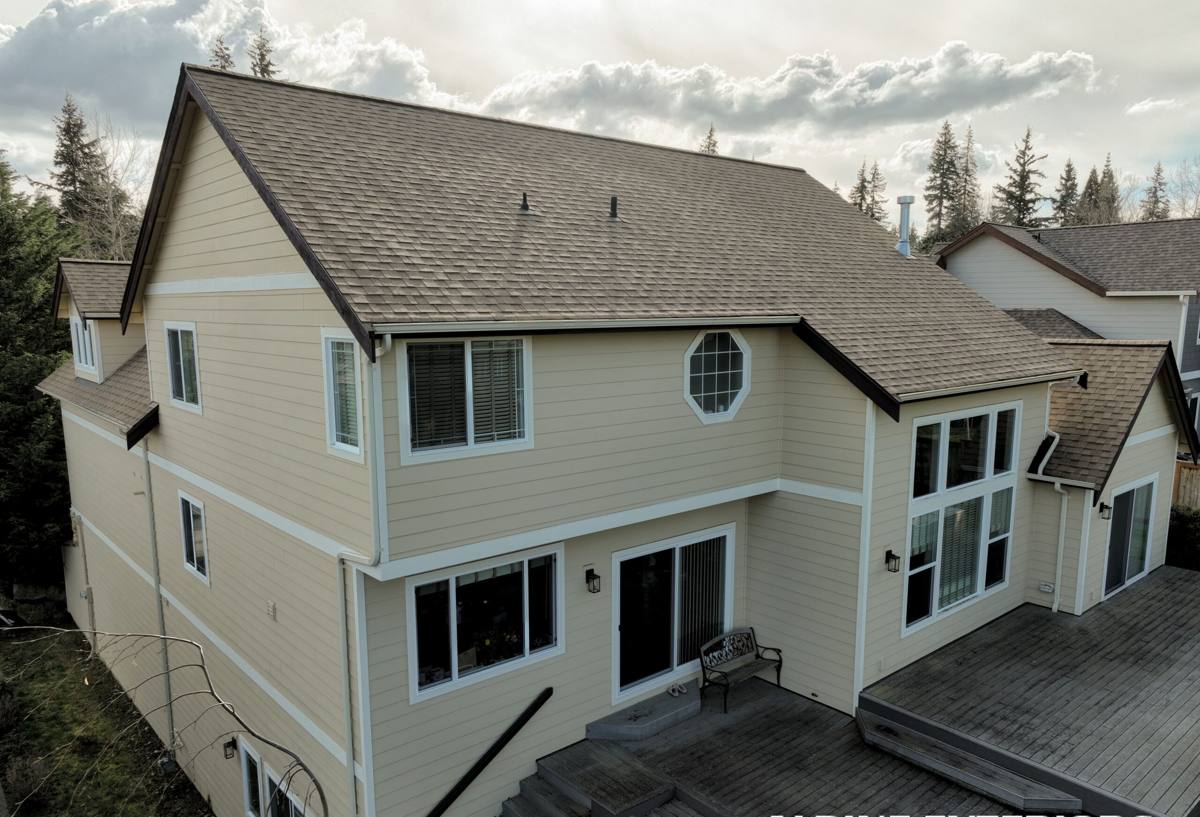
What the Local Climate Does to Siding Over Time
Whatcom County's weather isn't dramatic, but it's persistent, and persistence is what damages siding. It's rarely one storm that causes a failure — it's years of the same conditions repeating on the same wall.
A Long Moss Season
Between the fall rains and the shaded, tree-covered lots common around Nooksack, siding stays damp for long stretches at a time. That's ideal growing conditions for moss and algae, especially on north-facing walls, under eaves, and anywhere air doesn't move freely. Moss itself doesn't just look bad — it holds moisture directly against the siding surface, which accelerates whatever material is underneath it: rot in wood, delamination in engineered wood products, or coating breakdown on cheaper cement board.
Driving Rain and Wind-Driven Water
Rain that comes in at an angle finds every gap in a siding system — lap joints, butt seams, trim intersections, and old caulk lines. Over enough seasons, wind-driven rain works water past places that were sealed correctly when the house was built but have since failed. This is the most common root cause behind siding damage that looks minor from the ground but turns out to be more extensive once a panel comes off.
Temperature Swings and Material Movement
Whatcom County doesn't get extreme heat, but it does get cold snaps, damp cold mornings, and enough freeze-thaw cycling in winter to stress any siding that's already holding moisture. Water that's soaked into a panel or trim board expands when it freezes, which widens cracks and loosens fasteners that were already marginal.
Common Siding Damage We See on Nooksack Homes
Every house is different, but repair calls in this area tend to fall into a fairly short list of recurring problems:
- Soft, swollen, or delaminating panels near the ground, where splash-back keeps the bottom courses wet longer than the rest of the wall
- Persistent moss and black algae streaking on shaded or north-facing elevations
- Cracked or gapped caulking at trim, window, and door edges that has let water track behind the siding
- Rotted or spongy corner boards and window trim, often found only once you probe the wood
- Nail pops and loose panels from fastener corrosion or from siding that wasn't fastened to manufacturer spec originally
- Impact damage from storm debris, ladders, or landscaping equipment
- Staining or discoloration where a gutter, downspout, or roof valley has been dumping water onto a wall for years
Individually, most of these look like small cosmetic problems. The reason we treat them as repair priorities rather than "get to it eventually" items is that siding is a water management system first and an appearance feature second. Once water is getting behind it consistently, the damage spreads faster than most homeowners expect.
What a Correct Siding Repair Actually Involves
A repair that's done right starts with diagnosis, not with a caulk gun. Before we replace anything, we want to know why that section failed in the first place — otherwise we're just delaying the same repair by a few years.
- Remove the damaged section and inspect what's behind it — house wrap, flashing, sheathing condition, and insulation, if visible.
- Check for hidden moisture with a moisture meter on the sheathing and framing, not just a visual look at the siding face.
- Identify the entry point — a failed caulk joint, missing flashing, a clogged gutter, or a grading issue that's kept water against the wall.
- Correct the underlying cause before closing the wall back up. Replacing siding over an unresolved moisture source is not a repair, it's a delay.
- Match materials and finish as closely as possible so the repair blends in rather than becoming a visible patch.
- Re-seal and re-flash correctly, using materials and details that hold up under Whatcom County's rain load, not just the minimum required elsewhere.
Skipping the diagnosis step is the single biggest difference between a repair that lasts and one that fails again in a year or two. It's also the part of the job that's easiest for a homeowner to underestimate when comparing quotes, because a fast surface patch always looks cheaper up front.
Repair or Replace? How We Help You Decide
Not every damaged section needs a full re-side, and we're not going to tell you it does. But there's a point where patch repairs stop making financial sense and a full or partial replacement becomes the better long-term move. These are the factors we weigh with homeowners:
| Factor | Leans Toward Repair | Leans Toward Replacement |
|---|---|---|
| Extent of damage | Isolated to one or two wall sections | Spread across multiple elevations |
| Age of existing siding | Newer, otherwise sound material | Near or past its expected service life |
| Moisture findings | Localized, source identified and fixable | Widespread moisture behind multiple sections |
| Material type | Fiber cement or sound wood in good condition | Failing engineered wood, brittle vinyl, or delaminating boards |
| Match availability | Existing product/color can be reasonably matched | Discontinued product or heavily faded finish |
We'll always give you a straight answer on which side of that line your house falls on, along with the reasoning behind it — not just a recommendation.
Our Process for Nooksack Siding Repair Calls
- On-site inspection. We look at the damaged area and the surrounding wall, not just the spot you called about, since related damage often hides nearby.
- Diagnosis and written scope. You get a clear explanation of what's actually wrong, what caused it, and what fixing it correctly requires — before any work starts.
- Straightforward quote. One price for the repair as scoped, with any additional findings (like unexpected rot) discussed with you before we proceed, not added as a surprise afterward.
- The repair itself. Removal of the damaged material, correction of the underlying cause, and installation of matched replacement material, sealed and flashed to hold up under local conditions.
- Cleanup and walkthrough. We leave the site clean and walk the repair with you before we call the job done.
Why We Repair — and Only Install — James Hardie Fiber Cement
When we're patching an existing wall, we work with whatever material is already on the house, matched as closely as the manufacturer's product line allows. But when a repair turns into a larger replacement decision, or when a homeowner asks what we'd put on the wall going forward, we only install James Hardie fiber cement siding. We don't install vinyl, LP SmartSide, primed wood, or other fiber cement brands, and that's a standard we hold across every job, not just in Nooksack.
The reason ties directly back to everything above. Fiber cement doesn't absorb and swell the way engineered wood products can when moisture gets behind a panel, and it doesn't become brittle and crack the way vinyl does in cold, damp conditions. Hardie's ColorPlus factory finish also holds its color and resists the kind of fading and staining that makes future patch repairs hard to blend in — a real consideration in a climate where moss and algae streaking are a constant issue. Hardie's HZ5 product line is engineered specifically for wet, moisture-heavy climates like ours, and the company backs it with a strong, transferable warranty when it's installed to spec. None of that means other products are without merit — vinyl is inexpensive and low-maintenance in mild climates, and engineered wood machines and finishes easily. It's that, weighed against what Whatcom County's rain and moss season actually do to a wall over 15-20 years, fiber cement holds up in a way we're comfortable standing behind.
Why Hiring a Crew That Already Works in Nooksack Matters
A repair crew that regularly works Whatcom County homes has already seen the failure patterns specific to this area — where moss builds up fastest, which wall orientations take the worst of the driving rain, and how quickly a small caulk failure turns into hidden rot in this climate. That familiarity shows up in faster, more accurate diagnosis and fewer surprises once a wall is opened up. It also means a shorter response time when siding damage needs attention before the next round of fall rain, rather than waiting on a crew that has to drive in from outside the area.
Signs Your Nooksack Home May Need Siding Repair
If you're not sure whether what you're seeing is cosmetic or worth a call, this is the checklist we use as a starting point:
- Soft or spongy spots when you press on the siding, especially near the bottom of the wall
- Visible cracking, splitting, or gaps between panels or at trim joints
- Persistent moss or dark streaking that keeps coming back after cleaning
- Peeling paint or a chalky, deteriorating finish on painted siding
- Bubbling, warping, or panels that look wavy rather than flat
- Water stains or discoloration on interior walls near an exterior wall
- Visibly loose panels, popped nails, or fasteners backing out
Any one of these on its own might be minor. Several of them together, or any of them near a downspout, roofline, or shaded corner, are worth having looked at before another wet season adds to the damage.
If you're seeing any of these signs on your Nooksack home, we're happy to take a look and give you a straight, no-pressure assessment — including an honest answer on whether a repair is enough or a larger fix is worth considering. Fill out the form below for a free estimate.