 Ferndale
 What LP SmartSide Actually Is
LP SmartSide is an engineered wood siding product made from strand board — wood fibers that are compressed, resin-treated, and coated with a wax-based moisture additive called SmartGuard, then finished with a factory primer or pre-finished coating. It's a legitimate product with real advantages: it's lighter than fiber cement, easier on saw blades and installers' backs, and it holds paint well when properly maintained. A lot of reputable contractors install it, and plenty of homes wear it just fine for years. We're not here to tell you it's junk, because it isn't.
What we are here to explain is why, after years of doing siding work in Ferndale and across Whatcom County, we stopped offering it as an option — and why every home we side today gets James Hardie fiber cement instead.
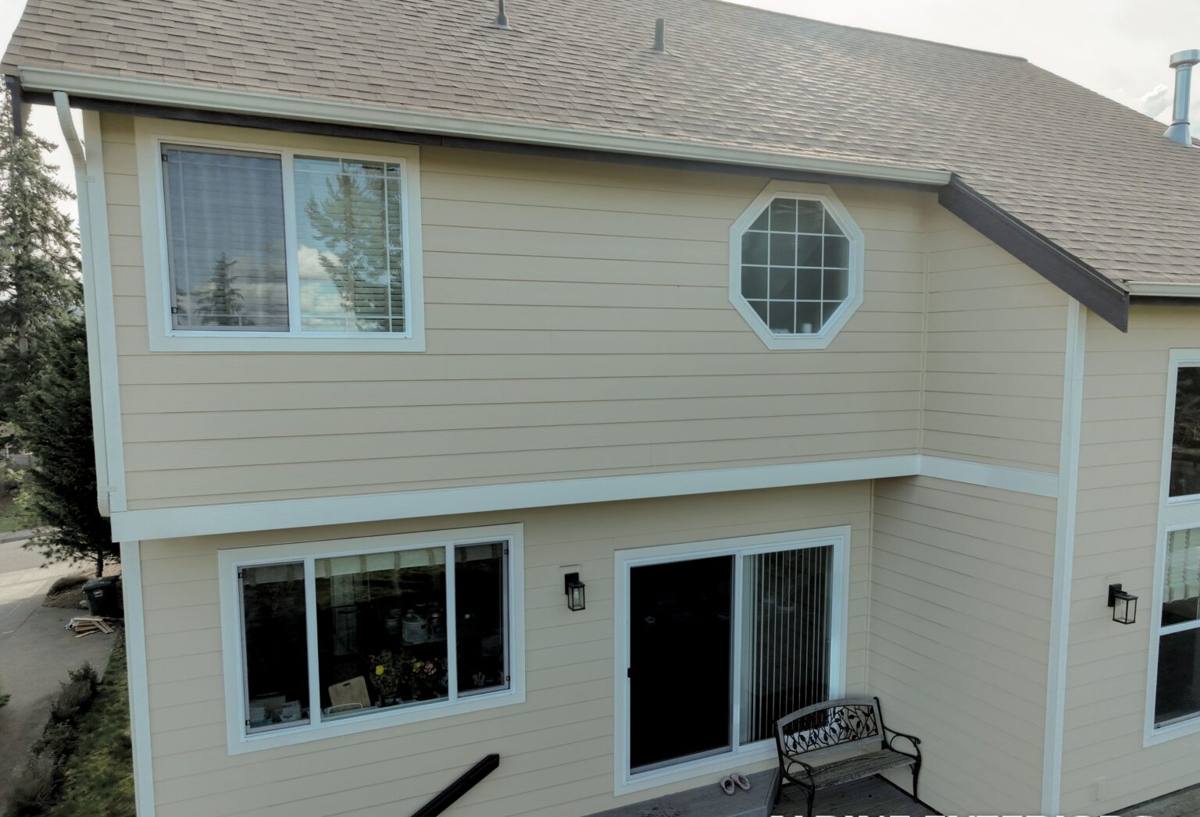
The Core Issue: It's Still Wood
Strip away the resin treatment and the wax additive, and LP SmartSide's core material is wood fiber. Wood fiber's fundamental weakness hasn't changed since the first generation of engineered wood siding products struggled with moisture in the 1990s — it swells, it can delaminate at cut edges and fastener penetrations, and once water gets past the factory coating, the clock starts ticking on rot from the inside out, often before it's visible on the surface.
LP has genuinely improved the product over the last two decades. The SmartGuard treatment process is a real engineering advance over the older OSB-based siding that gave engineered wood a bad name. But "better at resisting moisture" is not the same as "immune to moisture," and that distinction matters enormously in a place like Ferndale.
Why This Matters More Here Than Elsewhere
Whatcom County sits at the intersection of a few climate factors that stress any wood-based exterior product harder than a drier inland market would. We get salt-laden air off Bellingham Bay and the Strait of Georgia, driving rain that comes in sideways off Pacific storms rather than falling straight down, and a long moss and lichen season — realistically eight or nine months a year of surfaces staying damp — that keeps siding wet longer than the manufacturer's test conditions typically assume. Every one of those factors targets the exact weak point of an engineered wood product: the cut edges, the fastener heads, and the joints where installation quality determines whether water gets in.
Where Installation Sensitivity Becomes a Real Problem
LP SmartSide's warranty and long-term performance depend heavily on installation details that are easy to get wrong and hard to inspect after the fact:
- Every field-cut edge needs to be sealed with the manufacturer-specified primer or sealant before installation — skip one, and that's a moisture entry point that won't show a problem for years.
- Caulking at butt joints, trim intersections, and penetrations has to be maintained on a schedule, not just applied once at install.
- Clearance from grade, decks, and roof lines has to meet minimum standards, because splash-back moisture is one of the more common failure points.
- Fastener placement and type matter — the wrong nail pattern or an over-driven fastener can crack the coating and create a wick point.
None of this is a knock on the product's engineering. It's a statement about risk. Fiber cement gives you a wider margin for error on every one of these items, because the base material doesn't swell or rot when water reaches it. On a coastal Whatcom County home taking direct weather off the Strait, we'd rather not be betting a 30-year exterior on flawless caulk maintenance from every future homeowner.
Moss, Lichen, and the Maintenance Reality
Ferndale's climate grows moss on everything that holds moisture — roofs, fences, north-facing siding, you name it. Moss and lichen growth on a wood-based siding surface isn't just cosmetic. Organic growth holds water against the substrate, and on an engineered wood product, sustained damp contact at the surface is exactly the condition that stresses the coating and, over time, the substrate underneath. Keeping LP SmartSide performing well long-term in this climate means regular washing, regular paint film inspection, and prompt caulk touch-ups — an ongoing maintenance commitment that a lot of homeowners don't fully budget for at the time of installation.
Fiber cement isn't maintenance-free either — it still needs periodic washing and eventually a repaint if it's not a ColorPlus factory-finished product — but the consequence of deferred maintenance is fundamentally different. A fiber cement panel that goes a season or two without washing loses some curb appeal. An engineered wood panel that goes a few seasons without caulk and coating attention can develop problems at the substrate level.
How LP SmartSide Compares to James Hardie Fiber Cement
| Factor | LP SmartSide | James Hardie Fiber Cement |
|---|---|---|
| Core material | Engineered wood strand, resin and wax-treated | Cement, sand, and cellulose fiber — non-combustible |
| Moisture behavior | Resists moisture when coating and seals are intact; vulnerable at cut edges and breaches | Doesn't rot, swell, or delaminate from water exposure |
| Fire performance | Combustible, like any wood-based product | Non-combustible; recognized in wildfire-resistant construction |
| Installation error tolerance | Low — unsealed cuts and caulk gaps create real risk | Higher — the substrate itself doesn't degrade from a missed seal |
| Finish options | Factory primed or pre-finished; site or factory paint | ColorPlus factory-baked finish with long color warranty, or field paint |
| Typical warranty structure | Limited warranty with maintenance conditions | Strong transferable limited warranty; ColorPlus finish warranty separate |
| Weight and handling | Lighter, easier to cut and carry | Heavier, requires fiber cement-rated blades and tools |
| Coastal/moss climate fit | Workable with disciplined maintenance | Well-suited without added risk |
Why We Standardized on James Hardie
We're not a multi-product siding company that happens to prefer Hardie. We install James Hardie fiber cement exclusively, and that's a deliberate business decision, not a sales pitch dressed up as an educational page. A few reasons drove that call:
Non-Combustible Core
Hardie's cement-based composition doesn't burn. That's an increasingly relevant consideration in the Pacific Northwest as wildfire seasons stretch longer and smoke events become more common, even for coastal Whatcom County homes that aren't in a direct wildfire corridor.
Climate-Engineered Product Lines
Hardie makes HZ10 and HZ5 formulations engineered for specific climate zones — HZ10 for the wetter, milder regions like ours. That's a manufacturer acknowledging that siding needs to be engineered for where it's actually installed, not a one-size-fits-all national product.
ColorPlus Factory Finish
A factory-baked finish applied and cured under controlled conditions holds up more consistently than field-applied paint, and it carries its own warranty coverage separate from the substrate warranty.
Warranty Strength
Hardie's transferable limited warranty is long-dated and, critically, isn't built around the same kind of ongoing maintenance contingencies that govern engineered wood coverage. That matters to us because we're putting our name on the install, and we want a product where correct installation plus reasonable homeowner upkeep is enough to make the warranty mean something.
What This Means If You Currently Have LP SmartSide
If your Ferndale or Whatcom County home already has LP SmartSide on it, this isn't a page telling you to panic or rip it out. Well-installed, well-maintained SmartSide can serve a home for a long time. What we'd recommend:
- Walk the exterior once a year, focusing on ground-level clearance, deck ledger connections, and anywhere two pieces of siding meet.
- Check caulk joints for cracking or gaps, especially after a hard winter.
- Watch for soft spots, especially near the bottom courses and around window and door trim — press gently, don't just look.
- Keep gutters and downspouts functioning so bulk water isn't running down the wall face.
- Address moss and organic growth before it builds up a season's worth of trapped moisture.
If you're seeing soft spots, dark staining, or bubbling paint, that's worth a professional look before it spreads — not because the product failed you, but because catching it early is cheaper than catching it late on any siding material.
Making the Decision for a New Install or Full Replacement
If you're planning new construction or a full re-side in Ferndale, the decision isn't really "LP SmartSide versus James Hardie" in the abstract — it's about matching the product to this specific climate and your own tolerance for ongoing maintenance. If you want the lightest possible material, don't mind a maintenance calendar, and are comfortable re-caulking and monitoring cut edges over the years, SmartSide is a defensible choice with the right installer. If you'd rather put a non-combustible, moisture-stable product on the house and get on with your life, that's the case for fiber cement — and it's why it's the only thing we put on homes.
We'd rather tell you this upfront than sell you something and let you find out about the trade-offs five years in. If you're weighing options for a Whatcom County home, we're happy to walk your property, look at sun and weather exposure, and talk through what actually makes sense for your specific house — no pressure, no obligation. Reach out for a free estimate and we'll give you the same honest read in person.