 Ferndale
 Siding Failure Rarely Starts Where You Can See It
By the time a homeowner in Ferndale notices a soft spot, a bubbling panel, or a musty smell near an exterior wall, the actual damage has usually been building for years. Siding's real job isn't just to look good — it's to manage water. It has to shed rain, resist wind-driven moisture off Bellingham Bay, and let any water that does get behind it dry back out before it causes rot. When that system breaks down, it almost always breaks down quietly, behind the surface, long before there's anything visible from the driveway.
This page is about that hidden process: what moisture actually does to a wall system over time, why Whatcom County's climate makes it worse, and what separates siding that holds up for decades from siding that fails early.
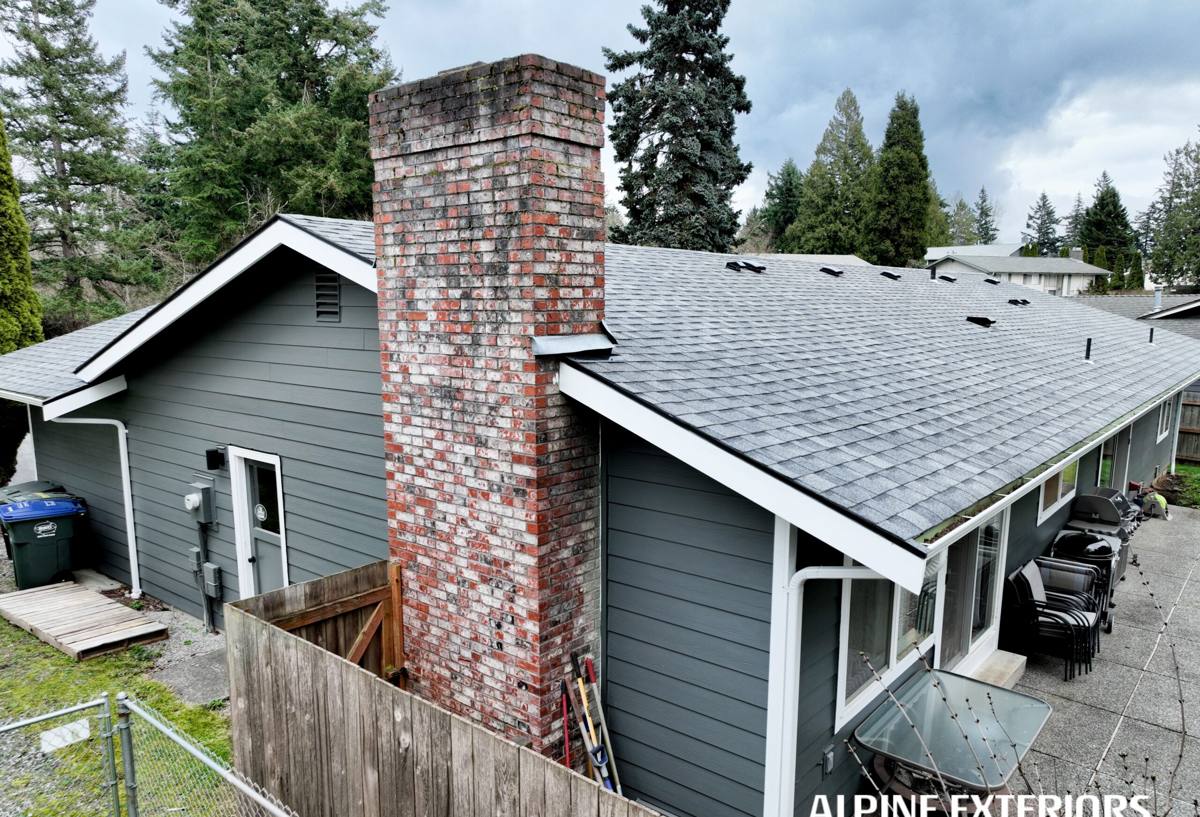
Why Water Behind Siding Is the Real Problem
Almost no siding material is 100% waterproof, and it doesn't need to be. Every properly built wall assumes some moisture will get past the outer layer — through a nail hole, a seam, a poorly sealed penetration for a hose bib or light fixture — and relies on a drainage plane and house wrap behind the siding to direct that water back out and down, away from the wood sheathing and framing.
Problems start when one of two things happens: too much water gets in, or the water that gets in has nowhere to go. Caulk that was never meant to be a primary water barrier, siding installed tight against trim with no capillary break, or panels face-nailed without the right clearance all create spots where water collects instead of draining. Once wood framing, sheathing, or trim stays damp for extended periods, rot fungi and mold take over, and by the time that shows up as a soft spot or discoloration, structural material has already been compromised.
Moisture Doesn't Need a Leak to Cause Damage
A common misconception is that siding failure means there was a leak — a hole, a crack, an obvious failure point. Often there isn't one. Wood-based products and even some engineered products can absorb ambient humidity directly through their surface, especially at cut edges and butt joints that weren't sealed at installation. In a marine climate like Ferndale's, where humidity stays elevated for months at a time, that slow absorption can do as much damage as a single bad flashing detail.
What Ferndale's Climate Does to a Wall System
Whatcom County sits in a spot where several moisture stressors stack on top of each other, and it's worth naming them specifically because they change how siding should be chosen and installed here compared to a drier inland climate.
- Salt air off the coast: corrodes fasteners and accelerates the breakdown of finishes not engineered for coastal exposure, and salt-laden moisture behaves differently on a wall surface than plain rainwater.
- Driving rain: wind-driven rain off the Strait of Georgia and Bellingham Bay hits walls at an angle, not straight down, which pushes water into laps, seams, and trim joints that a purely vertical rain would never reach.
- A long moss and algae season: the Pacific Northwest's extended damp, shaded, mild-temperature stretch (roughly fall through spring, longer than most of the country) is exactly what moss and algae need to establish on siding surfaces.
None of these alone is unusual. What makes Ferndale demanding is that all three run for a large part of the year, with relatively few fully dry stretches in between to let a wall system recover.
Moss Isn't Just Cosmetic
Moss and algae growth on siding gets treated as an appearance issue, but it's a moisture issue first. Moss holds water directly against the siding surface, keeps that surface shaded and cooler, and slows evaporation — which extends the amount of time a panel stays wet after every rain event. On materials that are sensitive to sustained moisture contact, a moss-covered north wall can stay damp for days after a storm has passed while a clean, sun-exposed wall on the same house dries in hours.
How Failure Actually Progresses Behind the Wall
Hidden moisture damage tends to follow a recognizable sequence, even though it can take years to play out:
- Water gets past the siding surface at a seam, fastener, or trim detail and reaches the sheathing or framing behind it.
- Because of poor drainage, a failed weather-resistive barrier, or simply too much volume, that moisture doesn't dry out between rain events.
- Wood framing and sheathing begin to absorb and hold moisture, softening over time even before visible mold appears.
- Rot fungi and mold colonize the damp wood, which is when odors, staining, and eventually structural softness show up.
- By the time siding is visibly warped, delaminating, or the wall feels soft to the touch, repair usually means opening the wall, not just replacing the outer layer.
This is why a siding contractor who only looks at the surface can miss the real story. A panel that looks fine from eight feet away can be sitting over sheathing that's already failed.
Signs Worth Checking For
Most of these are things a homeowner can look for without any special tools — just a walk around the exterior a couple of times a year, especially after Ferndale's wetter stretches.
- Panels or boards that look swollen, wavy, or feel spongy when pressed
- Paint or finish that's bubbling, peeling, or chalking unevenly in one area versus the rest of the house
- Dark staining or streaking below seams, window trim, or anywhere two materials meet
- A musty or earthy smell near an exterior wall, especially indoors along baseboards
- Visible moss or algae buildup that hasn't been cleaned in more than a season
- Soft or discolored trim around windows, doors, or where siding meets the foundation
- Insects (particularly carpenter ants) around exterior walls, which are often a sign of damp wood nearby
Any one of these on its own isn't necessarily an emergency, but they're worth having looked at rather than waited on — moisture problems get cheaper to fix the earlier they're caught.
Why Some Siding Materials Handle This Better Than Others
Not all siding responds to sustained coastal moisture the same way. This is the core of why we made the call, as a company, to install only James Hardie fiber cement and not the other common options on the market.
| Material | How It Responds to Sustained Moisture | Common Long-Term Concern in This Climate |
|---|---|---|
| Primed wood or cedar | Absorbs moisture directly; performance depends heavily on maintaining the finish | Rot at joints and lower courses without diligent repainting/resealing |
| Vinyl | Sheds surface water but doesn't stop moisture moving behind it; can trap water at seams | Warping in temperature swings and hidden moisture issues behind panels going unnoticed |
| OSB-based lap siding (e.g., LP SmartSide) | Engineered wood strand product; performs well when the finish and seals stay fully intact | Edge and seam swelling if caulking or finish maintenance lapses even briefly |
| Fiber cement (Cemplank, Allura, James Hardie) | Cement-based composition doesn't absorb and swell like wood-based products | Performance still depends heavily on correct installation detailing and finish quality |
Fiber cement as a category holds up well against sustained coastal moisture because it isn't built from wood fiber that swells and rots. That's a real advantage over vinyl and wood-based sidings in a climate like Whatcom County's. But not all fiber cement is equal, which is the other half of why we standardized on one manufacturer.
Why We Standardized on One Manufacturer
James Hardie engineers specific product lines (their HZ5 line, for example) for harsher, wetter climates rather than selling one generic product everywhere. Their ColorPlus factory-applied finish is baked on under controlled conditions, which holds up more consistently against salt air and UV exposure than field-applied paint that depends on weather conditions the day it's sprayed. Combined with a strong transferable warranty, it gives us a product we can stand behind for the specific conditions Ferndale homes face, rather than a general-purpose siding we'd be hoping performs here.
What Correct Installation Actually Involves
Material choice only solves half the problem — installation detailing is what actually keeps water out of the wall in the first place. On every job, the details that matter most are:
- Proper flashing above windows, doors, and anywhere trim meets siding, so water is directed outward instead of behind the panel
- Correct fastener placement and spacing so panels aren't over-driven or under-driven, which can crack finishes or leave gaps
- Adequate clearance at the bottom of the wall and at grade so siding isn't wicking moisture from the ground or a deck surface
- A functioning drainage plane (house wrap or building paper) behind the siding, not just a taped seam
- Sealing cut ends and butt joints per manufacturer specification, since factory finishes typically don't extend to a field-cut edge
Skipping any one of these can undercut even the best siding material. It's a big part of why "what brand of siding" isn't actually the only question worth asking — the installer's attention to these details matters just as much.
If You Suspect Hidden Damage
If you're seeing any of the warning signs above, the right first step is a real inspection — not a quote to re-side the whole house sight unseen, but someone actually checking soft spots, probing where practical, and being honest about whether the issue is cosmetic, surface-level, or has already reached the sheathing. A legitimate assessment should tell you plainly whether you're dealing with a repair, a partial re-side, or a full replacement, and why.
If you're noticing early signs on a Ferndale home, or just want a straight answer about what condition your siding is really in, we're happy to come take a look. There's no cost and no pressure to move forward — just an honest read on what's happening and what your options are.