 Ferndale
 Why We Narrowed Down to One Product
Most siding contractors carry a catalog: vinyl for the budget jobs, LP SmartSide for the middle tier, fiber cement for the customers who ask for it by name. We used to do the same thing. Somewhere along the way, after enough tear-offs on twelve- and fifteen-year-old siding that had no business failing that early, we stopped. Now we install James Hardie fiber cement siding and nothing else.
That's not a marketing angle. It's a decision about what we're willing to put our name on. Ferndale sits close enough to Bellingham Bay and the Salish Sea that salt-laden air is part of daily life here, and Whatcom County's wet season runs long — driving rain off the water, months of overcast humidity, and a moss season that can stretch from October into May on a shaded north wall. Siding here doesn't get a break. It needs to hold paint, resist moisture intrusion, and shrug off the kind of biological growth that thrives in cool, damp, low-sun conditions. Some products handle that reliably. Others handle it until they don't.
What Fiber Cement Actually Is
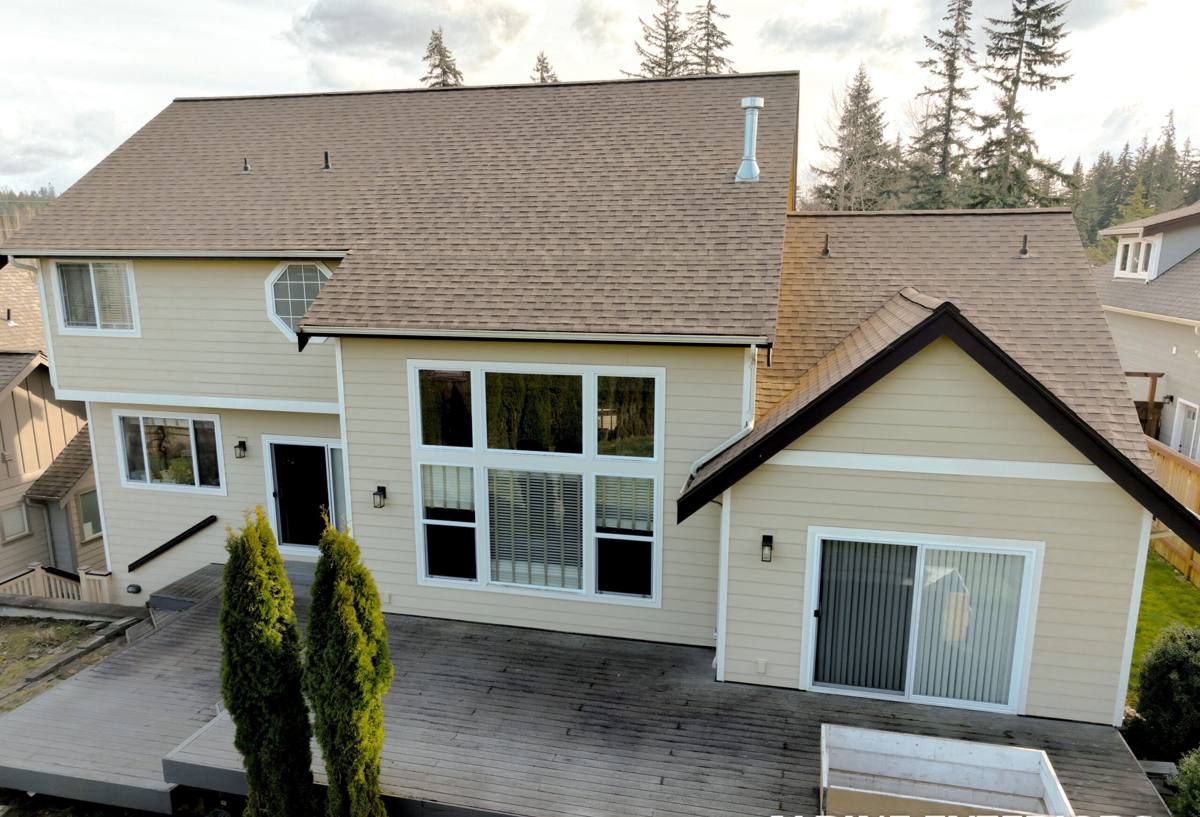
James Hardie siding is a composite of Portland cement, sand, and cellulose fiber, cured into a dense, dimensionally stable plank or panel. It is not plastic (like vinyl), not an engineered wood product (like LP SmartSide), and not solid wood (like cedar or primed spruce). That composition is the whole reason it behaves differently on a house:
- It does not have wood grain that can swell, cup, or rot when moisture gets past the paint film.
- It is non-combustible, which matters more every year as wildfire smoke seasons creep further north and insurance underwriters pay closer attention to exterior materials.
- It holds a straight, flat plane over time — no waviness developing along a wall as the material moves with humidity swings.
- It accepts a factory finish that doesn't depend on field conditions the day it's painted.
None of that makes it magic. Fiber cement is heavier to handle, requires specific fasteners and clearances, and is genuinely less forgiving of sloppy installation than vinyl. We'll get to that. But as a base material for a wall that has to survive Pacific Northwest weather for thirty-plus years, it starts from a stronger position than the alternatives.
Built for This Specific Climate: HZ5
James Hardie engineers its siding in region-specific formulations called HZ (HardieZone) products. HZ5 is the cold-and-wet climate formulation, engineered for freeze-thaw cycling and prolonged moisture exposure — exactly the profile Whatcom County sees most winters. It's a different mix than the HZ10 product sold into hot, dry southwestern markets. That distinction matters because a lot of siding failures we've been called out to inspect trace back to a product that was never designed for the climate it was installed in, or installed by a crew treating it like a generic building material rather than a system with climate-specific engineering behind it.
What "Climate-Engineered" Means in Practice
In real terms, HZ5 siding is formulated to resist moisture absorption at the cut edges and panel faces, maintain its bond with paint through repeated wet-dry cycles, and avoid the freeze-related cracking that can show up in products not designed for sustained cold-wet exposure. It's not a guarantee against every possible installation error, but it's one less variable working against the house.
ColorPlus: Factory Finish vs. Field Paint
Most Hardie siding we install goes on with a ColorPlus factory finish rather than being painted on-site. There's a real, practical difference between the two:
| Factor | ColorPlus Factory Finish | Field-Applied Paint |
|---|---|---|
| Application environment | Controlled, consistent temperature and humidity | Whatever the weather does on install day |
| Coat consistency | Multiple baked-on coats, uniform coverage | Depends on painter, weather, and number of coats applied |
| Fade/chip warranty | Backed by a separate finish warranty from Hardie | Typically covered by the paint manufacturer only, if at all |
| Touch-up matching | Factory-matched touch-up available | Matching depends on remaining paint stock and mixing accuracy |
| Repaint interval | Often well past 10-15 years before repaint is needed | Varies widely; coastal salt air can shorten this |
In a salt-air environment like ours, a factory-cured finish has a real advantage: it isn't relying on a painter getting ideal drying conditions on a Ferndale job site in October. We still offer primed Hardie for homeowners who want a specific custom color, but we're upfront that it shifts more of the long-term finish performance onto the paint job rather than the siding itself.
The Product Lines We Install
"James Hardie" isn't one product — it's a system with different profiles for different parts of a house. On a typical Ferndale project we're mixing and matching from a short list:
| Product | Typical Use |
|---|---|
| HardiePlank lap siding | Primary wall cladding, several width and texture options |
| HardieShingle | Accent gables, dormers, Craftsman and cottage-style detailing |
| HardiePanel | Vertical board-and-batten sections, garages, modern facades |
| HardieTrim | Corner boards, window and door trim, fascia |
| HardieSoffit | Vented and non-vented soffit systems |
Using one manufacturer's system across the whole exterior — trim, soffit, panel, and lap — keeps expansion rates, fastening details, and finish warranties consistent. Mixing a fiber cement field with a different brand's trim is a common source of long-term problems we've seen on other contractors' work.
What We Turned Away, and Why
We don't install LP SmartSide, vinyl, Cemplank, Allura, primed spruce, or bare cedar. Each of those is a legitimate product that plenty of reputable contractors install well. Our decision to stop offering them is about the trade-offs we weren't willing to keep managing on behalf of homeowners in this climate:
- LP SmartSide is an engineered wood strand product with a resin-treated substrate. It performs well when the factory-applied edge sealant and finish stay fully intact, but any cut edge, fastener puncture, or finish breach becomes a point where moisture can get into the wood fiber. In a region with our rain volume and moss growth, that's a maintenance commitment we didn't want to keep asking clients to stay on top of.
- Vinyl siding is inexpensive and low-maintenance in mild climates, but it's a thin plastic product that can warp under concentrated heat reflection, crack in hard freezes, and it has no meaningful fire resistance. It also doesn't hold paint, so a color decision made at installation is permanent unless the whole wall is replaced.
- Cemplank and Allura are both fiber cement competitors to Hardie, and the base material science is similar. Our reason for standardizing on Hardie over them comes down to the depth of their climate-specific engineering (the HZ system), the strength and portability of the ColorPlus finish warranty, and consistency of supply and support in our market.
- Primed spruce and bare cedar are real wood, and real wood in Whatcom County means an ongoing repainting and moisture-management commitment. Cedar has genuine appeal and can last decades with disciplined maintenance, but "disciplined maintenance" is the operative phrase, and most homeowners underestimate what that means in a climate with our moss season and rainfall totals.
None of these are bad products used incorrectly by bad people. They're products with maintenance and moisture profiles that didn't match what we wanted to guarantee our customers in this specific climate.
Installation Is Where Fiber Cement Succeeds or Fails
Fiber cement siding has a reputation problem that isn't really about the material — it's about installation. Hardie itself publishes detailed fastening, clearance, and flashing requirements, and a huge share of the fiber cement failures we get called to look at trace back to those specs being ignored:
- Minimum ground clearance and roof-line clearance not maintained, allowing splashback and standing moisture at the bottom course.
- Butt joints not flashed or caulked per spec, giving water a direct path behind the siding.
- Incorrect nailing — over-driven fasteners, wrong nail type, or nailing through overlaps incorrectly — which can crack planks or create movement over time.
- No rainscreen gap on wall assemblies that need one, trapping moisture against the water-resistive barrier.
This is the honest trade-off with fiber cement: it's a less forgiving product to install than vinyl, and a correctly installed lesser product will often outperform a poorly installed premium one. We install to Hardie's published fastening and clearance specifications on every job, which is a big part of why we don't spread ourselves across five different product lines — one system, installed the same disciplined way every time, is easier to guarantee.
Warranty and Real Long-Term Cost
James Hardie backs its fiber cement substrate with a long, transferable limited warranty, and ColorPlus finishes carry their own separate finish warranty covering fading and chipping. Transferability matters more than homeowners usually think about at the time of installation — it's a selling point when the house eventually changes hands, and it's a sign the manufacturer is confident in how the product ages.
The upfront cost of Hardie siding is higher than vinyl and generally comparable to or somewhat above engineered wood siding. The way to think about it honestly is cost per year of service, not cost per square foot at installation. A siding job that needs repainting every 6-8 years, or partial replacement at year 12-15 due to moisture damage, can cost more over three decades than a Hardie installation with a factory finish that holds 15+ years between repaints and a substrate that doesn't rot.
What to Check Before You Hire Anyone for Siding
Whether you go with us or another contractor, this list applies to any siding replacement in Whatcom County:
- Ask which specific product line and HZ rating is being quoted, not just "fiber cement" or "Hardie board."
- Confirm ground clearance, roof clearance, and flashing details will meet manufacturer spec in writing.
- Ask whether joints will be caulked, flashed with metal, or covered with trim — and get the answer in the contract, not verbally.
- Check whether the crew is factory-trained on the specific product being installed.
- Get the warranty terms in writing, including whether it's transferable to a future homeowner.
- Ask how they handle moss and algae exposure on shaded, north-facing walls specifically.
Ready When You Are
If your current siding is showing paint failure, soft spots, or moss buildup that keeps coming back no matter how often it's cleaned, we're glad to take a look and give you a straight assessment of what's going on and what it would take to fix it right. We offer free, no-pressure estimates — no obligation, no pressure, just an honest look at your home and the options that make sense for it.