 Ferndale
 Siding Built for Blaine's Coastal Exposure
Blaine sits right on Semiahmoo Bay, a few miles from the Canadian border, which means homes here take a different kind of beating than houses further inland in Whatcom County. Salt-laden air off the water, wind-driven rain rolling in from the Strait, and a damp shoulder season that can stretch from October well into May all add up to an exterior envelope that has to work harder than it does in a drier climate. We're based out of Ferndale and have worked on homes throughout this stretch of the county, and Blaine's coastal conditions are consistently among the toughest we see on siding, trim, and roofing.
This page covers what we look at when we bid a siding job in Blaine, why we've standardized on one product line for every house we side, and how that decision ties into the roofing, window, and deck work we also do on the same homes.
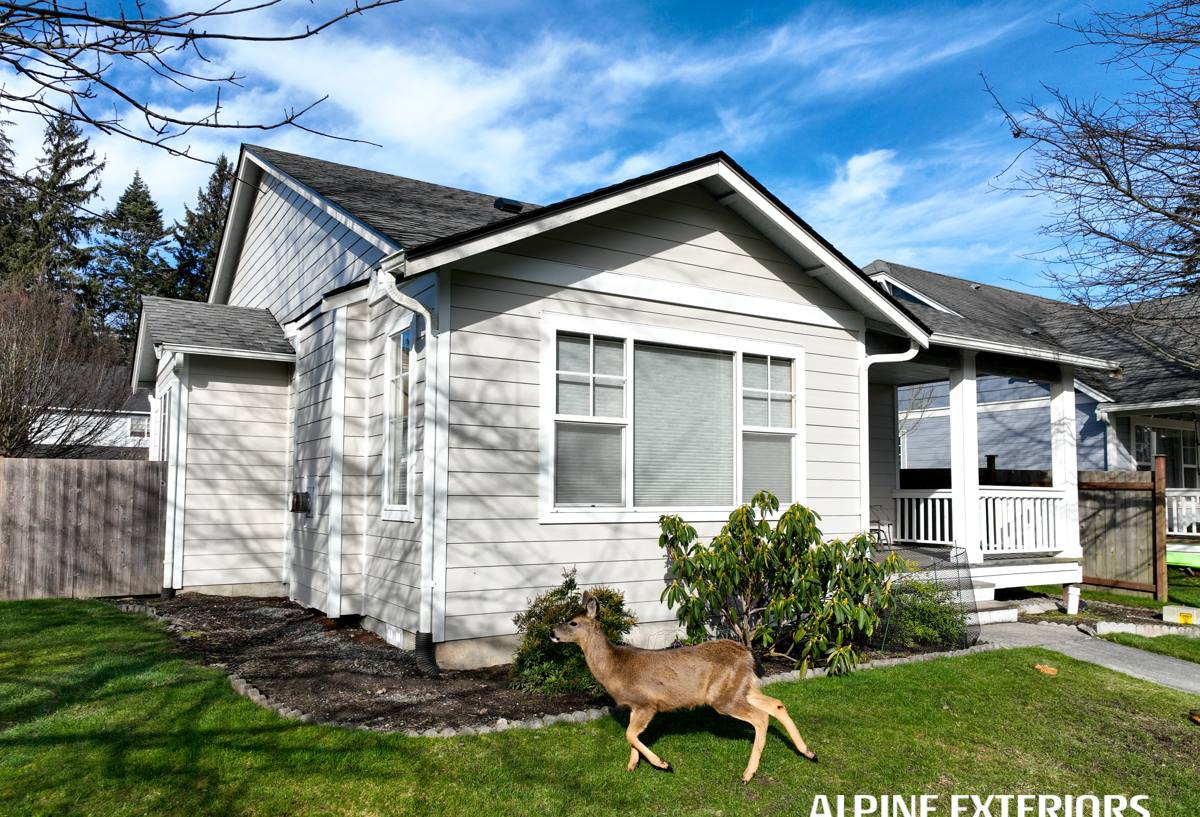
What Salt Air and Driving Rain Actually Do to a House
Salt air isn't just a metaphor for "near the water." Airborne salt is corrosive to exposed metal fasteners, flashing, and hardware, and it accelerates the breakdown of finishes that aren't formulated to resist it. On a house close to the bay, that means paint film fails faster, caulking dries out and cracks sooner, and any wood-based siding product starts absorbing moisture at the seams and joints years before it would inland.
Driving rain adds a second problem: wind-pushed water finds its way into horizontal laps, butt joints, and anywhere caulk has failed, rather than just sheeting straight down the wall like it would in calm weather. On a home with south or west exposure toward open water, that combination of salt and wind-driven moisture is exactly the scenario that wood-based and OSB-core siding products struggle with over time — swelling at the edges, softening at cut ends, and eventually taking on moisture faster than it can dry back out.
Why Moss Season Matters Here
Whatcom County's long, mild, wet stretch of the year gives moss and algae plenty of time to establish on north-facing walls, under eaves, and anywhere sunlight doesn't reach for months at a time. Moss holds moisture against the siding surface and, on porous or wood-based products, that constant dampness is what drives rot at seams and fastener points. It's a slower failure mode than storm damage, but it's the one we see most often on older homes in this area when we're called out for an inspection.
Why We Only Install James Hardie Fiber Cement
We made a decision as a company to install James Hardie fiber cement siding exclusively — we don't install vinyl, LP SmartSide, Cemplank, Allura, or primed wood siding of any kind. That's not a marketing position, it's a practical one based on what holds up in this specific climate.
- Non-combustible core — fiber cement doesn't burn, which matters as much for insurance conversations as it does for safety.
- Moisture behavior — Hardie's fiber cement doesn't swell, delaminate, or absorb water the way wood-based or engineered-wood siding can at cut ends and seams.
- Factory-applied ColorPlus finish — the color and topcoat are baked on at the factory under controlled conditions, which holds up better against salt air and UV than field-applied paint.
- Climate-engineered product lines — Hardie makes region-specific formulations (their HZ5 line is built for exactly this kind of wet Pacific Northwest exposure).
- Warranty structure — a real, transferable manufacturer warranty on both the substrate and the finish, which matters if you ever sell the house.
We're not going to tell you every other siding product is unusable — vinyl and engineered wood both have a place, and plenty of houses are sided in them without issue in gentler climates. But for a coastal Whatcom County exposure like Blaine's, we'd rather install one product we trust completely than offer a menu of options where some of them are a gamble on this particular stretch of coastline.
Our Services: Siding, Roofing, Windows, and Decks
Siding rarely fails in isolation. On most of the older homes we look at in Blaine, whatever caused the siding problem — a roof leak, a failed window flashing, ice damming, or just years of standing moisture — is usually visible in more than one place once we get up close. That's why we handle the whole exterior envelope rather than just siding:
- Siding — full Hardie plank, panel, and trim installation, including tear-off of failing existing siding.
- Roofing — roof condition directly affects how water moves down the wall assembly, so we check it as part of any siding estimate.
- Windows — window flashing and trim integration is one of the most common failure points we find during a siding tear-off; it gets addressed properly when we're already in the wall.
- Decks — ledger board attachment and deck-to-house flashing are another common source of hidden moisture damage on coastal homes.
Bidding these together, when a home needs more than one, usually saves money and avoids the situation where a new deck ledger gets bolted through siding that's about to be torn off anyway.
Why a Local Crew Matters for This Kind of Work
We're based in Ferndale, not dispatching a crew from across the state, and that matters for a few practical reasons on a Blaine project. We know what a Whatcom County building department expects on permits and inspections. We've seen how houses in this specific pocket of the county — close to open water, exposed to wind off the Strait — actually age over five, ten, and twenty years, not just how they look on installation day. And when a warranty question or a callback comes up two years down the road, we're not a stranger showing up from three hours away.
What to Expect From a Siding Project
Assessment
We start by walking the exterior and identifying moisture entry points, not just areas where the siding looks bad cosmetically. On coastal homes, the worst damage is often hidden behind siding that still looks fine from the street.
Tear-off and Inspection
Once old siding comes off, we inspect the sheathing and framing underneath. Any rot or moisture damage gets addressed before new siding goes on — covering a wet wall assembly with new siding just hides the problem for a few more years.
Weather Barrier and Flashing
Correct house wrap, flashing at every window and door, and proper overlap at seams matter more in a driving-rain climate than almost anywhere else. This is the step that determines whether the siding actually performs the way it's rated to.
Installation
Hardie installation to manufacturer spec means correct fastener placement, proper clearances at grade and roof lines, and factory-caulked or engineered joints rather than field improvisation.
Cost Factors on a Blaine Siding Project
| Factor | Why It Affects Cost |
|---|---|
| Existing siding removal | Tear-off, disposal, and any hidden sheathing repair add labor beyond the new siding itself |
| Home size and complexity | Cut-up walls, multiple gables, and dormers take more time per square foot than simple rectangular walls |
| Product line and profile | Hardie offers several plank widths, panel styles, and trim options at different price points |
| ColorPlus vs. field-painted | Factory finish costs more up front but removes a repaint cycle for years |
| Water exposure and elevation | Waterfront or wind-exposed walls may need extra flashing detail and moisture barrier attention |
| Access and site conditions | Steep lots, limited staging area, or landscaping to work around affects labor time |
Maintaining Hardie Siding in a Salt-Air Climate
- Rinse salt residue and grime off the siding once or twice a year, especially on walls facing open water.
- Keep gutters clear so overflow doesn't run down the wall face and feed moss growth.
- Trim back vegetation and tree cover on north-facing walls to reduce the shade that lets moss establish.
- Check caulking at trim joints and penetrations annually — caulk is the one component that isn't factory-finished and does wear out.
- Address any small crack or impact damage promptly rather than waiting; Hardie repairs are straightforward when caught early.
Compared to wood-based siding, the maintenance burden here is genuinely lower — no repainting cycle, no swelling seams to monitor — but "low maintenance" doesn't mean "no maintenance," and the salt-air environment around Blaine is exactly the kind of exposure where a little seasonal attention pays off.
Get a Local Estimate
If you're dealing with aging siding, moss buildup, or moisture damage on a home in Blaine, we're happy to come take a look and walk you through what we're seeing — no pressure, no obligation. Fill out the form below and our Ferndale-based crew will get back to you to schedule a free estimate.