 Ferndale
 Custer's Exterior Problem Isn't One Thing — It's Three
Ask a Custer homeowner what's chewing up their siding and you rarely get a single answer. It's the combination that does the damage. Custer sits close enough to the Strait of Georgia and Birch Bay that salt-laden air is a real, daily factor on exterior materials, not an occasional coastal storm event. Layer on Whatcom County's driving rain — wind-driven, sideways, working its way into every lap joint and butt seam it can find — and then add a moss season that, in this part of Washington, isn't really a season at all. It's most of the year. Any one of these on its own is manageable. Together, they're why we see so many premature siding failures on homes that were otherwise well-built.
Salt air is corrosive to fasteners and finishes, and it accelerates the breakdown of anything that isn't engineered to resist it. Driving rain finds gaps that would never be a problem in a drier climate — a slightly open seam, a caulk joint that's started to crack, a piece of trim that's pulled away a sixteenth of an inch. And moss doesn't just sit on a roof looking bad; it holds moisture against siding, roofing, and trim for weeks at a time, which is exactly the condition that causes rot, paint failure, and substrate breakdown in wood-based products.
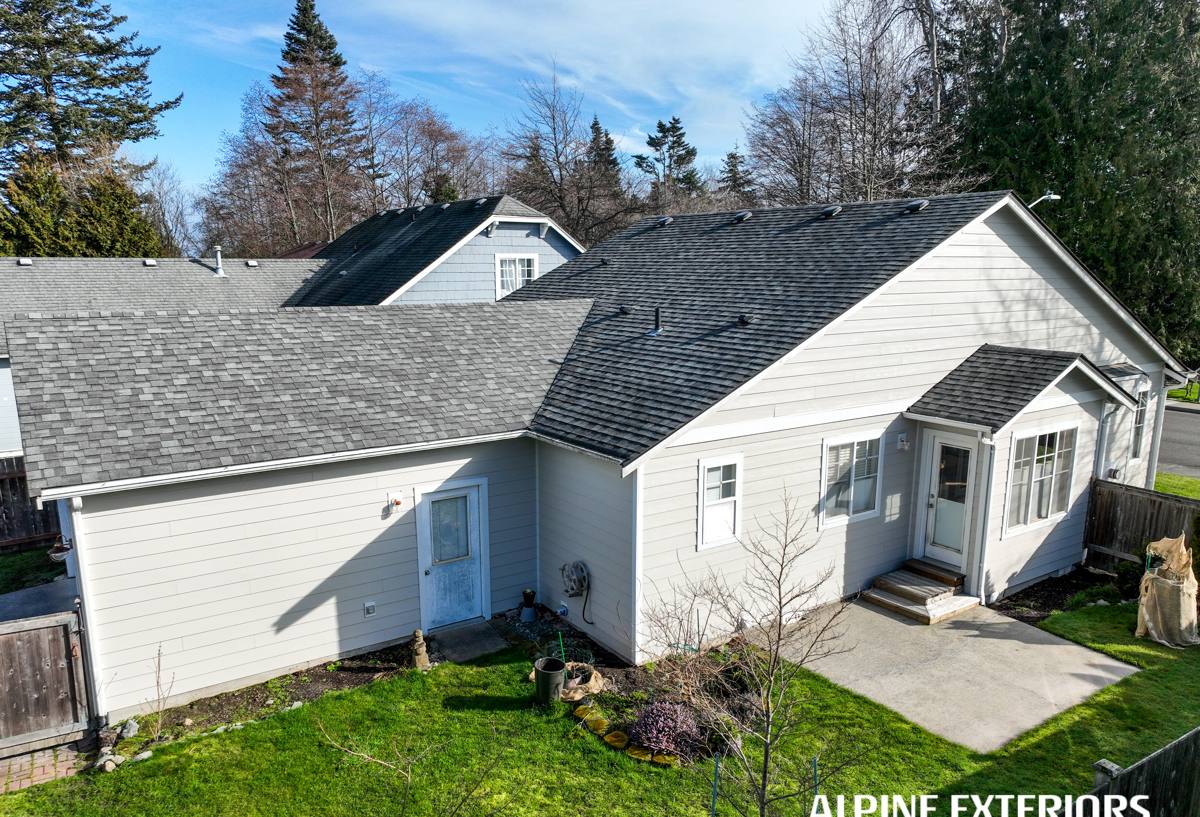
What This Looks Like on Real Homes
Drive through Custer and the surrounding Ferndale area and you'll see a real mix of building stock — older farmhouses, mid-century ranches, newer construction on larger rural lots, and everything in between. What they tend to share is direct exposure: fewer tall trees blocking wind in some areas, open exposure toward the water in others, and long stretches of the year where surfaces stay damp instead of drying out between rain events.
On the homes we get called to inspect, the pattern is consistent. Vinyl siding that's gone brittle and cracked from UV and temperature swings, with panels that have bowed or buckled where fasteners were driven too tight. Wood-based siding — whether cedar or engineered wood products like LP SmartSide — with soft spots at butt joints, bottom edges, and anywhere caulk has failed and let moisture sit against the substrate. Moss and algae staining that keeps coming back no matter how many times it's washed off, because the underlying material and installation details never addressed the actual moisture problem.
None of this means those products are junk. It means Whatcom County's specific combination of salt air, driving rain, and near-constant moisture pressure is a tougher environment than most siding products were designed to shrug off indefinitely.
Why We Standardized on One Product
We install James Hardie fiber cement siding exclusively. Not because we're locked into a single brand out of convenience, but because after years of servicing homes in this climate, it's the product we trust to perform here without an asterisk.
- Vinyl siding is affordable and low-maintenance in the sense that it doesn't need painting, but it's a petroleum-based product that becomes brittle with age and UV exposure, expands and contracts with temperature swings, and offers essentially no fire resistance. In a climate with constant moisture cycling, the seams and J-channels are also where water tends to find its way behind the panel.
- LP SmartSide and other engineered wood products use resin-treated wood strand technology that's a real improvement over old-school wood siding, but it's still a wood-based product at its core. Any breach in the factory coating or field-applied caulk creates an entry point for moisture, and in a climate where surfaces don't dry out quickly, that's a meaningful risk over the life of the siding.
- Cemplank and Allura are also fiber cement, and fiber cement as a category is the right call for this climate. Our reason for not installing them comes down to manufacturing consistency, factory finish quality, and warranty structure — details that matter over a 30-plus year installation, even when the base material category is sound.
- Primed spruce and cedar are genuinely beautiful, and we understand the appeal. But solid wood siding requires a maintenance commitment — recoating, caulk inspection, moisture monitoring — that most homeowners underestimate until they're a few years in and already dealing with soft spots.
James Hardie fiber cement is non-combustible, dimensionally stable across temperature and humidity swings, and manufactured with a factory-applied ColorPlus finish that's baked on rather than field-painted — which matters enormously in a climate where paint has to fight moss, mildew, and constant moisture just to stay adhered.
The Hardie Product Line for This Climate
James Hardie engineers its siding by climate zone (HZ5, HZ10) rather than shipping one generic product nationwide. That distinction matters more here than in a lot of the country, because Whatcom County's moisture load is genuinely different from, say, inland Eastern Washington.
| Product Line | Best Fit | Why It Works Here |
|---|---|---|
| HardiePlank Lap Siding | Most Custer and Ferndale homes | Classic profile, engineered moisture and freeze-thaw resistance for the Pacific Northwest |
| HardieShingle | Accent gables, dormers, coastal-style homes | Shingle look without the maintenance burden of real cedar shakes in a wet climate |
| HardiePanel | Modern builds, board-and-batten accents | Clean vertical lines, holds paint-free ColorPlus finish through wet seasons |
| HardieTrim | Corners, window and door surrounds | Fiber cement trim resists the rot that plagues wood trim in high-moisture areas |
Every Hardie ColorPlus color comes with a 30-year non-prorated finish warranty on top of the product warranty — a combination that's genuinely hard to match, and one reason we're comfortable telling homeowners it's the last siding decision they'll need to make for a very long time.
It's Not Just Siding — The Whole Envelope Has to Work Together
Siding doesn't work in isolation. We also handle roofing, windows, and decks, and on a coastal-influenced property like Custer, those systems all interact. A roof that's shedding moss and holding moisture affects the wall assembly below it. Windows with failed flashing send water directly into the wall cavity behind otherwise-good siding. Decks attached to the house create a transition point that's a common source of hidden rot if it isn't detailed correctly.
- Roofing: proper moss prevention starts at the roof, not the siding — algae-resistant materials and correct ventilation reduce the moisture load on everything below.
- Windows: flashing and sealing details around window openings are one of the most common failure points we find when we open up old siding.
- Decks: ledger board attachment and flashing where a deck meets the house is a classic hidden-rot location in wet Pacific Northwest climates.
- Siding: the visible layer, but only as good as the flashing, house wrap, and trim details underneath it.
Having one crew that understands how these systems tie together — instead of four separate contractors who never talk to each other — is a real advantage when the goal is a dry, durable building envelope.
How We Approach a Custer Project
Every home is different, but the process follows a consistent structure so homeowners know what to expect:
- On-site inspection: we look at current siding condition, trim, flashing, and any signs of moisture intrusion before quoting anything.
- Substrate check: if old siding is coming off, we inspect sheathing and framing underneath for rot before installing anything new over it.
- Weather-resistive barrier and flashing: correct house wrap and flashing details around every penetration — windows, doors, vents — matter as much as the siding itself in this climate.
- Hardie installation to manufacturer spec: correct fastener spacing, clearance from grade and roof lines, and caulk joints done right the first time.
- Final walkthrough: we go over the finished work with the homeowner before calling the job done.
What Correct Installation Actually Involves
Fiber cement siding is only as good as the installation behind it. Common mistakes that shorten a siding job's lifespan — even with a top-tier product — include face-nailing instead of blind-nailing where required, insufficient clearance between the bottom of the siding and grade, hard caulk joints where a gap should be left for movement, and skipping proper flashing at window and door heads. In a dry climate, a shortcut like this might not show up for a decade. In Whatcom County, it shows up faster.
What It Costs and What Drives the Number
Every siding job is priced around the specifics of the home, but a few factors consistently move the number up or down:
| Factor | Why It Matters |
|---|---|
| Tear-off vs. new construction | Removing and disposing of old siding, plus repairing any rot found underneath, adds labor and time |
| Home size and complexity | More corners, dormers, and roof lines mean more cutting, trim, and flashing detail |
| Product mix | Lap siding, shingle accents, and panel sections priced differently based on material and labor |
| Substrate repair | Rotted sheathing or framing found during tear-off needs to be addressed before new siding goes on |
| Access and site conditions | Steep grades, tight lot lines, or difficult staging areas affect labor time |
We won't quote a number without walking the property first — anything given sight-unseen isn't a real estimate.
Keeping Moss and Moisture from Winning
Even the right materials benefit from basic upkeep in this climate. A simple maintenance rhythm goes a long way toward protecting the investment:
- Rinse siding annually to clear pollen, salt residue, and early moss growth before it establishes
- Keep gutters clear so overflow isn't running down the face of the siding
- Trim back vegetation and tree cover that keeps siding shaded and damp longer than necessary
- Inspect caulk joints around windows, doors, and trim every year or two and re-caulk as needed
- Address roof moss promptly — it sheds spores and moisture onto the walls below
Why a Local Crew Makes a Difference
A contractor who only works occasionally in Whatcom County treats this climate the same as anywhere else — standard install, standard details, and hope it holds up. A crew that works this area regularly knows to flash a window head a little differently here, knows which orientations on a lot take the worst of the driving rain, and knows what moss-related failure actually looks like when it's caught early versus after it's done real damage. That's the difference between siding that looks good at installation and siding that's still performing twenty years later.
If you're weighing a siding, roofing, window, or deck project on a Custer or Ferndale property, we're happy to come take a look. The estimate is free, there's no pressure, and you'll get a straight answer about what your home actually needs.