 Ferndale
 What Cordata Homes Are Up Against
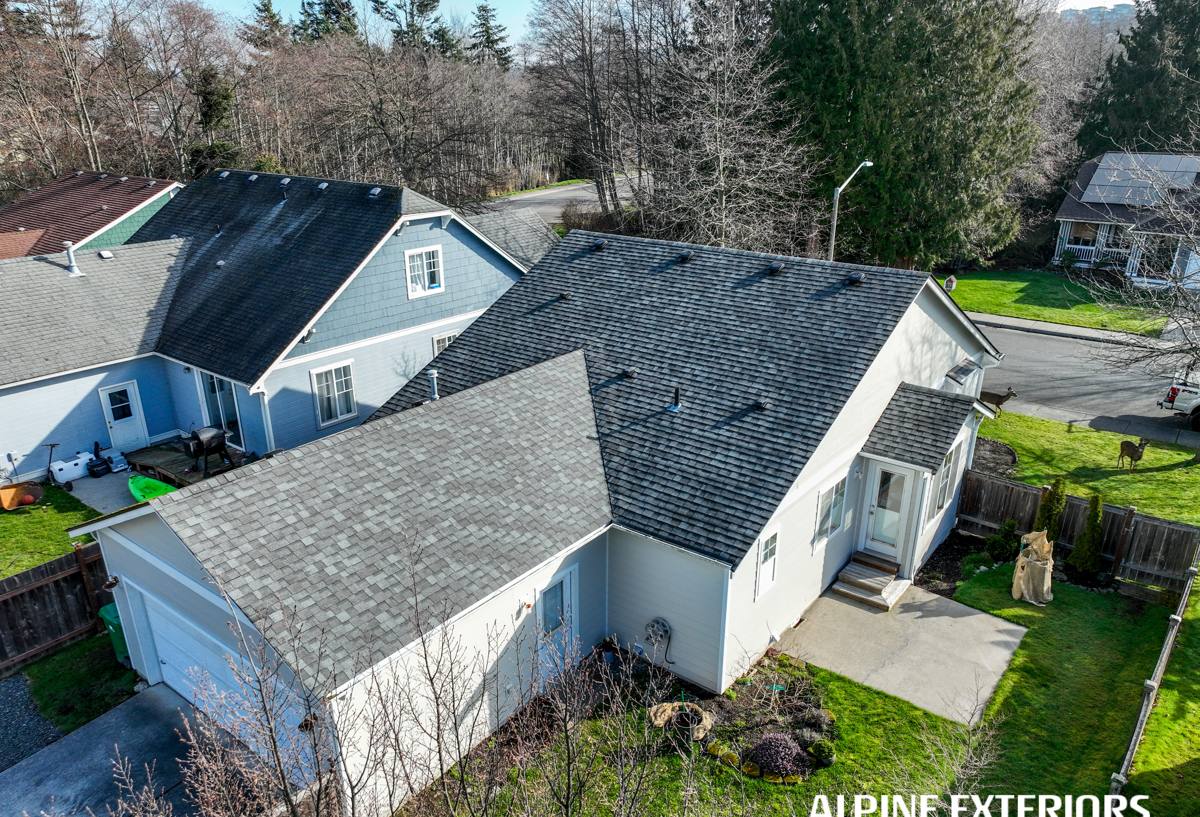
Cordata sits in the Ferndale-to-Bellingham corridor of Whatcom County, close enough to the water that salt air is a constant, low-grade presence on every exterior surface. Add in driving rain off the Strait of Georgia and Puget Sound, a long gray season where moisture sits against the house for weeks at a time, and a moss season that can stretch from fall through spring, and you have a climate that is genuinely hard on siding, trim, roofing, and anything else on the outside of a home. None of this is dramatic weather. It's the slow, steady kind that doesn't show up as storm damage — it shows up five or ten years later as swollen trim, peeling paint, soft spots at the bottom courses of siding, and moss creeping up from the roofline.
Homes in this part of Whatcom County are almost never dealing with one extreme event. They're dealing with cumulative exposure — hundreds of wet-dry cycles a year, salt-laden air working on fasteners and finishes, and moss and algae that thrive in the shade and dampness common under mature Pacific Northwest tree cover. Siding that isn't engineered for that cycle degrades from the inside out, often before it looks bad from the curb.
Why the Siding Material You Choose Matters More Here Than Elsewhere
In a drier climate, the gap between a good siding product and a mediocre one is mostly cosmetic. In Whatcom County, that gap is structural. Moisture that gets behind or into siding here doesn't dry out quickly — the air is too damp, too much of the year, for that. So the questions that matter are: does the material absorb water, does it swell or rot when it does, does its finish hold up to salt air and UV, and how forgiving is it of the inevitable nail pop, caulk failure, or minor installation gap that happens on every real job site.
This is why we install exclusively James Hardie fiber cement siding and don't offer LP SmartSide, vinyl, Cemplank, Allura, primed spruce, or cedar. Each of those products has genuine strengths — we're not going to pretend otherwise — but each also has a trade-off that we think is a bad bet in this specific climate.
The Short Version, Product by Product
- Vinyl is inexpensive and low-maintenance in the sense that it doesn't need painting, but it's a thin plastic product that can warp in temperature swings, crack in cold snaps, and it simply isn't built to be repainted or refreshed as it ages — when it fades or gets brittle, replacement is the only real fix.
- LP SmartSide is engineered wood — strand-based, treated, and a genuine improvement over old wood siding — but it's still a wood product at its core, meaning any breach in the factory coating or caulking gives moisture a path into a material that can swell and deteriorate over time, which is a harder risk to accept in a climate this wet.
- Primed spruce and cedar are traditional and attractive, but they're solid wood: they need repainting on a cycle, they're vulnerable to rot at end grain and butt joints, and in a moss- and moisture-heavy environment they demand more upkeep than most homeowners want to sign up for.
- Cemplank and Allura are fiber cement competitors to Hardie and share the same basic chemistry — cement, sand, and cellulose fiber — but we've standardized on Hardie for its factory-applied ColorPlus finish, its HZ5 formulation engineered for the Pacific Northwest's moisture and freeze-thaw pattern, and the depth of its installed track record and warranty backing.
Why We Install Only James Hardie
James Hardie fiber cement is non-combustible, dimensionally stable, and doesn't feed on moisture the way wood-based products can. Its ColorPlus finish is baked on at the factory under controlled conditions, not brushed or sprayed on-site, which means better adhesion and a finish that's engineered to resist fading from UV and the kind of damp-air exposure that's constant this close to the coast. Hardie also produces climate-specific product lines — the HZ5 line is formulated for regions like ours, with freeze-thaw cycling and sustained moisture in mind, rather than a one-size-fits-all national product.
None of that means Hardie is maintenance-free. It still needs to be installed correctly — proper flashing, correct clearance from grade and roof lines, correctly sealed joints — and it still benefits from periodic washing to keep moss and mildew from taking hold in shaded, damp areas. But the material itself isn't the weak point the way it can be with wood-based or thin vinyl products, and that matters when the weather doesn't let up for months at a stretch.
| Material | Moisture Behavior | Maintenance Cycle | Our Take for This Climate |
|---|---|---|---|
| James Hardie fiber cement | Doesn't absorb or swell; engineered for wet climates | Occasional wash; no repainting needed for the life of the finish | What we install |
| Vinyl | Doesn't rot, but can warp/crack with temperature swings | Low, but not repaintable or repairable long-term | Not offered |
| LP SmartSide (engineered wood) | Vulnerable if coating or caulk fails | Periodic caulk/paint touch-up | Not offered |
| Cedar / primed spruce | Absorbs moisture; prone to rot at joints/end grain | Repainting every 5-8 years | Not offered |
| Cemplank / Allura fiber cement | Similar chemistry to Hardie | Comparable to Hardie | Not offered — we standardized on Hardie's finish and warranty |
Beyond Siding: The Whole Exterior Envelope
Siding doesn't work in isolation. It's part of a system with the roof, windows, and, on a lot of Cordata-area homes, decks that take the same rain and moss exposure. When we're on-site for a siding project, we're also looking at how the roof sheds water past the siding line, whether window flashing is doing its job, and whether a deck's ledger board or fasteners show the kind of moisture staining that points to a bigger problem. We handle all four — siding, roofing, windows, and decks — because a repair that only addresses one of them while ignoring a flashing or drainage issue upstream tends to fail again within a few years.
Where These Systems Interact Most
- Roof-to-siding transitions: poor step flashing or kickout flashing at roof-wall intersections is one of the most common sources of hidden water damage in this region.
- Window flashing: older or improperly flashed windows are a frequent point where siding looks fine on the surface but the sheathing behind it is compromised.
- Deck ledger connections: where a deck attaches to the house, moisture intrusion at that joint is common in wet climates and easy to miss without someone looking specifically for it.
Signs Your Current Siding Is Losing the Fight
Most siding failure in Whatcom County is gradual, so homeowners often don't notice until it's fairly advanced. A few things worth checking, especially heading into another wet season:
- Soft or spongy spots when you press on siding near the bottom courses or around window trim
- Persistent moss or dark streaking that comes back quickly after cleaning
- Paint that's bubbling, peeling, or chalking rather than just fading evenly
- Visible gaps at seams, corners, or where siding meets trim
- Warping or a wavy appearance along a wall, especially on the north or shaded side of the house
Homeowner Checklist Before Calling for an Estimate
- Walk the exterior and note any soft spots, gaps, or discoloration by wall or elevation
- Check gutters and downspouts for backups that could be pushing water toward siding
- Look at trim around windows and doors for peeling paint or separation
- Note any areas with heavy moss growth or shade that stay damp longer than the rest of the house
- Check the deck ledger board area and any siding directly above a deck or patio roof
What Working With a Local Crew Actually Changes
A lot of exterior work looks similar on paper — remove old material, install new, caulk and paint. What differs is judgment calls made on-site: how much clearance to leave at grade given a specific lot's drainage, how to detail flashing around a particular window style, how aggressively to plan for moss and algae growth on a shaded north wall. A crew that works regularly in Whatcom County has already made those calls dozens of times on homes facing the same salt air and driving rain that a Cordata property deals with. That's different from a crew that mostly works inland or in a drier region and treats moisture detailing as an afterthought.
Local also means accountability. If a question comes up two years after installation — a caulk line that needs attention, a section that needs a closer look after a hard winter — a local company is a phone call away, not a name on an invoice from a crew that moved on to the next region.
What the Process Looks Like
For most Cordata-area siding projects, the process starts with a walk-around inspection to assess the current siding, trim, flashing, and any related roofing or window issues. From there we talk through what's actually needed — sometimes that's a full re-side, sometimes it's targeted repair plus a maintenance plan. If James Hardie is the right fit, we go over the HZ5 product line, ColorPlus color options, and what correct installation involves: proper clearances, flashing details, and fastener patterns that hold up to this climate long-term. Every project is scoped to the specific house, not a one-size-fits-all package.
| Cost Factor | Why It Matters in This Climate |
|---|---|
| Extent of hidden moisture damage | Sheathing or framing repairs found once old siding comes off are common in older, wetter-exposed homes |
| House size and wall complexity | More corners, trim details, and roof-wall intersections mean more flashing work |
| Existing flashing condition | Reusable flashing saves cost; deteriorated flashing at windows or rooflines needs replacement |
| Siding profile and trim choice | Lap width, trim detail, and color selection affect material cost, not installation quality |
| Access and site conditions | Mature landscaping, slopes, or tight lot lines can affect labor time |
If you're in Cordata or elsewhere in the Ferndale area and want an honest look at what your home's exterior actually needs, we're happy to walk it with you and give you a straightforward, no-pressure estimate — no obligation, just a clear picture of your options.