 Ferndale
 Siding Built for Nooksack's Damp, Moss-Prone Climate
Nooksack sits inland from Bellingham Bay in the Nooksack River valley, but don't let the distance from saltwater fool you — Whatcom County's weather doesn't stop at the coastline. Marine air off the Salish Sea pushes inland through the valley for most of the year, bringing long stretches of low clouds, fine driving rain, and the kind of persistent humidity that keeps everything from fence posts to rooflines damp for days at a time. Add in the shade from mature evergreens common on Nooksack properties, and you get an extended moss and algae season that runs from fall through spring.
Exterior siding in this area isn't just cosmetic — it's the first line of defense against moisture intrusion, wood rot, and the slow cosmetic decline that comes from mildew and moss staining. We install exclusively James Hardie fiber cement siding because it's engineered to hold up to exactly this kind of weather, and because we've seen firsthand what happens to other products after a decade or two of Whatcom County winters.
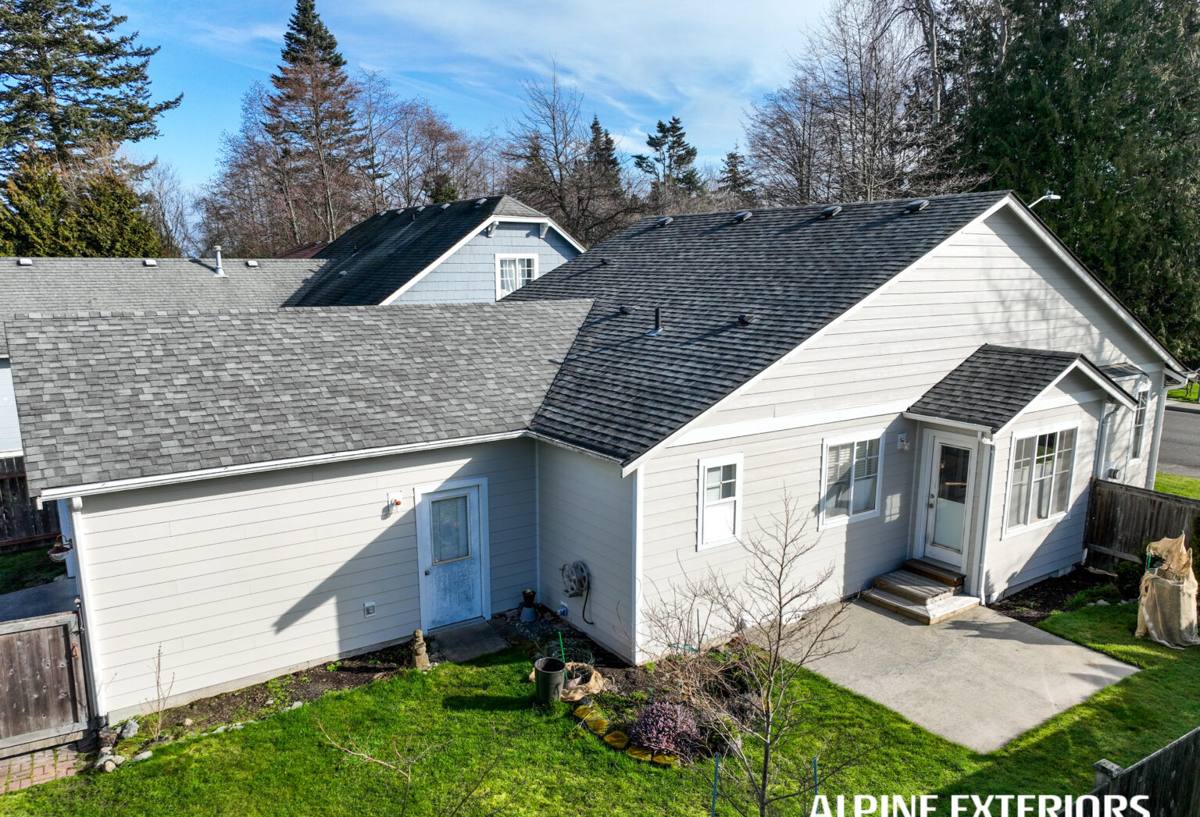
What Nooksack Homes Are Up Against
Driving Rain and Wind-Blown Moisture
Rain in this part of Washington rarely falls straight down. Storm systems moving through the valley tend to push rain sideways against wall assemblies, forcing moisture into seams, laps, and fastener points that a calmer climate would never test. Siding materials that swell, delaminate, or absorb water at the edges take the brunt of this over time.
Moss, Algae, and Shade
Many Nooksack lots back up to trees, pasture, or riverside vegetation that keeps north- and east-facing walls shaded well into the afternoon. Shaded, damp wall surfaces are exactly where moss and algae take hold first. Left unaddressed, organic growth holds moisture against the substrate and accelerates whatever decay process is already underway.
Temperature Swings and Seasonal Freeze
Whatcom County doesn't get brutal winters, but it does get enough freeze-thaw cycling — combined with saturated siding — to stress materials that aren't dimensionally stable. Wood-based products that have absorbed moisture and then freeze are prone to cracking and checking at the surface.
Why We Standardized on James Hardie
We used to install a wider range of siding products. After years of callbacks, warranty disputes, and re-siding jobs on homes that were barely 12-15 years old, we made the decision to install James Hardie fiber cement exclusively. Here's the reasoning, product by product.
Vinyl Siding
Vinyl is inexpensive and low-maintenance in mild, dry climates, but it wasn't built with our rain volume and temperature swings in mind. It can warp or buckle when installed too tight against thermal movement, and wind-driven rain finds its way behind panels at the J-channels and seams more easily than most homeowners expect. It also has no real fire resistance and a plastic appearance that doesn't hold up to close inspection.
LP SmartSide and Engineered Wood
Engineered wood siding has improved a lot over the decades, but it's still a wood-based product with an oriented-strand-board core. Any breach in the factory coating or field-cut edge sealant creates a path for moisture to reach that core, and once it does, swelling and edge deterioration follow. In a climate where wall assemblies stay damp for days at a stretch, that's a risk we're not willing to install and stand behind.
Cemplank and Allura
These are also fiber cement products, and they're not junk — but they're not what we install. James Hardie engineers its HZ5 product line specifically for the Pacific Northwest's moisture and humidity profile, backs it with a strong transferable limited warranty, and controls the ColorPlus finish process end to end. We'd rather install fewer products at a higher standard than juggle multiple manufacturers' specs and warranty terms.
Primed Spruce and Cedar
Cedar has real appeal — it's a Pacific Northwest tradition, and a well-maintained cedar exterior looks fantastic. But "well-maintained" is doing a lot of work in that sentence. In a valley climate like Nooksack's, cedar needs re-staining or re-sealing on a tight cycle, and any lapse in that maintenance opens the door to rot, especially at end grain and fastener penetrations. Primed spruce trim has the same fundamental vulnerability without the visual upside. We use Hardie trim boards instead, which give a comparable clean look with none of the recoating schedule.
How James Hardie Fiber Cement Performs Here
James Hardie siding is made from cement, sand, and cellulose fibers, engineered into boards and planks that are non-combustible, dimensionally stable, and resistant to moisture absorption in the way wood-based products are not. The HZ5 formulation is specifically engineered for wet, humid climates like ours, which matters more in Nooksack than it would in a drier inland region.
ColorPlus Factory Finish
Rather than field-painting siding after installation, Hardie's ColorPlus finish is baked on at the factory in multiple coats, which gives better fade and chip resistance than most job-site paint jobs, and comes with its own finish warranty separate from the product warranty. That matters in a shaded, damp climate where field-applied paint can struggle to cure and bond properly.
Moss and Algae Resistance
No siding material is moss-proof — moss will grow on anything if conditions are right and the surface is never cleaned. But fiber cement doesn't feed organic growth the way wood fiber can, and it holds up to the periodic gentle washing needed to keep a shaded wall looking clean, without the material degradation that comes from wetting and drying wood-based siding repeatedly.
Product Comparison at a Glance
| Material | Moisture Behavior | Fire Resistance | Typical Maintenance |
|---|---|---|---|
| James Hardie Fiber Cement | Dimensionally stable, engineered for wet climates | Non-combustible | Occasional wash, repaint on ColorPlus not required for years |
| Vinyl | Can trap moisture behind panels; warps with heat/cold cycling | Combustible, melts | Low, but prone to fading and cracking over time |
| LP SmartSide / Engineered Wood | OSB core vulnerable once coating is breached | Combustible | Caulk and coating inspections needed regularly |
| Cedar / Primed Spruce | Absorbs moisture at end grain and fasteners | Combustible | Re-stain or repaint on a recurring cycle |
Beyond Siding: Roofing, Windows, and Decks
Siding doesn't work in isolation. A wall assembly that manages moisture well still fails if the roof is shedding water onto it, if window flashing is done wrong, or if a deck ledger is trapping moisture against the house. We handle roofing, windows, and decks alongside siding for Nooksack homeowners specifically because these systems have to work together.
- Roofing that's properly flashed at valleys, walls, and penetrations keeps water off the siding in the first place
- Windows installed with correct flashing and drainage prevent the single most common source of hidden wall rot
- Decks built with proper ledger flashing and gapped decking keep moisture from wicking into the adjacent wall
- Coordinated exterior work means fewer contractors, fewer handoff gaps, and one crew accountable for how the systems meet
Why a Local Crew Matters for Nooksack Homeowners
Whatcom County's building climate isn't the same as siding installed in Spokane or Eastern Washington, and a crew that mostly works drier regions will make different assumptions about house wrap, flashing details, and fastener spacing than one that works this valley every week. We know how Nooksack's mix of open pasture and tree-lined lots affects sun exposure and shade patterns on a house-by-house basis, and we size up moisture and moss risk accordingly during the estimate, not after installation.
Local also means being reachable. If a warranty question comes up five years down the road, or a storm knocks something loose, you're calling a crew that's still working in the area, not chasing down a company that moved on.
What Correct Installation Looks Like
James Hardie siding performs to spec only when it's installed to spec. That includes correct fastener spacing and depth, proper clearance from grade and roof lines, correctly lapped and sealed joints, and compatible flashing and house wrap details underneath. Manufacturer warranties can be affected by installation errors, which is one more reason we follow Hardie's published installation guidelines closely rather than treating them as optional.
Questions Worth Asking Any Siding Contractor
- What specific siding product and product line are you quoting, and why that one?
- Are you a manufacturer-certified or preferred installer for that product?
- How do you handle flashing at windows, doors, and roof-to-wall intersections?
- What does the warranty actually cover, and is it transferable if I sell the house?
- Can you walk me through your fastening and clearance details before work starts?
Planning a Siding Project in Nooksack
Most siding projects here start with an exterior assessment — checking existing siding condition, looking for moisture damage around windows and roof lines, and evaluating how sun and shade patterns on your specific lot will affect long-term performance. From there we talk through Hardie product lines, plank profiles, and ColorPlus color options that fit the house and the neighborhood.
If you're weighing a full re-side, a repair after storm damage, or you're planning ahead before problems show up, we're happy to take a look and give you a straight answer about what your house actually needs. Reach out for a free, no-pressure estimate — we'll walk the exterior with you and explain exactly what we see.