 Ferndale
 The Real Question Behind This Comparison
Almost every homeowner re-siding a house in Ferndale asks some version of the same question: is vinyl siding good enough, or is fiber cement worth the extra upfront cost? It's a fair question, and it deserves a straight answer instead of a sales pitch. Both products can look good going onto a house. The differences show up five, ten, and twenty years later, once the marine air, the driving rain off the Strait of Georgia, and the long gray moss season have had time to work on the material.
This page lays out what each product actually is, where vinyl does its job well, where it struggles in Whatcom County's climate specifically, and why our company made the decision to install only James Hardie fiber cement siding rather than offer both. We're not going to tell you vinyl is garbage — it isn't. We're going to tell you what it does and doesn't do, and let you weigh that against what fiber cement does instead.
What Vinyl Siding Actually Is
Vinyl siding is extruded PVC plastic, formed into overlapping panels and usually installed over a layer of house wrap or rigid foam. It's been the most common siding material in North America for decades, mostly because it's inexpensive to manufacture, light to ship and handle, and fast to install. A crew can side a house in vinyl in a fraction of the labor-hours it takes for fiber cement.
Where Vinyl Genuinely Performs Well
- Low material cost, which keeps the total project bid lower up front
- Does not rot, since it contains no wood fiber or cellulose
- Lightweight, so it puts less structural load on older framing
- Simple to source in standard colors from big-box suppliers
- Reasonable performer on a warm, dry-summer house with good roof overhangs
If a homeowner is working with a tight budget on a short-hold property, vinyl isn't an irrational choice. The honest trade-offs show up when you factor in this region's weather and how long people actually keep their homes here.
Where Vinyl Struggles in Whatcom County's Climate
Ferndale sits close enough to the water that salt-laden air is a routine part of the weather, not an occasional event. Combine that with the driving, sideways rain that comes through in fall and winter storms, plus a moss season that can run half the year in shaded, north-facing areas, and you get a set of conditions that expose vinyl's weak points.
Heat Warping and Sun Exposure
Vinyl is a thermoplastic. It softens and expands with heat and contracts in the cold, which is why installers have to leave nail slots loose enough for the panels to move. On south- and west-facing walls that catch reflected sun off windows or dark surfaces, vinyl panels can warp, buckle, or "oil-can" over time. It's rarely a structural problem, but it looks bad and it doesn't reverse itself.
Color Fade and UV Breakdown
Vinyl color is mixed into the plastic itself, not applied as a separate finish coat, but UV exposure still breaks down the pigment and the plastic surface over years. Darker colors fade faster and more visibly than light ones, which is part of why the vinyl color palette skews toward pastels and whites — the darker options simply don't hold up as well.
Water Behind the Panels
Vinyl siding is not a waterproof skin — it's a rain screen designed to shed most water while relying on the house wrap behind it to manage what gets through the seams, laps, and penetrations. In a climate with sustained wind-driven rain, that secondary drainage plane is doing real work. If flashing details or the water-resistive barrier behind the vinyl were done poorly — which happens more often than homeowners realize, since vinyl installation is often treated as low-skill, fast work — moisture gets trapped behind the panels where nobody sees it until there's rot in the sheathing.
Moss and Organic Growth
Vinyl's smooth plastic surface doesn't feed moss and algae directly, but the horizontal laps and J-channels around windows and corners collect moisture and organic debris in shaded, damp areas — exactly the conditions common on the north and east sides of homes tucked under trees around Ferndale. Over a long wet season, that buildup shows as streaking and green discoloration that pressure washing only partly resolves.
What Fiber Cement Is and Why It Behaves Differently
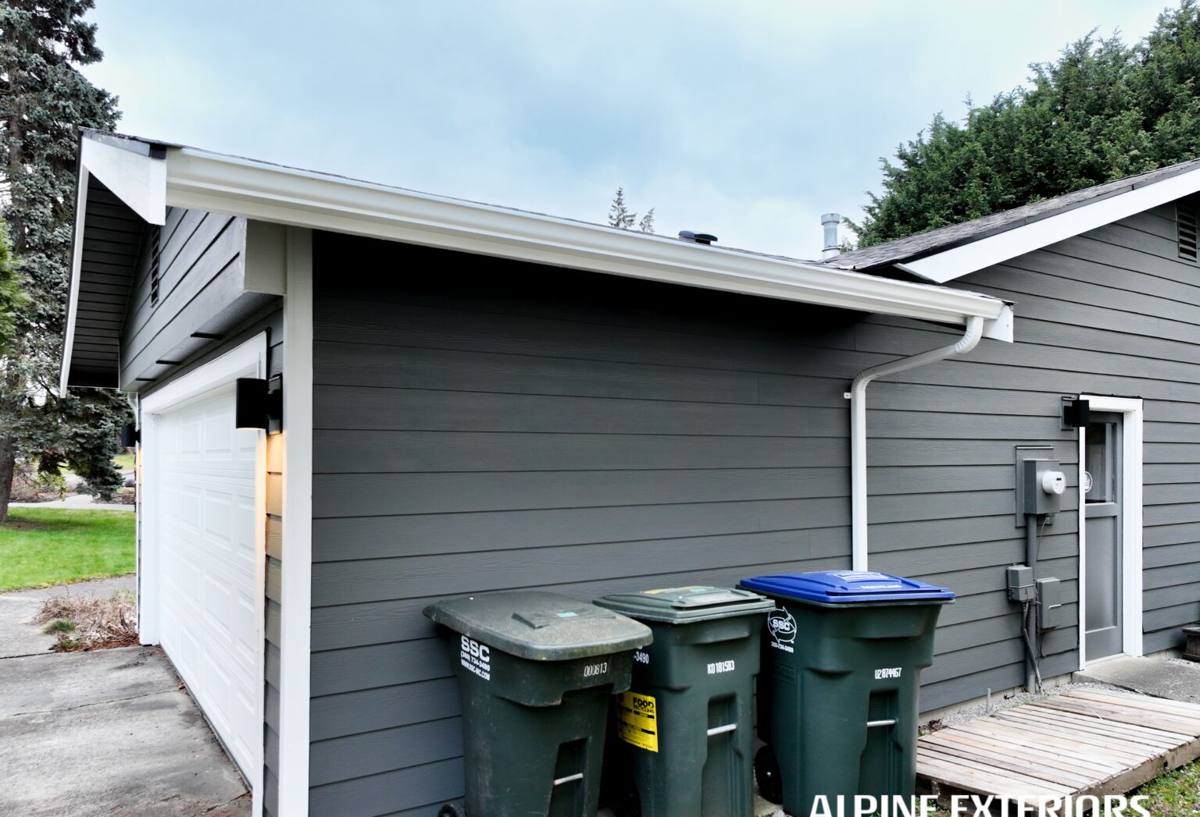
James Hardie fiber cement siding is made from cement, sand, and cellulose fiber, cured into a dense, stable board. It is not plastic and it is not wood — it's its own category, engineered specifically to resist the things that damage siding in wet, coastal, temperature-swinging climates.
Moisture and Rot Resistance
Because fiber cement contains no organic wood fiber for rot fungus to feed on, and because it's manufactured to a controlled moisture content, it holds up to sustained rain exposure far better than wood-based products, and it doesn't trap and hide moisture behind a plastic shell the way vinyl can when the drainage plane underneath fails. James Hardie also makes climate-specific "HZ" formulations engineered for wet, humid regions like the Pacific Northwest, which further improves how the board handles moisture cycling over decades.
Fire Resistance
Fiber cement is non-combustible. It won't ignite, melt, or contribute fuel to a fire the way vinyl siding can under direct flame exposure. That's a meaningful consideration for insurance underwriting and for peace of mind, even outside of wildfire-prone areas.
Dimensional Stability
Fiber cement doesn't expand and contract with temperature the way vinyl does, so it doesn't warp, buckle, or oil-can on sun-exposed walls. It stays flat and straight for the life of the installation when installed to spec.
Impact and Wind Resistance
Fiber cement is dense and rigid. It resists hail, wind-driven debris, and the accidental bumps of ladders, sports equipment, and yard tools far better than a thin plastic panel, which can crack or puncture under a sharp impact.
Factory Finish vs. Field-Applied Color
One of the most underappreciated differences between the two products is how the color gets onto the siding in the first place. Vinyl color is baked into the plastic during extrusion. James Hardie's ColorPlus finish is a factory-applied, baked-on coating process done under controlled conditions, engineered specifically to resist UV fading and to hold a sharper, richer color range than either raw fiber cement or vinyl — including deep, saturated colors that vinyl manufacturers avoid because their pigments can't handle the fade. ColorPlus finishes also come with a dedicated finish warranty separate from the substrate warranty, covering peeling, cracking, and chipping of the factory coat.
Side-by-Side Comparison
| Factor | Vinyl Siding | James Hardie Fiber Cement |
|---|---|---|
| Base material | Extruded PVC plastic | Cement, sand, cellulose fiber |
| Combustibility | Combustible, can melt/ignite | Non-combustible |
| Heat/sun warping | Can warp, buckle, oil-can | Dimensionally stable |
| Color application | Mixed into plastic (fades w/ UV) | Factory-baked ColorPlus finish |
| Rot resistance | N/A (no organic fiber), but traps moisture behind panel if barrier fails | Engineered for moisture, HZ climate formulations |
| Impact resistance | Can crack/puncture | Dense, resists impact well |
| Typical lifespan | 20–30 years before warping/fading drives replacement | 30–50+ years with correct install and upkeep |
| Repainting | Not typically repainted; replaced when faded | Can be repainted decades out if desired |
| Upfront material cost | Lower | Higher |
Installation: Why the Details Matter More With Fiber Cement
Fiber cement is less forgiving of shortcuts than vinyl, and that's actually part of its case, not against it. Correct James Hardie installation requires specific fastener patterns, proper clearances above roof lines and decks, correct flashing and caulking at every penetration, and factory-specified gaps and overlaps. Done right, the system performs exactly as engineered for decades. Done wrong — nailed too tight, flashed poorly, or butted directly against another surface without clearance — moisture problems can develop regardless of how good the board itself is.
This is exactly why we install exclusively to James Hardie's published specifications rather than treating siding as a generic wrap-the-house task. It's also why we don't install vinyl, LP SmartSide, Cemplank, Allura, primed spruce, or cedar alongside Hardie — spreading a crew's expertise across multiple systems means nobody masters the installation details that actually determine whether the siding performs for 10 years or 40.
Maintenance Over the Life of the Siding
- Vinyl: periodic washing to remove salt film, pollen, and moss staining; inspect for cracked or missing panels after storms; watch for warping on sun-exposed walls; no repainting option if color fades
- Fiber cement (ColorPlus): periodic washing; inspect and re-caulk joints per manufacturer schedule; touch-up paint available for nicks; can be fully repainted decades later if the homeowner wants a color change
- Both products: keep gutters clear and downspouts directed away from the wall line, since standing water at the base of any siding system causes problems over time
- Both products: trim back vegetation and tree cover where practical to reduce the shaded, damp conditions that drive moss and algae growth in Whatcom County's wetter months
Warranty Structure
Vinyl warranties vary widely by manufacturer and are frequently prorated, meaning the payout shrinks the longer you've owned the siding — a 30-year warranty that pays out 10% of replacement cost in year 20 isn't much of a warranty in practice. James Hardie backs its fiber cement products with a non-prorated limited warranty on the substrate, plus a separate finish warranty on ColorPlus color, and the warranty is transferable to a subsequent homeowner if the house sells — a detail that matters to buyers and appraisers alike.
Why We Standardized on James Hardie
We made a deliberate decision not to offer vinyl, or any of the other lower-cost siding products, alongside James Hardie. It would be easier, and sometimes cheaper for the customer up front, to offer both and let price drive the decision. We don't do that because we've seen what each product looks like fifteen and twenty years into a Whatcom County winter, and we'd rather stand behind one system we can install to spec every time than offer a menu of products with very different long-term outcomes. That's a business decision we're transparent about, not a claim that vinyl is unusable — it's a statement about what we're willing to put our name on.
Questions Worth Asking Before You Sign With Any Contractor
- Is the quote based on manufacturer-specified fastener spacing, clearances, and flashing details, or a general labor rate?
- Does the crew installing the siding specialize in this product, or do they rotate between multiple siding systems?
- What does the warranty actually cover, is it prorated, and is it transferable if you sell the house?
- Who is responsible for flashing and moisture barrier work — the siding crew, or a separate sub?
- Can you see examples of the contractor's completed work in a climate similar to Whatcom County's?
If you're weighing vinyl against fiber cement for a home in Ferndale or elsewhere in Whatcom County, we're glad to walk through your specific house, its exposure, and what a correctly installed James Hardie system would look like — no pressure, no obligation. Use the form below to request a free estimate.