 Ferndale
 Two Respected Products, One Very Different Material
Homeowners in Ferndale often come to us with a quote in hand for LP SmartSide and a simple question: why do we only install James Hardie? It's a fair question, and it deserves a straight answer rather than a sales pitch. Both products have earned a place in the siding industry. LP SmartSide is engineered wood — strand board coated with resin and a protective overlay. James Hardie is fiber cement — a blend of cement, sand, and cellulose fiber. They look similar once painted. They do not behave the same way once they're on a wall in Whatcom County for fifteen years.
This page isn't about declaring one product "bad." It's about explaining the material science behind why we, as a contractor who has to stand behind our work in this specific climate, standardized on one system and stopped installing the other.
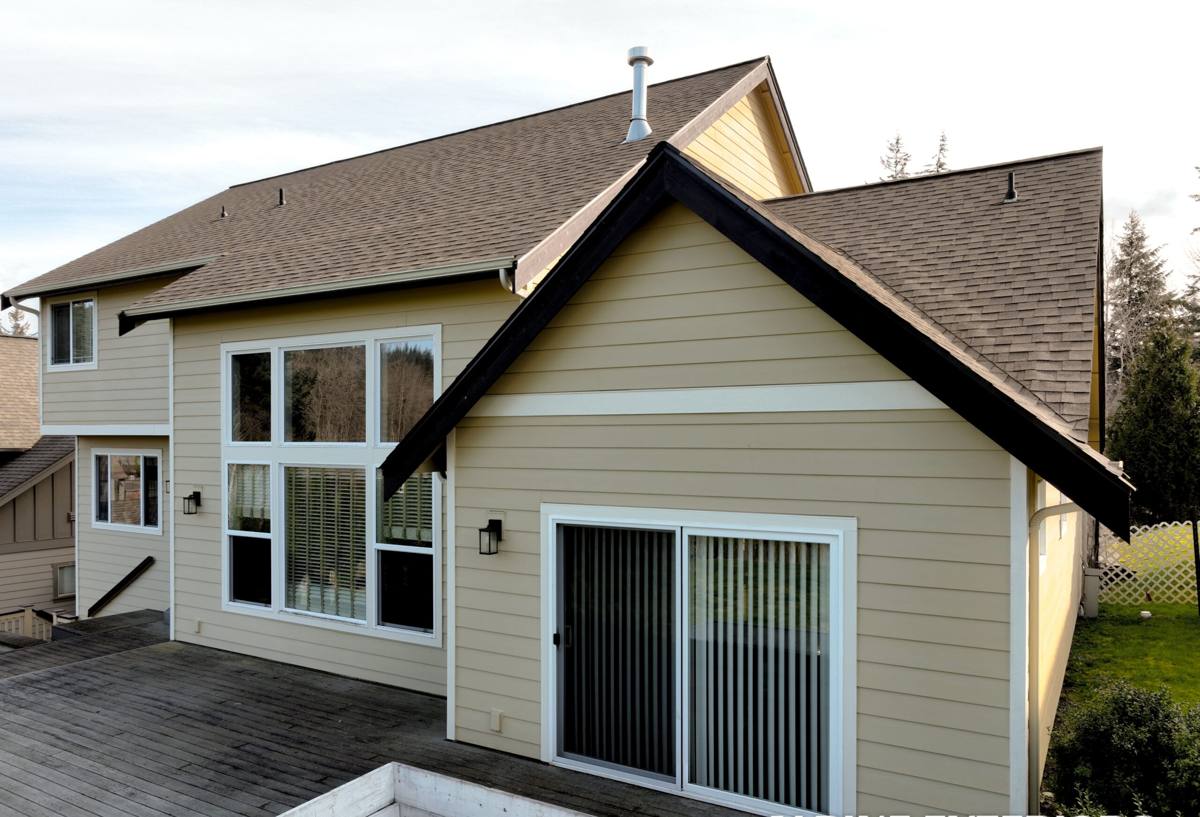
What LP SmartSide Gets Right
Engineered wood siding has real advantages, and we won't pretend otherwise. It's lighter than fiber cement, which makes it easier and faster to handle on site. It holds a nail well without the pre-drilling or specialized fastening patterns fiber cement sometimes requires. It has a warmer, more traditional wood-grain look that some homeowners prefer over the slightly flatter texture of cement board. And it's generally less expensive to install than premium fiber cement lines, which matters on a tight budget.
If wood-look siding were only ever installed in a dry climate, on a well-detailed home, by a crew that sealed every cut edge without exception, it would perform reasonably well. That's a lot of "ifs" — and it's exactly where the trade-offs start to matter.
The Engineered Wood Trade-Off: Moisture at the Edges
Engineered wood siding is still, at its core, wood fiber. Wood fiber swells when it absorbs water. The factory coating and overlay on products like LP SmartSide are designed to keep water out of the face of the board — but every cut end, every mitered corner, every place a fastener penetrates the surface is a place where raw substrate is exposed unless it's field-sealed with the manufacturer's specified sealant.
That sealing step is not optional, and it's not a one-time job. Manufacturer warranties on engineered wood siding typically require documented use of specific edge sealers at every cut, plus ongoing caulk maintenance at seams and trim intersections. Skip a step, let a bead of caulk fail after a few winters, or leave a cut end unsealed behind a piece of trim, and that's the spot where moisture gets in. Once wood fiber starts to swell, delaminate, or soften at an edge, it doesn't get better — it spreads.
None of this means the product is defective. It means the product's long-term performance depends heavily on installation discipline and ongoing homeowner maintenance, in a way that fiber cement simply doesn't.
Why Ferndale's Climate Raises the Stakes
Every siding product has a "forgiving climate" and an "unforgiving climate." Whatcom County is not the forgiving one. Ferndale sits close enough to Bellingham Bay and the Salish Sea that salt-laden air is a real factor on window and door hardware, fasteners, and any exposed wood fiber. Add the region's driving rain — wind-blown moisture that hits siding at an angle instead of running straight down — and water finds horizontal cuts, corner boards, and butt joints that a calmer climate would rarely test.
Then there's moss. Whatcom County's long wet season, mild temperatures, and heavy tree cover on many Ferndale lots create ideal moss and algae conditions on north-facing and shaded walls for much of the year. Moss holds moisture directly against the siding surface for extended periods — it's essentially a wet sponge sitting on the wall. On a material that resists water absorption, that's a cosmetic nuisance you wash off. On a material where sustained moisture exposure can reach an unsealed edge, it's a slower-moving problem that's easy to miss until it's advanced.
We're not describing a hypothetical here — we're describing the exact combination of conditions (salt air, driving rain, extended moss season) that this region produces every single year, on every wall orientation eventually.
How Fiber Cement Handles the Same Conditions
James Hardie's fiber cement is cement, sand, and cellulose fiber, cured into a rigid, dimensionally stable board. It doesn't swell when it gets wet and it doesn't rot. It's also non-combustible, which is a genuine safety advantage regardless of climate. Because the base material doesn't absorb and hold water the way wood fiber does, a cut edge or a fastener penetration is a far less critical failure point — it still should be primed and painted per Hardie's instructions, but the consequence of an imperfect detail is much smaller.
Hardie also builds specific product lines engineered for different exposure levels — their HZ5 designation, for example, is formulated for regions with more freeze-thaw cycling and moisture exposure than their standard HZ10 line. That's a manufacturer acknowledging that climate matters and engineering around it, rather than relying entirely on field sealing to compensate.
The factory-applied ColorPlus finish is baked on under controlled conditions and backed by its own finish warranty, separate from the substrate warranty — so the color and the board each carry their own long-term coverage.
Side-by-Side: The Factors That Actually Matter
| Factor | James Hardie Fiber Cement | LP SmartSide Engineered Wood |
|---|---|---|
| Base material | Cement, sand, cellulose fiber | Wood strand board with resin/overlay |
| Moisture response | Does not swell or rot | Can swell/delaminate if edges aren't sealed and maintained |
| Fire classification | Non-combustible | Combustible (wood-based) |
| Edge/cut sealing requirement | Recommended for finish protection | Required by warranty terms, ongoing |
| Typical maintenance | Periodic wash, repaint on your schedule | Regular caulk/seal inspection and upkeep |
| Finish | Factory ColorPlus baked-on finish available | Factory primed or pre-finished, field-painted options |
| Weight/handling | Heavier, more crew handling | Lighter, faster to install |
Installation Sensitivity Is the Real Dividing Line
Almost every siding failure we've been called out to inspect over the years traces back to installation, not the product line itself. That's true across materials. But the two products are not equally forgiving of a rushed or incomplete install.
With fiber cement, a missed detail is usually a cosmetic fix. With engineered wood, a missed detail at a cut edge is a moisture entry point that can sit undetected behind trim for years. Here's what correct installation actually requires, regardless of which product a homeowner chooses:
- Every field cut end sealed per manufacturer spec, not just the factory edges
- Proper fastener type, spacing, and penetration depth — not shortcuts to save time
- Correct flashing and drainage plane behind the siding, especially at windows, doors, and horizontal trim
- Manufacturer-specified clearance from grade, roofing, and decks to avoid standing moisture contact
- Caulking at seams done with a product and technique that will actually last in a wet climate
- Ventilation behind the cladding so any moisture that does get in can dry out
We install fiber cement to Hardie's published specifications because it's the system we know cold, we can warranty with confidence, and it gives us the largest margin for error in a climate that doesn't forgive shortcuts.
Warranty Structure: Read the Fine Print
Warranty length isn't the only thing that matters — what keeps the warranty valid does. Engineered wood warranties commonly include maintenance obligations: documented sealing at cuts, timely repainting, and prompt repair of any damage. If those obligations aren't met and documented, a claim can be reduced or denied. Fiber cement warranties still require reasonable care and proper installation, but they aren't riding on the same ongoing field-sealing discipline. James Hardie's warranty is also transferable to a new owner within its terms, which matters if you plan to sell the home before the siding's functional life is up — a detail worth asking about with any product you're comparing.
Why We Standardized on Hardie
We made a business decision years ago to install one fiber cement system rather than carry multiple product lines. That decision came down to accountability. We can only warranty our workmanship with full confidence on a material whose long-term performance doesn't hinge on every single field seal being flawless and every homeowner staying on top of a maintenance schedule indefinitely. In a county with salt air off the bay, wind-driven rain most of the year, and a moss season that stretches across several months, fiber cement gives homes here the best odds of looking and performing the same way in year fifteen as it did in year one.
That's not a knock on every engineered wood installation everywhere — it's a statement about what we're willing to put our name behind on Whatcom County homes specifically.
If you're weighing siding options for a home in Ferndale or anywhere in Whatcom County, we're happy to walk your specific house, look at sun exposure, tree cover, and wall orientation, and give you a straight answer about what will hold up. Reach out for a free, no-pressure estimate using the form below.