 Ferndale
 Semiahmoo's Exterior Problem Is Different From the Rest of Whatcom County
Semiahmoo sits out on the water in a way most of Whatcom County doesn't. Homes here catch wind and moisture straight off Semiahmoo Bay and Drayton Harbor, with very little tree cover or terrain to slow it down before it hits a wall. That combination — salt-laden air, near-constant marine humidity, and wind-driven rain that comes in sideways instead of straight down — is a harder environment for exterior building materials than what you'll find a few miles inland in Ferndale or Lynden.
We've been doing exterior work throughout Whatcom County long enough to know that a siding, roofing, window, or decking product that performs fine in a sheltered inland yard can fail early out on the water. Salt air accelerates corrosion on fasteners and trim metal. Constant dampness feeds moss, algae, and mildew growth on anything that holds moisture at the surface. And homes exposed to open water take wind loads that push rain up under laps and around openings that would otherwise stay dry. None of this is exotic — it's just physics that adds up faster near the bay than it does a few miles away.
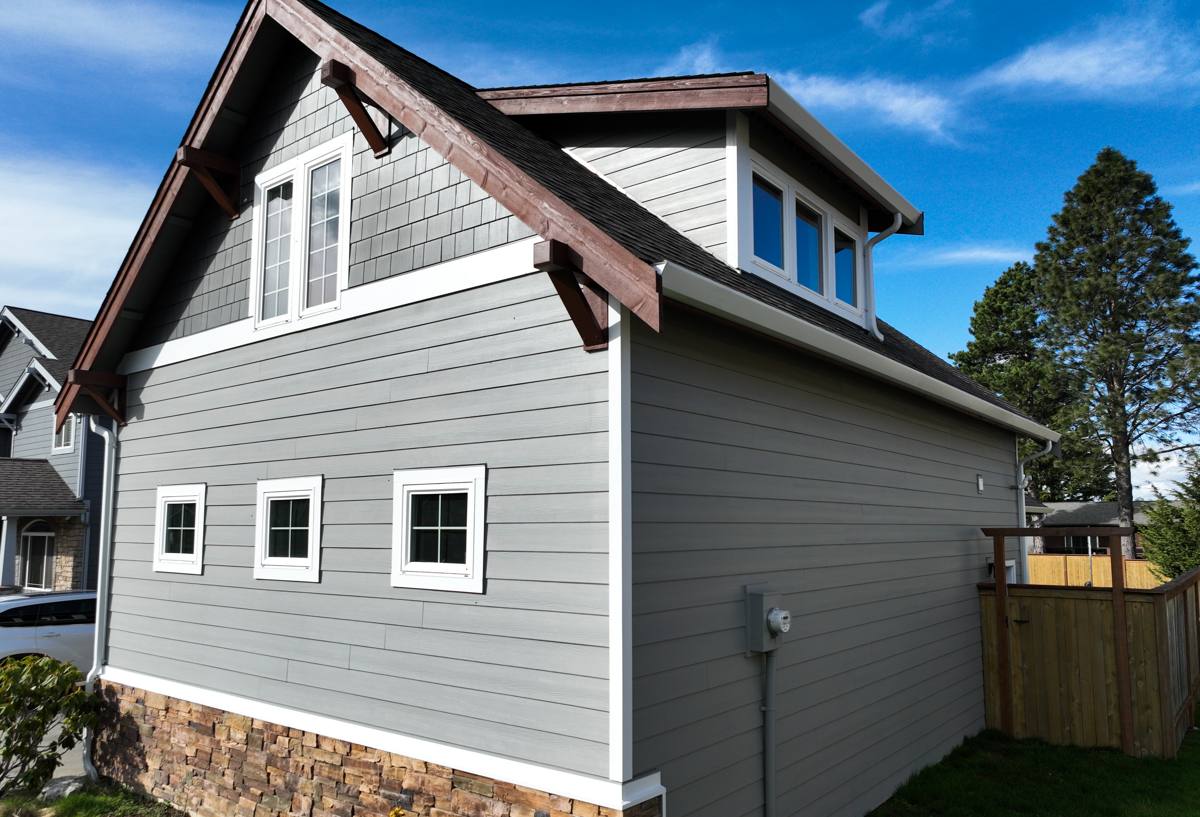
Why Moss and Moisture Are the Real Enemy Here
Ask any longtime Whatcom County homeowner what eats siding and paint jobs, and moss is near the top of the list. Western Washington's long wet season already gives moss a head start; a coastal location like Semiahmoo extends that season further because surfaces simply don't dry out as often between rain events. Moss and algae don't just look bad — they hold moisture against the siding surface, and materials that absorb water are the ones that pay the price over time in the form of swelling, cracking, or rot.
This is one of the biggest reasons we steer homeowners toward fiber cement rather than wood-based or wood-composite siding products for water-exposed properties. A siding material that resists moisture absorption at its core, rather than relying entirely on a surface coating to keep water out, simply holds up better through a long, damp moss season year after year.
What Salt Air Actually Does to a House
- Corrodes exposed fasteners, flashing, and trim metal faster than inland exposure
- Breaks down lower-grade paint and factory finishes, leading to chalking and fading
- Feeds algae and moss growth on shaded or north-facing walls and rooflines
- Drives wind-blown rain into laps, seams, and penetrations that face open water
- Accelerates wear on caulking and sealants around windows and trim
Why We Install Only James Hardie Fiber Cement Siding
We don't install vinyl siding, LP SmartSide, Cemplank, Allura, or primed wood products, and a coastal community like Semiahmoo is exactly why. Vinyl siding can warp and buckle under sustained wind exposure and UV cycling, and its seams and J-channels give wind-driven rain more opportunities to find a way behind the cladding. Engineered wood siding products use wood strand cores that, however well-treated, are still wood at heart — vulnerable to swelling and edge deterioration if moisture gets past the coating over years of exposure, which is a tougher bar to clear in a marine environment than inland.
James Hardie fiber cement is cement, sand, and cellulose fiber — noncombustible, dimensionally stable, and engineered specifically for exposure conditions like this one. Hardie's HZ5 product line is formulated for the Pacific Northwest's wet, temperate climate, and the ColorPlus factory-applied finish is baked on under controlled conditions rather than field-painted, which gives it a more consistent, longer-lasting bond than site-applied paint typically achieves — an advantage that matters more, not less, in salt air.
We're not saying every other product is worthless everywhere. We're saying that after years of exterior work in this specific climate, Hardie is the one we're willing to stand behind and warranty on homes exposed to the kind of conditions Semiahmoo sees. That's our standard, and we hold to it.
Siding Material Comparison for a Coastal Property
| Material | Moisture Behavior | Salt Air / Wind Exposure | Finish Longevity |
|---|---|---|---|
| James Hardie fiber cement | Does not absorb water like wood-based products; dimensionally stable | Engineered HZ5 formulation for wet coastal climates | Factory-baked ColorPlus finish, backed by transferable warranty |
| Vinyl siding | Doesn't rot, but seams allow wind-driven rain intrusion | Can warp, buckle, or crack under sustained wind and UV | Color is through the material but fades and chalks over time |
| Engineered wood (LP SmartSide) | Wood-strand core vulnerable if coating is compromised | Edge and seam exposure is the weak point near moisture | Field-applied or factory finish, shorter track record in wet marine settings |
| Cedar / primed wood | Absorbs moisture readily; needs consistent upkeep | High maintenance burden in constant dampness | Requires repainting or restaining on a recurring cycle |
Roofing, Windows, and Decks Face the Same Exposure
Siding isn't the only part of a Semiahmoo home working overtime against the weather. We handle roofing, window replacement, and deck construction alongside siding because these systems all interact — a roof that's shedding water properly, windows that are flashed and sealed correctly, and a deck built with weather-appropriate materials and fasteners all work together to keep a coastal home dry.
On roofing, proper flashing detail and moss-resistant material choices matter more here than in drier parts of the county — a roof that isn't shedding water and debris well becomes a moss farm within a couple of seasons. On windows, we pay close attention to flashing and sealant details around openings, since wind-driven rain finds gaps that would never be a problem in a sheltered location. On decks, we favor materials and fastener hardware rated for coastal or high-moisture exposure, since standard fasteners can corrode and stain decking prematurely out here.
What Correct Installation Looks Like in This Environment
Fiber cement siding performs the way it's designed to only when it's installed to manufacturer specification — and in a wind- and moisture-exposed location like Semiahmoo, the details matter more than usual. That means:
- Correct water-resistive barrier and rainscreen or drainage plane behind the siding
- Proper flashing at every window, door, and penetration, not just caulk as a substitute
- Manufacturer-specified fastener spacing, type, and corrosion-resistant hardware
- Correct clearances at grade, decks, and roof lines to keep siding out of standing moisture
- Factory-finished panels handled and cut in ways that don't compromise the ColorPlus coating
Skipping any of these steps might not show up as a problem in year one. In a coastal environment, shortcuts tend to show up early — as moisture staining, premature caulk failure, or moss taking hold behind poorly flashed trim — rather than staying hidden for a decade the way they might on a more sheltered inland property.
Cost Factors for Semiahmoo Exterior Projects
Every home is different, and we don't publish blanket pricing because square footage, existing wall condition, trim complexity, and access all move the number. That said, homeowners out here should expect a few things that affect cost more than they would on a typical inland job:
| Factor | Why It Matters Near the Water |
|---|---|
| Existing moisture damage | Coastal exposure means a higher chance of finding sheathing or trim damage once old siding comes off |
| Fastener and flashing hardware | Corrosion-resistant hardware costs more but is not optional in salt air |
| Wall complexity and trim detail | More corners, openings, and trim mean more flashing work and labor time |
| Access and staging | Wind exposure and site layout can affect scaffolding, staging, and scheduling around weather windows |
Maintenance in a Salt Air, High-Moss Environment
Even the right material still benefits from basic upkeep. A short annual checklist goes a long way toward protecting a coastal home's exterior investment:
- Rinse siding and trim annually to clear salt residue, pollen, and organic buildup
- Keep gutters clear so water isn't overflowing onto siding or trim below
- Trim back vegetation and clear debris that traps moisture against exterior walls
- Check caulking around windows and penetrations each year for cracking or gaps
- Address moss on roofing or shaded siding promptly rather than letting it establish
Why a Local Crew Matters for a Property Like This
A crew that mostly works inland, sheltered neighborhoods doesn't always think about rainscreen detailing, fastener corrosion resistance, or flashing sequencing the same way a crew that regularly works coastal and waterfront properties does. We're based in Whatcom County and have worked exterior projects across the range of conditions this area throws at a house — from the drier stretches inland to fully exposed waterfront sites like Semiahmoo. That local, hands-on experience shapes how we sequence a job, which details we refuse to shortcut, and which products we're willing to put our name behind out here.
We're also not going anywhere. A warranty is only as good as the contractor standing behind it, and we intend to still be a phone call away in this county for the life of the products we install.
What to Ask Before Hiring for a Coastal Property
If you're gathering quotes for siding, roofing, window, or deck work on a Semiahmoo property, a few questions separate contractors who understand coastal exposure from those who don't:
- Do you adjust flashing, fastener, or drainage details for wind and moisture-exposed sites?
- What siding, roofing, and decking materials do you recommend for salt air exposure, and why?
- Is your crew local, and do you have experience with waterfront or spit-exposed properties specifically?
- What does your warranty cover, and does it account for coastal conditions?
- Can you walk me through your installation sequence for wind-driven rain protection?
If you're weighing a siding, roofing, window, or deck project on a Semiahmoo property, we're happy to walk the exterior with you, talk through what we're seeing, and put together a straightforward, no-pressure estimate. Just fill out the form below to get started.