 Ferndale
 Building a Deck That Actually Holds Up in Semiahmoo
Semiahmoo sits close enough to the water that every deck built here is fighting a different battle than a deck built twenty miles inland. Salt-laden air moves through fasteners and framing connectors faster than most homeowners expect, driving rain gets pushed sideways into ledger boards and stair stringers, and the long stretch of wet, low-light months from October through April keeps everything damp long enough for moss and algae to take hold. A deck that's framed and finished without those three things in mind will look fine for a season or two, then start showing problems that are expensive to reverse: soft spots near the house, black streaking on the decking, and hardware that rusts from the inside before the surface ever shows it.
We build decks in Ferndale and the surrounding Whatcom County waterfront communities, and Semiahmoo work has its own rhythm. It's not a different trade, but it does mean choosing materials, fasteners, and drainage details a little more carefully than you would for a deck sitting in a dry, sheltered yard.
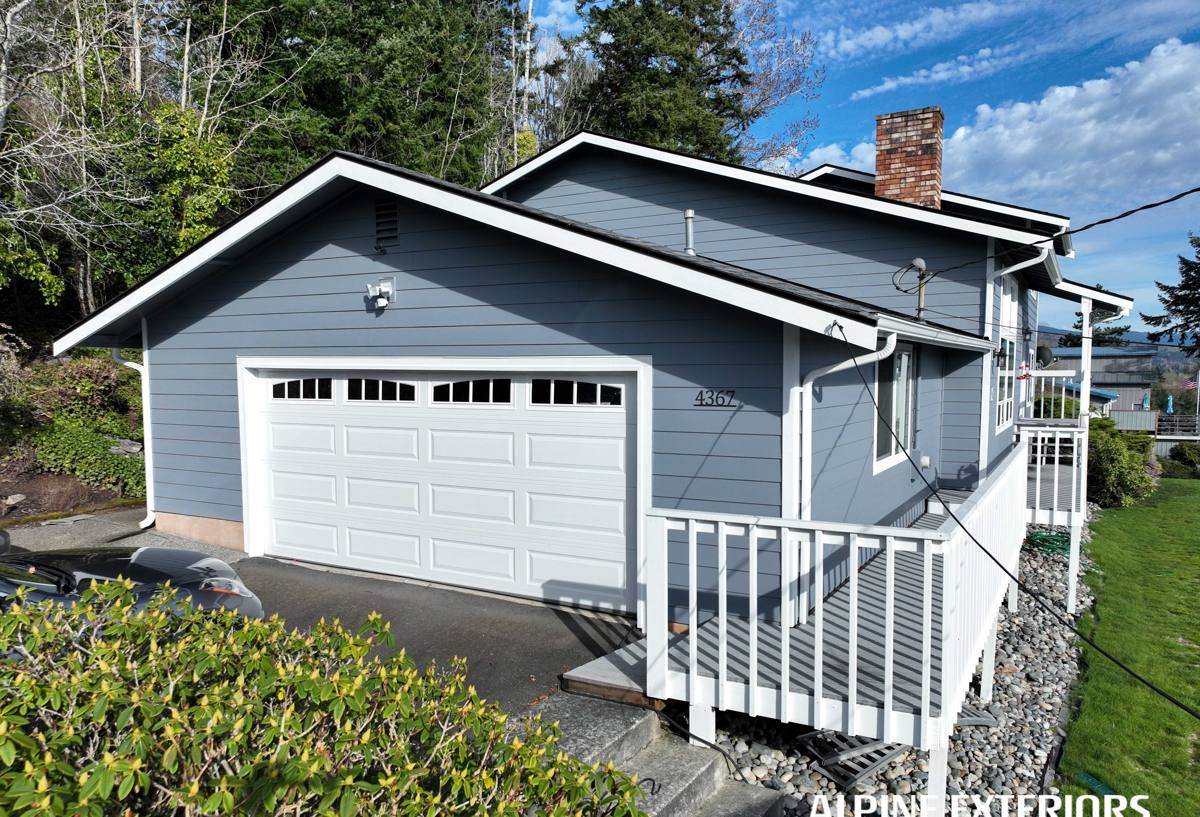
What Salt Air Does to a Deck Over Time
Salt air doesn't announce itself the way a leak does. It works slowly, through corrosion. Standard electro-galvanized screws and joist hangers can start breaking down within a few years this close to the water, especially where the coating gets scuffed during installation or where two dissimilar metals touch and set up galvanic corrosion. The failure isn't cosmetic rust on a screw head you can see — it's the loss of holding strength in a joist hanger or ledger bolt you can't see, which is exactly the hardware holding your deck to your house.
Why Fastener Choice Matters More Here Than Elsewhere
For any deck within a mile or two of the water, we spec stainless steel or heavy-duty coated fasteners rated for coastal exposure, and we're deliberate about matching hardware metal to fastener metal to avoid galvanic reactions. It costs more up front than a standard fastener package. It's also the single easiest thing to get wrong on a Semiahmoo deck, because the deck can look perfectly built for years before hardware failure shows up.
Driving Rain, Ledger Connections, and Where Water Actually Gets In
Most deck rot doesn't start on the open decking boards — it starts at the ledger board, the point where the deck attaches to the house, and at any post base or stair stringer that sits close to grade. Wind-driven rain off the water pushes moisture sideways and upward under railings and against the house wall in a way that straight-down rain never would. If the ledger flashing isn't detailed correctly, or if there's no proper water-resistive barrier and flashing tape behind it, water tracks behind the ledger and into the rim joist and framing of the house itself — a much bigger repair than anything on the deck.
The Ledger Details We Won't Skip
- Self-adhering flashing membrane behind and over the ledger board, integrated with the house's water-resistive barrier — not just caulk
- A gap or flashing that lets any water that does get behind the ledger drain back out instead of pooling
- Structural ledger bolts (not deck screws) with washers rated for exterior use, spaced to code
- Stand-off hardware or a ventilation gap in some cases, so the ledger isn't sitting flush and trapping moisture
None of this is unique to Semiahmoo in principle — it's code-correct deck framing anywhere in Washington. What's different here is the margin for error. A ledger detail that's "close enough" might go ten years without a problem in a dry inland yard. Near Semiahmoo, with near-constant moisture and salt exposure, a shortcut shows up in half that time.
Moss, Algae, and Surface Longevity
Whatcom County's wet season is long, and Semiahmoo's proximity to open water keeps humidity and shade-driven dampness around even longer in shaded corners of a deck — under railings, behind planters, on the north side of a house. Moss and algae need moisture and organic debris to get started, and once established they hold water against the decking surface, which accelerates wood decay and makes composite surfaces slick and dark over time.
Design Choices That Reduce the Moss Problem
You can't eliminate moss risk on a shaded, coastal deck, but you can design around it. Proper board spacing and airflow underneath the deck let surfaces dry out between rain events instead of staying damp for days. Keeping the deck framing height enough off grade for real cross-ventilation matters more here than in a drier climate. And choosing a decking surface with a consistent, gap-free wood-grain texture rather than a deeply embossed pattern gives moss and algae fewer pockets to establish in.
Decking Material Comparison for a Semiahmoo Climate
| Material | Salt Air / Coastal Behavior | Moss & Moisture Resistance | Maintenance |
|---|---|---|---|
| Pressure-treated wood | Fasteners need coastal-rated hardware; wood itself holds up reasonably with proper sealing | Needs regular cleaning and re-sealing to resist moss and staining | Highest — annual cleaning, periodic re-staining/sealing |
| Cedar | Naturally rot-resistant but still needs coastal-grade fasteners | Attractive but requires diligent upkeep to prevent graying and moss in shaded areas | High — regular cleaning and finish maintenance |
| Composite decking | Performs well; no risk of wood rot at the board level | Textured composites resist standing water better; still needs periodic washing in shaded spots | Low — occasional washing, no sealing/staining |
| PVC decking | Fully synthetic, no moisture absorption into the board | Very good; smooth surfaces shed moss and algae most easily | Lowest — soap and water cleaning as needed |
We don't push one material on every job. A cedar deck with the right finish schedule can look great near the water for years; it just asks more of the homeowner in upkeep. Composite and PVC decking cost more up front but take moisture and moss largely out of the maintenance conversation, which is worth weighing honestly against your budget and how much deck upkeep you actually want to do.
Framing and Structural Choices That Matter Here
Underneath whatever decking surface you choose, the framing is doing the real work of keeping the deck safe and long-lasting. For Semiahmoo-area decks we pay particular attention to a few structural points:
- Post bases set on proper footings with metal post base connectors that keep the post end off standing water, rather than posts buried directly in concrete
- Joist tape or a protective barrier on the top of every joist, so fastener penetrations don't become entry points for moisture into the wood
- Beam and joist spans sized correctly for your specific deck height, railing loads, and any hot tub or heavy furniture the deck needs to support
- Stair stringers and rail posts detailed with the same coastal-grade hardware as the ledger, since stairs sit closest to grade and catch the most splash-back moisture
A deck that looks identical from the surface can have very different service life depending on these choices underneath. It's worth asking any contractor bidding your Semiahmoo deck to walk you through exactly what hardware and flashing details they're using and why.
Our Process for a Semiahmoo Deck Build
1. On-Site Assessment
We look at your home's exposure — how close you are to the water, how much wind-driven rain your site gets, how much shade the deck footprint will have — and factor that into material and hardware recommendations before we ever talk price.
2. Design and Material Selection
We walk through decking, railing, and structural options with the coastal factors above laid out plainly, including the maintenance trade-offs, so you're choosing with full information rather than guessing.
3. Permitting and Structural Planning
Deck permits in Ferndale and unincorporated Whatcom County typically require structural plans showing footings, framing, and attachment details. We handle that paperwork and build to what's approved — no shortcuts that could cause problems at final inspection or, worse, down the road.
4. Build and Flashing Details
Ledger flashing, post bases, joist protection, and fastener selection all get handled to the coastal-appropriate standard described above, not a generic inland spec.
5. Final Walkthrough
We go over the finished deck with you, including a realistic maintenance schedule for whatever material you chose, so you know what to expect in year one versus year five.
Why It Matters to Hire a Crew That Already Works This Area
A contractor who mostly builds decks in drier, inland parts of Whatcom County isn't necessarily going to think about galvanic corrosion between hardware or push for coastal-rated flashing tape as a default — because most of their jobs don't need it. That's not a knock on their general skill; it's just that Semiahmoo conditions aren't the conditions they build for every day. A crew that regularly works this stretch of coastline already has the fastener and flashing specs dialed in as standard practice, not an upgrade you have to know to ask for.
Common Questions We Get Before a Semiahmoo Deck Build
Should I upgrade my railing hardware too?
Yes — railing posts and their fasteners are just as exposed to salt air and rain as the deck framing, sometimes more so because they're vertical and catch wind-driven moisture directly. We spec the same coastal-grade hardware for railings as we do for the structural deck.
What about an existing deck that's showing early wear?
If your current deck has surface moss, minor staining, or a few soft boards but the framing underneath is sound, targeted repair and refinishing can extend its life. If the ledger connection or main framing shows rot or rusted hardware, that's a structural conversation, not a cosmetic one, and we'll tell you honestly which situation you're in.
Getting Started
Every Semiahmoo lot has a slightly different exposure to wind and water, and the right deck build reflects that rather than a one-size-fits-all approach. If you're planning a new deck or looking at repairs on an existing one, we're happy to come take a look, walk the site, and give you a straightforward, no-pressure estimate. Use the form below to get in touch.