 Ferndale
 Building Decks for Sandy Point's Marine Exposure
Sandy Point sits closer to open water than most of the rest of Ferndale and inland Whatcom County, and that changes what a deck has to survive. Salt-laden air moves through fasteners and finishes faster here than it does a few miles inland. Wind-driven rain hits decks from angles a standard roof overhang doesn't cover. And the long gray stretch from fall through spring keeps every horizontal surface damp long enough for moss and algae to take hold. A deck built to a generic spec will show its age in Sandy Point years before it should. A deck built for this specific exposure won't.
This page covers what we actually do differently when we build or replace a deck for a Sandy Point property — the materials, the framing details, the finishing choices, and the maintenance rhythm that fits this stretch of Whatcom County.
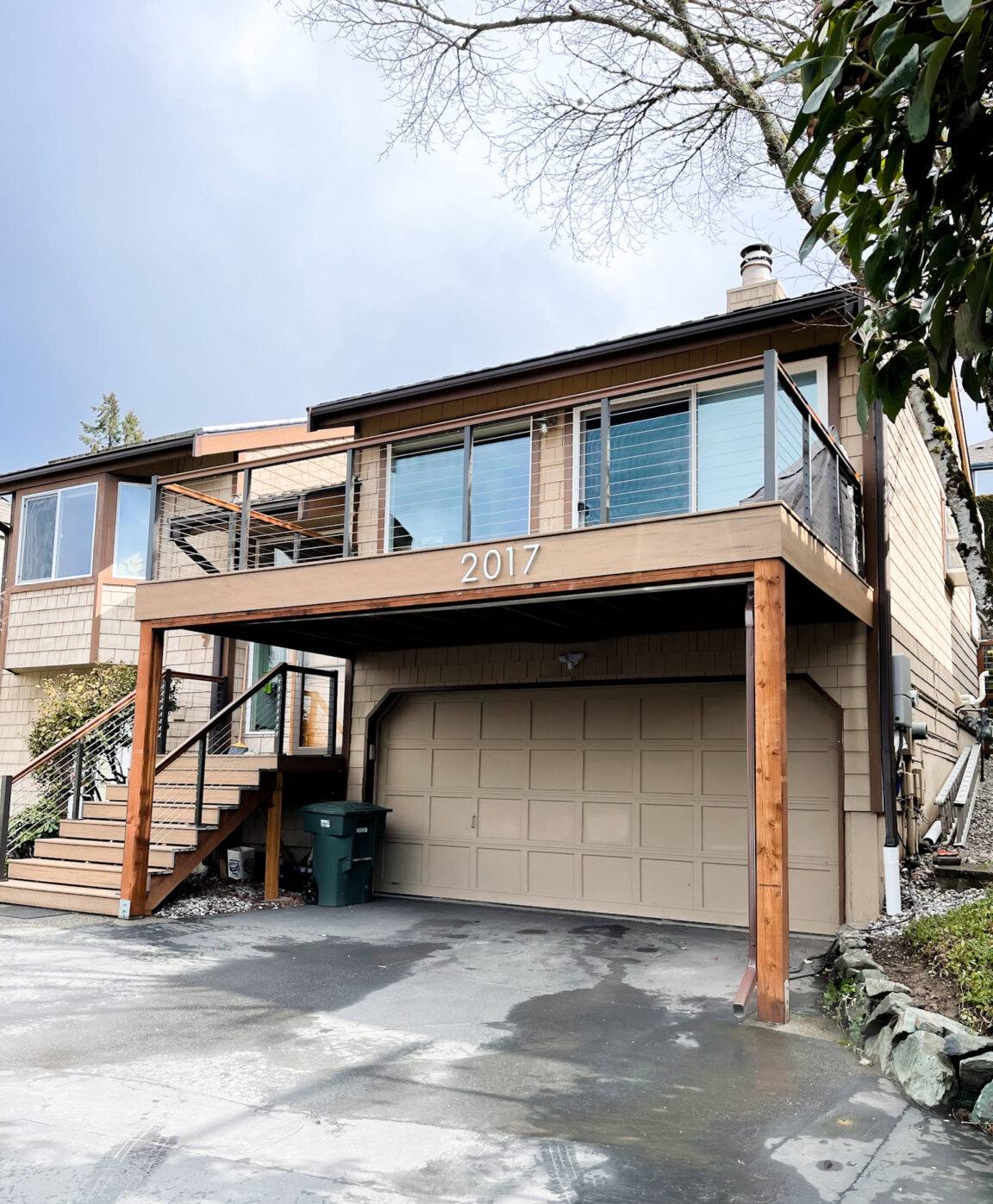
What Salt Air and Driving Rain Actually Do to a Deck
Salt air and metal
Salt air accelerates corrosion on any fastener, bracket, or hanger that isn't rated for it. On an inland deck, a mismatched or under-spec fastener might cause a cosmetic rust streak after a decade. Near Sandy Point's shoreline exposure, the same fastener can start staining lumber and losing holding strength in a fraction of that time. Every hidden connector matters as much as the boards people see.
Driving rain and moisture entry points
Rain that comes in sideways off the water finds its way into places a straight-down rain never would — behind ledger boards, under railing post bases, into end-grain cuts on decking. Once moisture gets past the surface, it dries slowly in our climate, and slow-drying wood is exactly what rot and moss both need.
Moss season and the wear it adds
Whatcom County's damp season runs long. A deck surface that stays shaded or doesn't drain well can carry a moss film for months at a stretch, which holds moisture against the boards and makes the surface slick and slippery underfoot. Moss isn't just cosmetic here — it's a moisture-retention problem and a safety issue on stairs and landings.
Decking Materials: What Holds Up Near Sandy Point
There's no single "right" decking material for every budget, but each option behaves differently in salt air and constant damp. Here's how the common choices compare for this specific exposure:
| Material | Moisture behavior | Maintenance | Notes for this area |
|---|---|---|---|
| Pressure-treated wood | Absorbs and releases moisture; prone to cupping/checking | Annual cleaning, periodic stain/seal | Lowest upfront cost; needs the most upkeep to fight moss and graying near the water |
| Cedar | Naturally rot-resistant, still needs sealing | Refinish every few years | Good look, but salt air and rain still call for regular maintenance to hold its finish |
| Capped composite | Doesn't absorb water into the core; surface sheds moisture | Occasional wash, no staining/sealing | Best fit for a low-maintenance deck that still has to fight moss and salt spray year-round |
| PVC decking | Fully synthetic, no wood fiber to rot | Wash as needed | Highest upfront cost, but the least sensitive to constant dampness of any option here |
We don't push one product line on every job. The right call depends on your budget, how much upkeep you want to do, and how exposed the deck's location is — a deck tucked under an eave has different needs than one fully open to the weather.
Framing and Fasteners: Where a Deck Actually Fails First
Most deck failures we get called out to inspect started underneath the visible surface, not on top of it. In a salt-air, high-rain environment, we treat the substructure as the part that determines whether the deck lasts:
- Stainless steel or heavy hot-dip galvanized fasteners rated for coastal exposure — not the standard coated screws sold for general construction
- Ledger board flashing that actually sheds water away from the house band board, sealed at every penetration
- Joist tape over framing lumber so fastener holes don't become the first point of rot
- Post bases set above grade and away from standing water, with proper footings sized for our soil and frost conditions
- Gapping between boards sized to let the deck actually dry between rain events, not just look tight on installation day
None of this is visible once the deck is finished, which is exactly why it's the part worth asking a contractor about directly before work starts.
Drainage and Airflow: The Difference Between a Deck That Sheds Moss and One That Doesn't
Moss needs standing moisture and low airflow to establish itself. A deck built with the right board spacing, a slight pitch away from the house, and clearance underneath for air to move will simply stay drier through the wet months — which means less moss, less slip risk, and a lot less scrubbing for whoever owns the house. Decks that sit low to the ground or against solid skirting without vents tend to trap moisture underneath, and that dampness works its way back up into the framing over time. When we design a deck for this kind of exposure, drainage and airflow get planned in from the start rather than patched in after the fact.
Our Process for a Sandy Point Deck Project
1. On-site assessment
We look at sun exposure, prevailing wind and rain direction, existing drainage, and how close the site is to open water, since that changes how aggressively we spec fasteners and finishes.
2. Material and layout conversation
We walk through the material comparison above in terms of your actual budget and how much maintenance you want to take on, and we design the layout and railing to fit the house and the lot, not a generic template.
3. Permitting
Deck work typically requires a permit through the applicable local jurisdiction, and we handle that process as part of the job rather than leaving it for the homeowner to sort out.
4. Build
Framing, flashing, and fastener choices follow the coastal-exposure standards above regardless of which decking material you choose. This is the step where corners get cut on cheaper jobs, and it's the step that determines whether the deck is still solid in fifteen years.
5. Walkthrough
Before we consider the job finished, we walk the deck with you — railing height and spacing, stair details, drainage, and finish — so nothing gets discovered after the fact.
What a Sandy Point Deck Costs to Build
Deck pricing depends on size, material, height off the ground, railing style, and site access — a straightforward ground-level deck costs meaningfully less than an elevated deck with stairs and custom railing. Rather than quote a number that doesn't mean much without seeing the site, here are the factors that move the price most:
| Cost factor | Why it matters here |
|---|---|
| Decking material | Composite and PVC cost more upfront than wood but cut long-term maintenance costs in this climate |
| Height and stairs | Elevated decks need more structural framing and code-compliant railing and stair details |
| Site access | Some Sandy Point lots have tighter access for material delivery, which affects labor time |
| Fastener and flashing spec | Coastal-grade hardware costs more than standard hardware but is not optional here |
| Railing style | Cable, glass, and custom wood railings all price differently and hold up differently to salt air |
We give a written, itemized estimate before any work starts, so you know exactly what you're paying for and why.
Keeping a Sandy Point Deck in Good Shape Year to Year
Even a well-built deck needs a maintenance rhythm suited to this climate. A simple annual checklist goes a long way:
- Sweep debris out of board gaps before it composts into a moss-friendly layer
- Rinse or scrub visible moss and algae before it spreads, especially on stairs and shaded corners
- Check railing posts and stair connections for movement once a year
- Inspect fasteners and hardware for early corrosion, particularly near the water-facing side
- Reseal or restain wood decking on the schedule the product actually calls for, not just when it looks bad
- Confirm drainage paths under and around the deck haven't been blocked by planting beds or debris
Composite and PVC decks cut most of this list down to occasional cleaning, which is part of why we discuss maintenance appetite up front rather than after the fact.
Why a Crew That Already Works Sandy Point Matters
A deck contractor who mostly works inland projects is used to a different set of failure points than the ones that show up near the water. Working in Sandy Point regularly means we already know which fastener grade actually holds up, how far the salt exposure reaches inland from the shoreline, and how the local permitting process runs for this part of Ferndale and Whatcom County. Many Sandy Point properties are part of a community association with its own guidelines on exterior projects, and it's worth confirming any requirements with your association before work begins — we're glad to work alongside whatever process applies to your property. Local familiarity doesn't replace good building practice, but it means fewer surprises during the build and a deck that's specified correctly the first time.
If you're planning a new deck or replacing one that hasn't held up to the weather out here, we're happy to come take a look and put together a free, no-pressure estimate — just fill out the form below.