 Ferndale
 Decking Built for Sandy Point's Waterfront Conditions
Sandy Point sits right up against the Strait of Georgia, and that location shapes everything about how a deck ages there. Homes here take on salt-laden air almost daily, driving rain off the water for much of the fall and winter, and a moss season that runs longer than it does even a few miles inland in Ferndale. A deck built without those conditions in mind will show it within a few years — soft spots, corroded fasteners, slick green film on the boards by January. Composite decking, installed correctly for this specific environment, holds up to all three far better than wood, but "composite" isn't a single product with one set of rules. What matters is picking the right board, the right substructure, and the right hardware for a waterfront lot in Whatcom County.
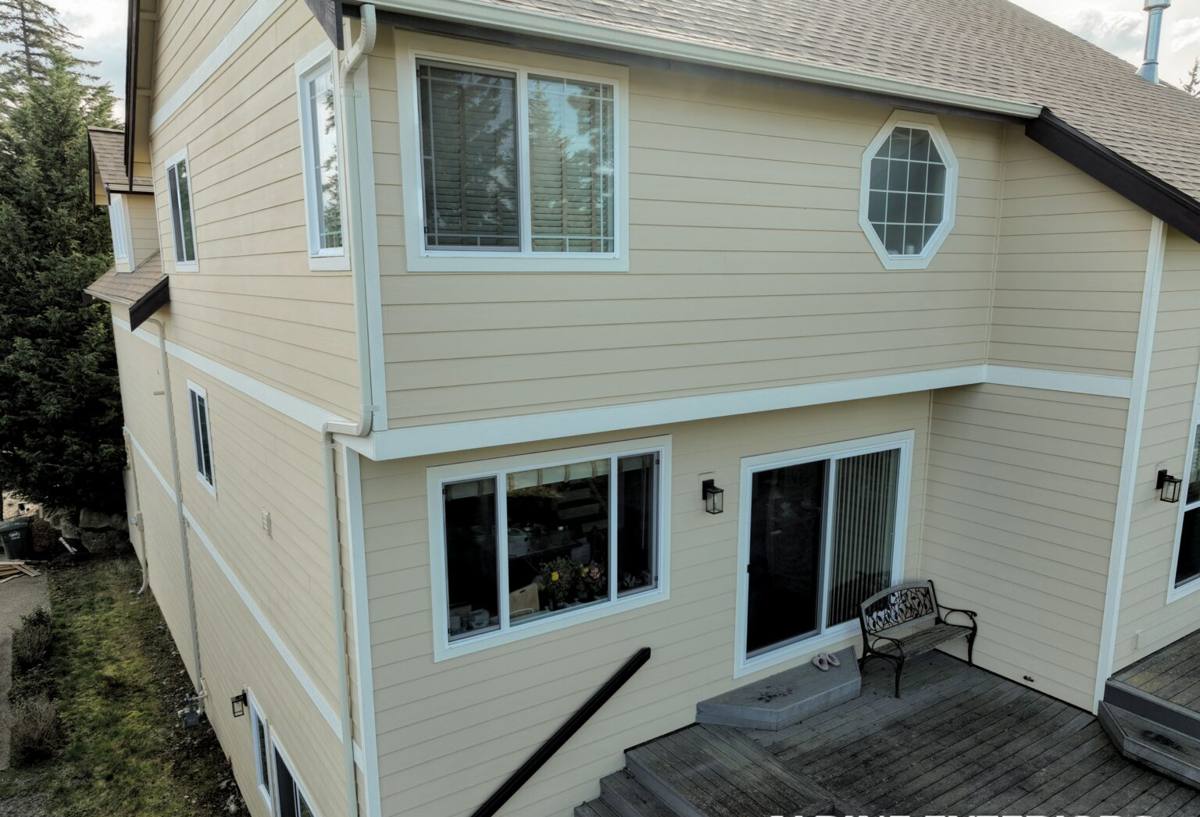
Why Composite Makes Sense on the Water
Salt Air and Corrosion
Salt air doesn't just affect metal roofing and gutters — it works on every exposed fastener, bracket, and connector on a deck too. Standard deck screws and joist hardware corrode faster this close to the water, and once a fastener starts rusting, it can stain the decking around it and eventually lose its grip. Composite boards themselves don't corrode or rust, but a composite deck is only as good as the metal holding it together, which is why fastener choice matters more here than it would on a deck built a few miles inland.
Moss, Algae, and Standing Moisture
Whatcom County's damp, mild winters are moss-friendly almost everywhere, but a waterfront lot with more shade, more humidity, and less direct wind exposure than an open field can hold onto moisture even longer. Wood decking absorbs that moisture, swells, and gives moss and algae something to root into. Composite boards don't absorb water the way wood does, so moss and algae sit on the surface instead of taking hold in the material — which makes them far easier to rinse or brush off before they build up into a slippery, staining layer.
What a Correct Composite Deck Installation Involves
Substructure and Framing
The composite boards get the attention, but the framing underneath is what determines whether the deck lasts. In a marine climate, we look at joist spacing more carefully than a manufacturer's minimum spec — tighter spacing reduces flex and deflection, which matters more when boards are getting wet and drying out repeatedly through a long rainy season. Pressure-treated framing lumber is standard, but in a salt-air environment we also pay attention to how that lumber is protected where it meets fasteners and hardware, since that's where corrosion problems start.
Fasteners and Hardware
This is the detail that separates a deck that holds up on the water from one that doesn't. We use fastener and hardware grades rated for coastal and high-corrosion environments — not just the standard galvanized hardware that's fine for an inland deck. It costs more up front and saves a homeowner from hidden problems five or ten years down the line, when a corroded ledger connection or joist hanger is a much bigger repair than it would have been to spec correctly the first time.
Ventilation and Drainage
Composite decks need airflow underneath just as much as wood decks do — arguably more, since trapped moisture under low-clearance decks in a wet climate is where rot in the framing and mold on the underside of boards tend to start, even though the boards themselves resist it. We build in proper ventilation gaps, slope the substructure slightly for drainage, and make sure water has somewhere to go instead of pooling against the house or under low-lying sections near grade.
Composite vs. Other Decking Materials for a Sandy Point Property
| Material | Salt Air Behavior | Moss/Algae Resistance | Maintenance Needed |
|---|---|---|---|
| Composite (capped) | No corrosion of the board itself; hardware is the variable | Sits on surface, rinses off easily | Periodic cleaning, no sealing or staining |
| Pressure-treated wood | Fasteners and lumber both corrode/degrade faster near water | Absorbs moisture, moss roots into grain | Annual sealing/staining, regular scrubbing |
| Cedar | Naturally rot-resistant but softens with constant salt moisture | Better than treated pine, still needs upkeep | Regular oiling, sanding, replacement of worn boards |
| Uncapped composite | More prone to surface wear and staining in wet, salty air | Can hold moisture in the outer layer over time | Occasional cleaning, less durable long-term |
We install fully capped composite boards on Sandy Point projects specifically because the cap layer is what keeps salt air and moisture from working into the board itself over the years. Uncapped or lower-grade composite can still absorb some moisture at the surface, which shows up as staining and texture changes sooner than a homeowner expects.
Our Process for a Sandy Point Deck Project
Site Visit and Assessment
We walk the property, look at sun and wind exposure, drainage around the existing structure, and how close the deck sits to the water. That tells us how aggressive to get with fastener grade, ventilation, and board color — darker boards can run hotter and show water spotting differently than lighter ones, which matters on an exposed waterfront lot.
Installation
Framing goes in first, inspected before boards go down. We install hidden fasteners where the product allows for a clean surface with fewer exposed screw heads for salt air to work on, and we keep joist spacing and blocking tight around stairs, railings, and any cut ends, since cut edges on composite need to be handled correctly to avoid moisture wicking in over time.
Finish and Walkthrough
Before we call it done, we walk the deck with the homeowner, point out drainage paths, show where ventilation gaps are, and go over what basic maintenance looks like for the specific board we installed. Different composite lines have slightly different cleaning recommendations, and we want homeowners to know theirs.
Maintenance in a Salt-Air, Moss-Prone Climate
Composite decking is low-maintenance compared to wood, but "low-maintenance" isn't "no-maintenance," especially this close to the water. A simple seasonal routine keeps a Sandy Point deck looking right through the wet months:
- Rinse the deck surface every few weeks during the wet season to keep salt residue and organic buildup from settling in
- Sweep or brush off fallen leaves and debris promptly — trapped debris holds moisture against the board and gives moss somewhere to start
- Clean with a soft-bristle brush and a mild deck cleaner a couple of times a year rather than pressure-washing at close range, which can damage the cap layer
- Check railing posts, stair connections, and any exposed hardware once or twice a year for early signs of corrosion or loosening
- Keep gutters and downspouts near the deck clear so runoff isn't dumping extra water onto the deck surface or framing below
- Trim back vegetation that shades sections of the deck year-round, since those spots stay damp longest and are where moss shows up first
Cost Factors for a Composite Deck in Sandy Point
Every project is different, but a few factors consistently move the price on waterfront decks in this area: the grade of composite board (capped lines cost more than uncapped but hold up longer in salt air), the amount of substructure work needed if existing framing has to be replaced, the corrosion-resistant hardware upgrade, and any custom elements like built-in seating, multi-level layouts, or railing systems. As a rough range, composite decking projects in this region typically run from the mid-thousands for a straightforward, smaller deck up to well into five figures for larger, multi-level, or heavily customized builds. We give exact numbers after seeing the site, not before.
Why a Crew That Already Works Sandy Point Matters
A lot of deck problems on the water trace back to a crew that built to a generic spec instead of the actual conditions on that lot. Knowing how far the salt air reaches inland, how much shade a given orientation holds onto through winter, and how drainage behaves on a diked waterfront lot isn't something you get from a manual — it's something you learn by building decks in Whatcom County's coastal communities specifically. That's the difference between a deck that needs attention again in five years and one that's still doing its job in twenty.
If you're planning a new deck or replacing one that hasn't held up to Sandy Point's climate, we're happy to take a look and give you a straightforward, no-pressure estimate. Fill out the form below and we'll get in touch.