 Ferndale
 Marietta's Siding Has a Harder Job Than Most
Marietta sits close enough to the water that salt-laden air is part of daily life, not an occasional event. Combine that with the steady, driving rain that moves through Whatcom County most of the year and the long moss season that follows it, and you have three separate forces working against a home's exterior at the same time. Siding here doesn't just need to look good — it needs a finish that resists salt corrosion, a material that won't swell or rot when it stays damp for weeks at a stretch, and a surface that doesn't feed moss and mildew the way bare wood or cheap composite can.
We install James Hardie fiber cement siding exclusively, and Marietta is exactly the kind of environment that explains why. This page walks through what the local climate actually does to a home's exterior, what a correct Hardie installation involves, and how our process is built around the conditions this neighborhood sees every year.
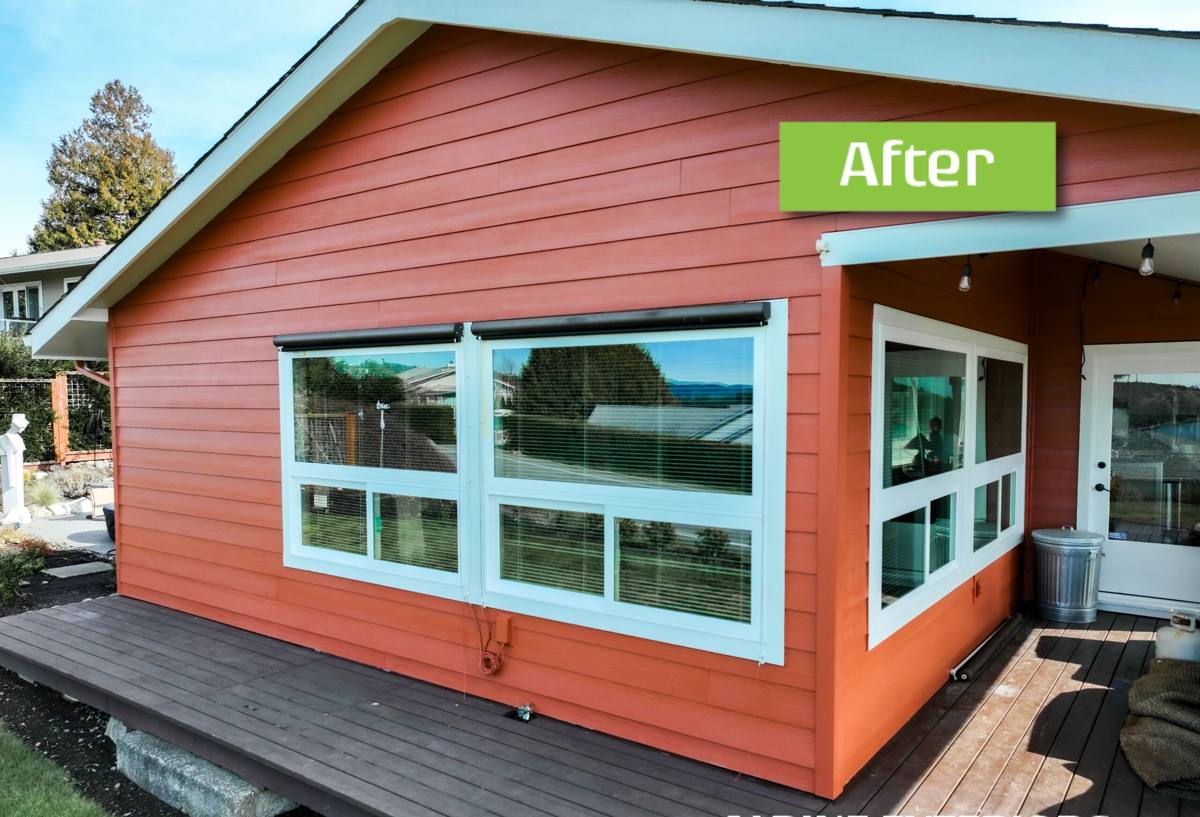
What Ferndale and Marietta's Climate Does to Siding
Salt Air
Airborne salt is corrosive to metal fasteners, flashing, and trim, and it's abrasive to painted surfaces over time. Vinyl siding can chalk and discolor faster near the water, and site-applied paint on wood or composite siding breaks down sooner when salt air is added to the mix. Fiber cement doesn't corrode, and James Hardie's factory-baked ColorPlus finish is formulated to hold up against UV and airborne salt far longer than a field-applied coat.
Driving Rain
Whatcom County gets rain that comes in sideways as often as it comes straight down, which means siding here has to perform as a rain-screen, not just a rain-shedder. Every seam, lap, and penetration is a place water can find its way behind the cladding if the installation isn't done correctly. This is less about the siding material itself and more about how it's flashed, lapped, and fastened — which is where a lot of otherwise-good siding jobs fail.
Moss Season
Cool, wet, and shaded conditions for months at a time make Whatcom County prime moss territory. Moss and algae don't just sit on the surface — on porous or poorly sealed materials, they hold moisture against the substrate and accelerate rot and paint failure. A dense, properly primed fiber cement surface gives moss less to grab onto and holds up far better to periodic cleaning than wood or engineered wood siding.
Why James Hardie Specifically
We don't install LP SmartSide, vinyl, Cemplank, Allura, primed spruce, or cedar. That's a deliberate standard, not a lack of options. Each of those products has real strengths, but in a climate like this one, the trade-offs — moisture sensitivity at cut edges, shorter finish life, more frequent recoating, or a warranty structure that doesn't hold up as well over decades — are trade-offs we're not willing to put on a customer's home. James Hardie's fiber cement is non-combustible, dimensionally stable when wet, and backed by a factory finish system engineered specifically for the kind of coastal-influenced, high-moisture climate the Pacific Northwest delivers.
HZ5 Engineering for This Region
James Hardie makes climate-specific product lines, and homes in this region call for the HZ5 formulation, engineered for wetter, harsher climates rather than the drier HZ10 line used in the desert Southwest. HZ5 products are formulated with moisture and freeze-thaw cycling in mind, which matters in a place where siding rarely gets more than a few dry days in a row for much of the year.
ColorPlus Finish
Instead of site-applied paint, ColorPlus is baked on at the factory in multiple coats, which gives a harder, more UV- and salt-resistant finish than anything sprayed or brushed on-site. It also means color consistency across the whole job and touch-up product that matches exactly, rather than a homeowner guessing at a paint mix years later.
Comparing Siding Options for a Salt-Air, High-Rain Climate
| Factor | James Hardie Fiber Cement | Vinyl | Wood / Engineered Wood |
|---|---|---|---|
| Salt air resistance | Strong — factory finish resists corrosion and chalking | Fair — can discolor and become brittle near water | Weak — accelerates finish failure and rot |
| Moisture behavior | Dimensionally stable, engineered edges seal against water | Doesn't rot, but seams can trap moisture behind panels | Absorbs moisture; swells, cups, or rots without diligent upkeep |
| Moss/algae resistance | Dense surface resists buildup, cleans easily | Resists growth but scratches and stains over time | Porous surface holds moisture, feeds growth |
| Finish longevity | Factory finish rated for decades | Color molded in, fades with UV over time | Needs recoating on a regular cycle |
| Fire performance | Non-combustible | Combustible | Combustible |
What a Correct Hardie Installation Actually Involves
The material is only half the equation. In a climate that throws driving rain and salt air at a home for most of the year, workmanship determines whether that siding performs for thirty-plus years or starts failing at year eight. A correct installation includes:
- A weather-resistant barrier (housewrap or building paper) installed and lapped correctly beneath the siding, functioning as the home's real waterproofing layer
- Proper flashing at every window, door, and roof-to-wall intersection — the points where driving rain finds its way in first
- Correct nail or screw fastener spacing and depth, per James Hardie's published fastening schedule, not "close enough"
- Factory-primed field-cut ends sealed with approved sealant before installation, since a raw cut edge is the one place fiber cement can take on moisture
- Minimum ground clearance and proper clearance from decks, patios, and roof lines to keep siding away from standing water and splash-back
- Correct panel and lap gaps to allow for expansion without buckling
- ColorPlus-matched caulk and touch-up product at seams and joints, applied per manufacturer specification
- Rain-screen or drainage detailing appropriate to the wall assembly, so any incidental moisture has a path to drain and dry out
Skipping any one of these doesn't show up on day one — it shows up three, five, or ten winters later as staining, soft trim, or moisture behind the wall. That lag is exactly why installation quality matters more here than in a drier climate, where mistakes get more time to reveal themselves before real damage sets in.
How We Approach a Marietta Project
| Stage | What Happens | Why It Matters Here |
|---|---|---|
| Site assessment | Inspect existing siding, trim, flashing, and any moisture or moss damage | Identifies problem areas driving rain and moss have already found |
| Product selection | Confirm HZ5 panel style, profile, and ColorPlus color | Matches the product to this region's moisture and salt exposure |
| Prep and moisture barrier | Remove old siding, repair sheathing, install correctly lapped weather barrier | This layer does the real waterproofing work behind the cladding |
| Flashing and detailing | Install or replace flashing at all windows, doors, and roof lines | Closes the gaps driving rain exploits first |
| Installation | Fasten and seal panels to manufacturer spec, including cut-edge sealing | Protects against the one vulnerability in fiber cement — an unsealed cut edge |
| Final inspection | Walk the job checking gaps, caulking, and trim details | Catches anything that would fail early in this climate |
What Drives Cost on a Marietta Siding Job
| Cost Factor | Why It Varies |
|---|---|
| Existing wall condition | Rot or moisture damage found under old siding requires sheathing repair before new siding goes on |
| Home size and complexity | More corners, gables, and window/door openings mean more flashing and trim work |
| Panel style and profile | Lap siding, shingle-style panels, and board-and-batten all price differently in labor and material |
| Trim and accessory package | Full trim replacement, corner boards, and frieze boards add material and labor |
| Access and site conditions | Steep grades, tight lot lines, or limited staging area affect labor time |
We give a specific number after we've actually looked at the house — anyone quoting a firm price sight unseen in a climate this variable is guessing.
Why It Matters That We Already Work in Marietta
A crew that already works this stretch of Whatcom County has already seen how driving rain moves through a given lot orientation, which walls take the worst of the salt air, and where moss tends to establish first on a roofline or north-facing wall. That's not something you can fully substitute with a general contracting background — it comes from doing the work here, repeatedly, and paying attention to which details actually mattered five or ten years later. It also means faster response for warranty questions, follow-up caulking touch-ups, or a second opinion on a wall that's showing early signs of moisture trouble, because we're not driving in from out of the area to look at it.
Maintaining Hardie Siding in This Climate
Hardie siding is low-maintenance, not zero-maintenance, and the maintenance that does matter is shaped by the local climate:
- Rinse siding periodically to clear salt residue and organic buildup before moss gets a foothold
- Keep gutters clear so overflow doesn't run down the siding face and accelerate staining
- Trim back vegetation and tree cover that keeps a wall shaded and damp longer than it needs to be
- Recaulk seams if you notice cracking or gaps, especially around windows and trim
- Address any soft trim or staining early — in this climate, small moisture issues don't stay small for long
If your home in Marietta is due for new siding, or you want a second opinion on a job someone else installed, we're happy to come take a look. The estimate is free, there's no pressure, and you'll get a straight answer about what your home actually needs.