 Ferndale
 Lynden's Climate Is Harder on Siding Than Most Homeowners Realize
Lynden sits in the middle of Whatcom County's agricultural belt, but don't let the distance from open water fool you — this area still gets the full Pacific Northwest treatment. Moisture off the Strait of Georgia and Puget Sound drifts inland on prevailing winds, driving rain comes in sideways for weeks at a stretch in the fall and winter, and the combination of shade, humidity, and mild temperatures gives moss and algae a long growing season on anything that holds moisture against a wall. Add in the Nooksack River valley's fog and dew cycles, and you've got siding conditions that punish anything not built specifically for wet-side-of-the-Cascades weather.
Homes here don't fail because siding gets rained on — every siding product gets rained on. They fail because the product or the installation traps that moisture instead of shedding it. That's the standard we install to on every Lynden job: siding and flashing details that assume water will hit the wall, and are built to move it back out.
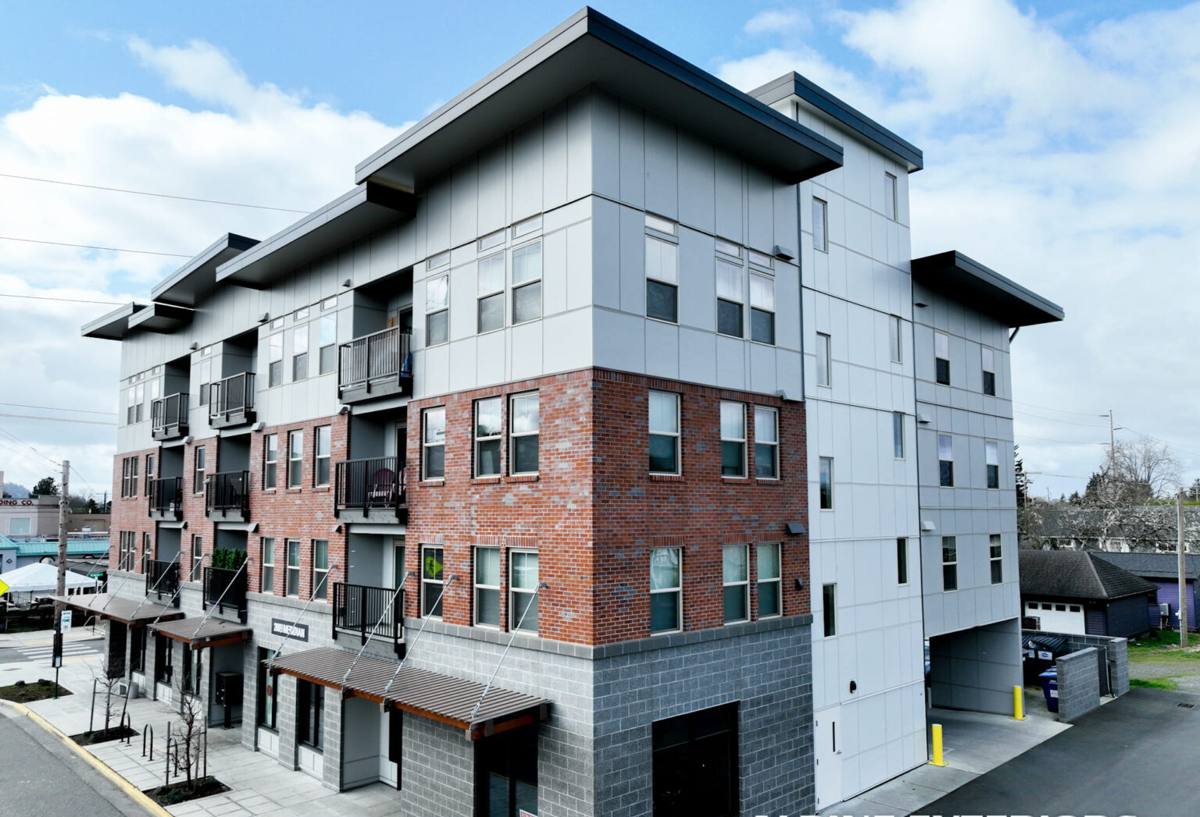
What Off-the-Shelf Siding Choices Get Wrong Here
A lot of siding products perform fine in drier climates and struggle in ours. Engineered wood products can swell and delaminate at cut edges and seams if moisture gets behind them repeatedly. Vinyl doesn't rot, but it flexes and gaps with our temperature swings, giving wind-driven rain a path behind the panel. Cedar and primed spruce look great on day one but need a maintenance schedule — recoating, caulking, moss treatment — that most homeowners don't keep up with once the novelty wears off, and once that maintenance lapses in a climate like ours, deterioration moves fast.
We standardized on James Hardie fiber cement for a simple reason: it's a non-combustible, cement-based product that doesn't feed moss the way wood-based siding can, doesn't swell and rot at cut edges, and holds its factory finish for decades without the repainting cycle other materials demand. That doesn't mean Hardie needs zero care — it still needs correct flashing, proper caulking, and an occasional wash to keep moss from gaining a foothold — but the underlying material isn't working against you the way some alternatives are.
James Hardie's HZ5 Line — Built for This Exact Climate
James Hardie engineers its siding by climate zone, and Whatcom County falls into the HZ5 zone — the wetter, cooler end of their spectrum. HZ5 boards are formulated for regions with sustained rain, freeze-thaw cycles, and higher humidity, with a moisture-resistant composition and engineered profiles designed to shed water rather than absorb it. This isn't a marketing distinction — it's a different mix and finishing process than what Hardie ships to hot, dry climates, and it's the version we order for every Lynden home.
For Lynden specifically, we most often recommend:
- HardiePlank lap siding — the standard horizontal profile, available in several exposure widths and textures (smooth or cedar-grain), for the majority of the home's field
- HardiePanel vertical siding — for board-and-batten accents, gable ends, or a modern look on newer builds
- HardieTrim — for corners, fascia, and window/door surrounds, matched to resist the same moisture exposure as the field siding
- HardieSoffit — pre-vented panels where roof overhangs need airflow without gaps that let pests or moisture in
What a Correct Installation Actually Involves
The siding product is only part of the equation. In our experience, most siding failures we're called to look at — regardless of brand — trace back to installation shortcuts, not the material itself. A correct Hardie install on a Lynden home includes:
Water management behind the siding
A drainable house wrap or rainscreen gap, correctly lapped and taped at every seam, so any moisture that gets past the siding has a path down and out instead of sitting against the sheathing. This matters more here than in drier climates because the wall assembly will see moisture load every winter, not occasionally.
Flashing at every penetration
Windows, doors, hose bibs, light fixtures, deck ledgers — every place something interrupts the siding plane is a place water wants to get behind it. Step flashing, kick-out flashing at roof-to-wall intersections, and properly lapped window flashing aren't optional extras; they're the difference between siding that lasts and siding that hides a slow leak for years.
Fastening and gapping to Hardie's spec
James Hardie publishes specific nailing patterns, fastener types, and minimum gaps at butt joints, corners, and trim. Over-driven nails, wrong fastener length, or boards installed tight with no expansion gap are common corner-cutting mistakes that lead to cracking, popped fasteners, and moisture intrusion — and they can void the manufacturer's warranty even though the board itself was never the problem.
Caulking and paint-grade sealant at the right joints — and not everywhere
Hardie's ColorPlus system is designed to let certain joints breathe and move; over-caulking can trap moisture instead of shedding it. Knowing which joints get sealed and which don't is a detail that separates a crew that installs Hardie regularly from one that's treating it like any other siding product.
Installation Mistakes We Frequently Find on Repaint or Repair Calls
- No rainscreen or drainage gap behind the siding, especially on older or budget-driven installs
- Missing or improperly lapped kick-out flashing where a roofline meets a wall
- Boards butted tight with no expansion gap, leading to cracking at seams
- Face-nailing where blind-nailing was specified, leaving exposed fastener heads that rust and stain
- Siding installed too close to grade or a roof surface, holding moisture and inviting moss
ColorPlus Factory Finish vs. Field Painting
| Factor | ColorPlus Factory Finish | Field-Applied Paint |
|---|---|---|
| Application environment | Controlled factory process, multiple baked-on coats | Applied on-site, subject to weather, temperature, and dry time |
| Typical repaint interval | Often 15 years or more before touch-up is needed | Commonly 5-10 years depending on exposure |
| Color consistency | Uniform across every board in the batch | Can vary with application conditions and coat thickness |
| Warranty coverage | Backed by Hardie's finish warranty when installed to spec | Typically covered by the paint manufacturer only, not Hardie |
| Best use case | Most homes wanting long-term, low-maintenance color | Custom or non-stock colors, trim accents |
For most Lynden homeowners, ColorPlus is the more practical choice specifically because of our repaint window — fewer years spent scheduling exterior painting around our rainy season means fewer chances for a rushed or poorly timed paint job to fail early.
How We Approach a Lynden Job
- On-site assessment — we look at existing siding, sheathing condition, roofline intersections, and any moisture staining or soft spots before quoting anything
- Tear-off and sheathing check — old siding comes off and we inspect what's underneath; any water-damaged sheathing gets addressed before new siding goes on, not covered up
- Drainage plane installation — house wrap or rainscreen system installed and taped per manufacturer spec
- Flashing detail work — windows, doors, roof intersections, and penetrations flashed before siding starts
- HZ5 Hardie installation — lap siding, panels, and trim installed to Hardie's fastening and gapping specifications
- Final detailing — caulking at specified joints only, touch-up as needed, site cleanup
What Drives Cost on a Lynden Siding Job
| Factor | Why It Matters |
|---|---|
| Home size and wall complexity | More corners, gables, and dormers mean more cutting, trim, and flashing detail |
| Existing siding removal | Tear-off of old vinyl, wood, or damaged siding adds labor before new siding starts |
| Sheathing repair | Water-damaged sheathing found during tear-off needs to be replaced, not skipped |
| Product line and profile | Lap siding, panel siding, and trim packages price differently based on width, texture, and coverage |
| Finish choice | ColorPlus factory finish vs. a custom field-painted color can affect material cost and timeline |
| Site access | Tight lot lines, second-story work, or landscaping obstacles affect labor time |
We give exact numbers only after seeing the home in person — anyone quoting a firm price over the phone for a full siding job hasn't actually looked at your walls yet.
Why It Matters That We Already Work in Lynden
A crew that regularly works Whatcom County homes already knows how local roof pitches, soffit designs, and foundation heights tend to interact with siding details — and knows which flashing and gapping mistakes show up most often on repair calls in this specific climate. That familiarity shows up in fewer surprises during tear-off, fewer callbacks for caulking or trim issues, and a finished job that's built for the rain and moss season we actually get here, not a generic install pulled from a manual written for a different climate.
Questions Worth Asking Any Siding Contractor Before You Hire
- Are you a certified James Hardie installer, and can you show that certification?
- What drainage plane or rainscreen system do you install behind the siding?
- How do you flash roof-to-wall intersections and window openings?
- What happens if you find water damage under the old siding — is that priced separately or handled as part of the job?
- Do you install a full range of Hardie products (lap, panel, trim, soffit), or just one profile?
If your Lynden home's siding is showing moss buildup, soft spots, peeling paint, or you're just planning ahead for a replacement, we're happy to take a look and walk you through what your home actually needs. Reach out for a free, no-pressure estimate using the form below.