 Ferndale
 What Cordata's Weather Actually Does to Siding
Cordata sits inland from the water compared to some Whatcom County neighborhoods, but the marine air off the Salish Sea still reaches it, and the weather pattern is the same one that shapes the rest of Ferndale and the surrounding county: long stretches of low-intensity rain, wind-driven storms off the Strait, and short, mild summers that never fully dry the ground out before the next system rolls in. That combination is hard on siding in three specific ways, and any product or install method that ignores them will show it within a few years, not a few decades.
Driving Rain, Not Just Rain
Whatcom County gets more wind-driven rain than a straight rainfall total suggests. Water doesn't just fall on siding here, it gets pushed sideways into laps, seams, and butt joints. A siding system that isn't detailed to shed that water — proper lap overlap, correct fastener placement, a real drainage plane behind the cladding — will eventually let moisture behind the panels, even if the surface looks fine.
A Long Moss and Algae Season
Mild temperatures and near-constant dampness mean moss, mildew, and algae have most of the year to establish themselves on north-facing walls, shaded siding, and anything under tree cover. Organic growth isn't just cosmetic — it holds moisture against the surface longer than open air would, and on the wrong substrate that accelerates rot, delamination, or paint failure.
Salt Air and Fastener Corrosion
Homes throughout this part of Whatcom County, including inland pockets like Cordata, still see some marine air influence carried in off the bay and the Strait. Over years, that air is harder on unprotected metal — nail heads, trim flashing, and fasteners — than it is on siding further from the coast. It's a slow effect, but it's a real one, and it's part of why fastener choice and flashing detail matter more here than they would in a dry inland climate.
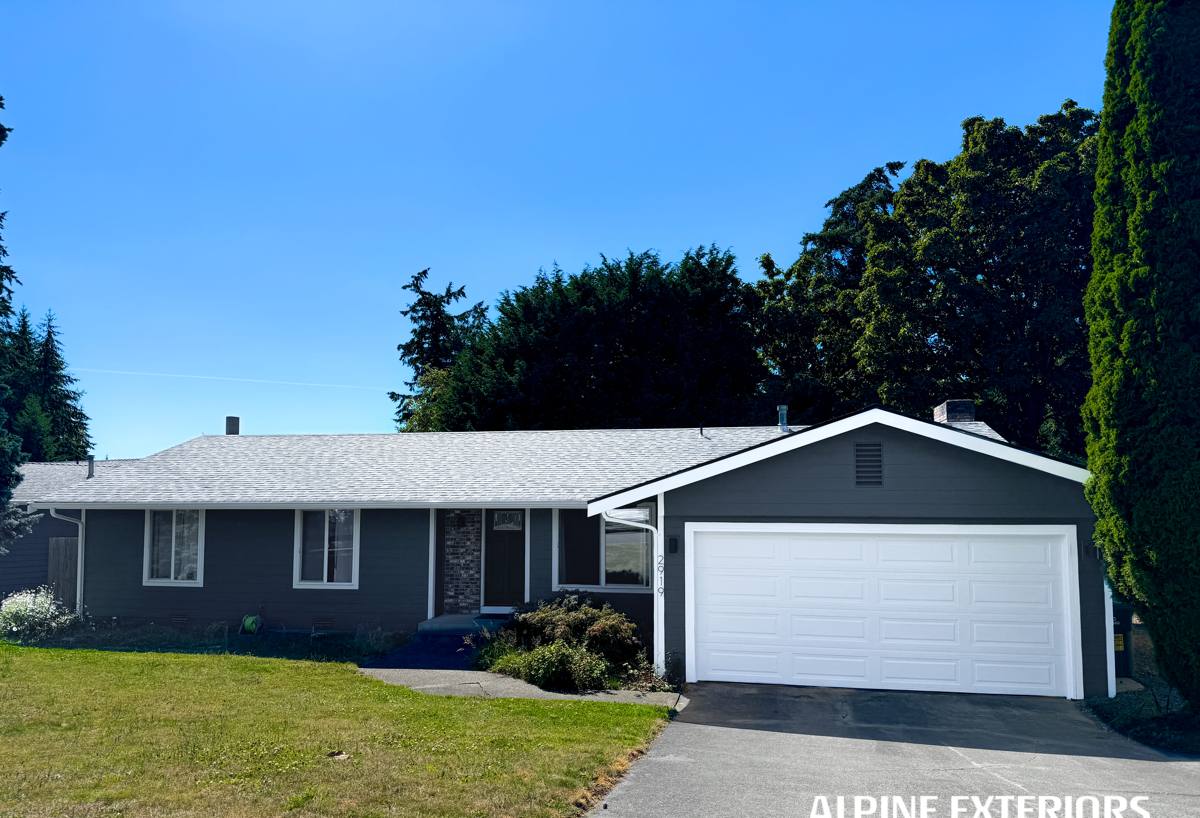
Why We Install Only James Hardie Fiber Cement
We don't install LP SmartSide, vinyl, Cemplank, Allura, or bare wood siding. That's not a marketing position, it's a decision we made after weighing how each product actually performs against the climate described above. James Hardie's fiber cement is engineered around moisture and fire resistance in a way that lines up with what Cordata homes need, and we'd rather stand behind one system we know well than split our crew's expertise across several.
A Non-Combustible Core
Hardie's fiber cement is made from cement, sand, and cellulose fiber — it doesn't burn, warp from heat, or feed a fire the way wood-based or foam-backed products can. That's a fire-safety advantage regardless of climate, and it comes with no moisture trade-off, which matters in a place where things stay damp most of the year.
ColorPlus Finish vs. Field-Applied Paint
Hardie's ColorPlus finish is baked on at the factory under controlled conditions, not brushed or sprayed on-site in whatever weather shows up that week. In a region where a dry, low-humidity painting window can be hard to find, a factory finish removes one of the biggest variables that causes early paint failure on field-finished siding.
Climate-Engineered Product Lines
Hardie makes region-specific formulations (its HZ product lines) engineered for different moisture and freeze-thaw conditions. We spec the version built for the Pacific Northwest's wet, moderate climate rather than a generic national product, because the difference shows up over a 20-30 year service life, not in the first year.
What a Correct Installation Involves
Fiber cement siding is only as good as the install behind it. The board itself resists moisture and fire, but the water-management details — the parts you can't see once the job is done — decide whether that performance actually holds up in a climate like this one. This is where a rushed or unfamiliar crew and an experienced one produce a visibly different result over time, even though the siding looks identical on day one.
| Installation Detail | Why It Matters in Cordata's Climate | What a Rushed Job Often Skips |
|---|---|---|
| Weather-resistive barrier + rain-screen gap | Gives wind-driven rain that gets behind the siding a path to drain and dry out | Barrier installed but no drainage gap, trapping moisture against the sheathing |
| Fastener type and placement | Corrosion-resistant fasteners placed per spec keep panels secure without splitting the board | Wrong fastener alloy or over-driven nails that crack the plank edge |
| Flashing at windows, doors, and trim | Directs water away from penetrations instead of into the wall assembly | Reused old flashing or caulk used in place of proper metal flashing |
| Lap and joint spacing | Correct overlap and gapping prevents capillary draw of water into seams | Tight-butted joints that look clean but trap moisture |
| Caulking at joints, not on butt seams | Hardie's own guidance limits caulk to specific locations so panels can still shed water correctly | Over-caulking every seam, which can trap moisture instead of releasing it |
None of this shows up in a walk-through the day the crew leaves. It shows up five or ten years later, in the form of soft trim, streaking, or paint that's failing at the seams first. That's why we treat these details as non-negotiable rather than optional upgrades.
Our Process on a Cordata Project
The steps are the same whether the home is a small rambler or a larger two-story, but the sequence matters:
- Inspection and tear-off — we look at the sheathing underneath once the old siding is off. This is when hidden moisture damage from a failed prior install, if any, gets found and dealt with before new siding goes over it.
- Water-resistive barrier and flashing — installed to current best practice, not just re-using whatever was there before, with attention to every window, door, and penetration.
- Hardie panel and trim installation — installed to manufacturer fastening and clearance specs, including ground clearance and roofline clearance that matter for keeping moss and standing moisture away from the bottom edge of the siding.
- Caulking and touch-up — done at the specified joints only, using products rated for this climate's humidity range.
- Final walk-through — checking reveals, alignment, and finish before we consider the job done.
Living With a Long Moss Season
No siding is maintenance-free in Whatcom County, but a correctly installed Hardie system needs far less upkeep than the alternatives we chose not to install. Vinyl can't be pressure-washed at close range without cracking or blowing out at the seams. Untreated wood or primed spruce needs repainting on a cycle that a wet climate shortens considerably. Fiber cement with a factory finish holds up to routine cleaning and doesn't feed organic growth the way wood fiber products can.
- Rinse siding gently once or twice a year to clear pollen, dust, and early moss growth before it establishes
- Trim back vegetation and tree cover that keeps any one wall shaded and damp longer than the rest of the house
- Check and clear gutters before the fall rains start, since overflow is one of the most common causes of localized siding staining and moss
- Watch north-facing and shaded walls first — they'll show moss and mildew before sunnier elevations do
- Repaint touch-up areas (dings, cuts) promptly so the factory finish's protection isn't compromised at exposed edges
Questions Worth Asking Before You Hire
Fiber cement is unforgiving of a bad install in exactly the ways described above, so vetting a contractor matters more than it would for a lower-stakes exterior project. A few questions separate a crew that knows this climate from one that's guessing:
- Are you a certified James Hardie installer, and can you explain your fastening and clearance specs without looking them up?
- What rain-screen or drainage approach do you use behind the siding, and why?
- How do you handle flashing at windows and doors — metal flashing, or caulk as a substitute?
- Do you carry liability insurance and workers' comp coverage for the crew on-site?
- Can you walk me through what happens if you find rot or moisture damage once the old siding comes off?
Why a Crew That Already Works Cordata Matters
A contractor who works this part of Whatcom County regularly already knows which details matter here — the drainage gap behind the siding, the fastener spec, the clearance at grade — because they've seen what happens locally when those details get skipped. That's different from a crew working from a generic national install guide with no feel for how much moisture this region actually holds onto for most of the year. We're based in Ferndale and work Cordata and the surrounding communities regularly, so the climate context in this page isn't theoretical to us — it's what shapes how we spec every job here.
If you're weighing a siding replacement in Cordata, we're glad to come take a look and give you a straightforward, no-pressure estimate — no obligation, just an honest read on what your home actually needs.