 Ferndale
 Why Fairhaven Homes Wear Out Siding Faster Than the Inland Neighborhoods
Fairhaven sits close enough to the water that homes here take a different kind of beating than a house ten or fifteen miles inland in Whatcom County. Salt-laden air moves in off the water and settles on everything — siding, trim, fasteners, flashing. Add Whatcom County's long wet season, driving rain that comes in sideways off the water more often than most homeowners expect, and a moss season that can run eight or nine months out of the year on shaded north and west walls, and you've got a climate that actively looks for weak points in a siding system. It doesn't take a defective product to fail here. It takes an average product, or an average installation, in an environment that doesn't forgive either one.
We install James Hardie fiber cement siding exclusively — no vinyl, no LP SmartSide, no cedar, no primed wood products — and we do it because this specific climate rewards a siding system that doesn't absorb water, doesn't swell, doesn't feed mold, and holds a factory finish instead of a field-applied paint job. This page is about what that looks like specifically for Fairhaven homes, not siding in general.
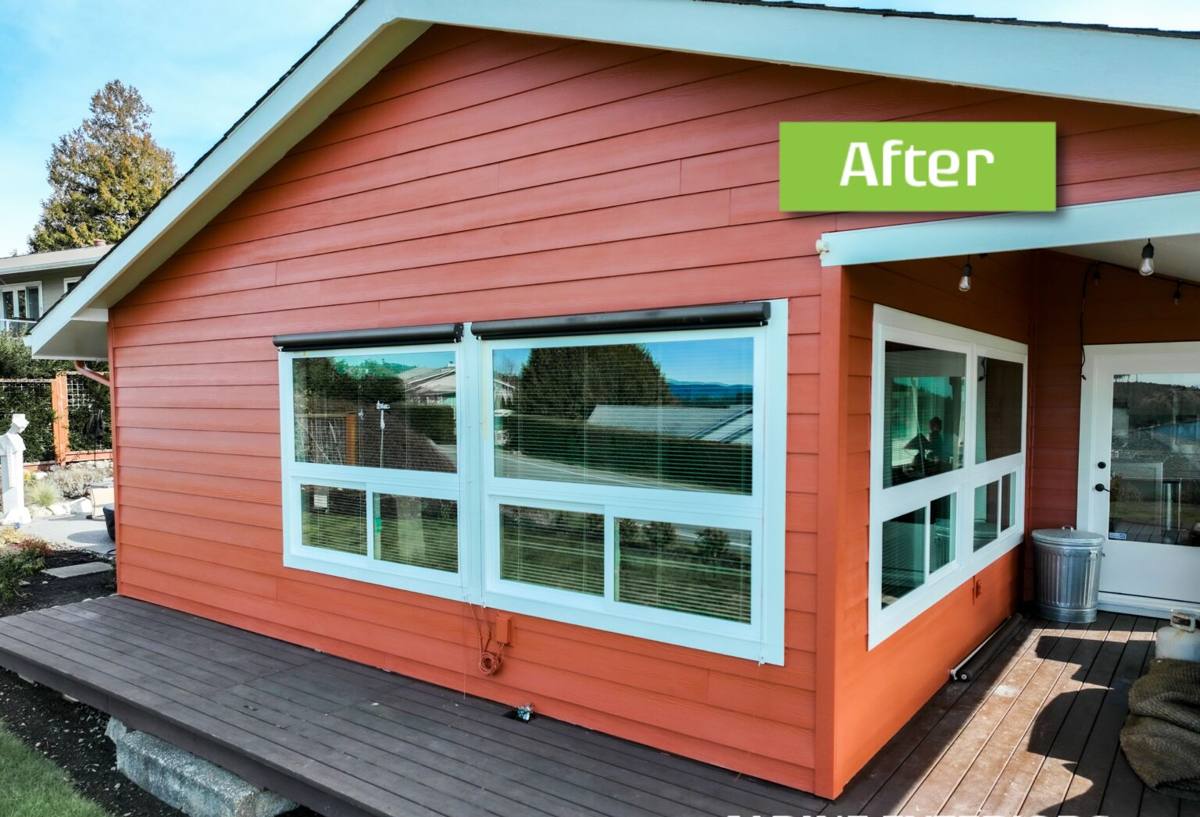
What Salt Air Actually Does to a House
Salt air is corrosive to metal and abrasive to finishes over time. On a home near the water, that shows up in a few predictable places:
- Fasteners and flashing corrode faster if they aren't the right grade of stainless or coated steel for a marine-influenced environment
- Paint and lower-grade factory finishes chalk and fade faster under salt exposure combined with UV
- Caulk joints break down sooner, opening small gaps where wind-driven moisture gets behind the siding
- Any exposed raw edge — a field cut that wasn't sealed — becomes a place where salt-laden moisture concentrates
None of this means a house near Fairhaven is doomed to constant repairs. It means the margin for error is smaller. A siding system with a durable factory finish, correct fastener specification, and properly sealed cut edges holds up. A system that depends on a homeowner repainting every few years, or that has seams and joints that open up under repeated wet-dry cycling, shows its age fast in this environment.
Where James Hardie's ColorPlus Finish Fits In
James Hardie's ColorPlus finish is baked on at the factory under controlled conditions, which gives it better UV and fade resistance than most field-applied paint. That matters here specifically because repainting siding on a home exposed to salt air and constant moisture is more disruptive and more frequent than it would be inland — you're fighting the same conditions that are aging the finish while you try to apply a new coat. A finish that's engineered to hold color longer without repainting is a real, practical advantage in this location, not a marketing point.
Driving Rain and Moss Season: The Moisture Side of the Equation
The second half of what makes Fairhaven demanding on siding is simply how much wind-driven rain the area sees, combined with how long things stay damp once they're wet. Whatcom County doesn't dry out fast in the fall, winter, or spring, and shaded walls — especially north- and west-facing ones under trees or close to neighboring structures — can stay damp for days after a storm passes. That's exactly the environment moss and algae need to establish themselves, and it's exactly the environment where any siding product that absorbs moisture starts to have problems.
Fiber cement doesn't absorb water the way wood-based products do, and it doesn't trap moisture behind it the way some vinyl installations can when the wall assembly isn't detailed correctly. That's a meaningful difference in a place where a wall can stay wet for a week at a time in December or January. But the product is only half the story — how it's installed determines whether that moisture resistance actually gets used.
Moss and Algae: What Actually Helps
Moss doesn't grow on siding because the siding is defective — it grows where conditions favor it: shade, moisture, and a surface texture or seam that gives it somewhere to take hold. A few things reduce the problem without eliminating the underlying weather:
- Correct clearance between siding and grade, decks, and roof lines so water and debris don't sit against the bottom courses
- Tight, correctly caulked joints so moss and algae don't get a foothold in gaps
- A finish that doesn't have a porous surface for spores to grip and grow into
- Keeping gutters and downspouts directing water away from siding runs, not sheeting down the wall
We can't change how much shade a lot gets or how much rain Whatcom County sees in a given winter. We can make sure the installation itself isn't giving moss extra help.
What a Correct James Hardie Install Looks Like on a Fairhaven Home
The product is only as good as the installation, and this is where a lot of siding jobs — on any brand — go wrong. James Hardie publishes specific installation requirements, and in a coastal-influenced, high-moisture area like Fairhaven, following them isn't optional detail work, it's the difference between siding that lasts and siding that fails early at the seams.
| Install Detail | Why It Matters Here |
|---|---|
| Correct fastener type and spacing | Salt air accelerates corrosion on the wrong fastener grade; loose fasteners open gaps for wind-driven rain |
| Proper clearance from grade, roofline, and decks | Fairhaven's wet season means standing moisture at the base of a wall gets more contact time than an inland home would see |
| Correctly lapped and sealed house wrap / weather barrier behind the siding | Driving rain off the water finds any gap; the barrier behind the siding is the real waterproofing layer |
| Sealed and painted cut edges (factory edges are pre-primed; field cuts are not) | An unsealed cut edge is where fiber cement is most vulnerable to moisture intrusion over time |
| Proper joint and seam treatment (caulked or shiplap, per Hardie spec) | Open or poorly sealed joints are where moss and algae get started and where water gets behind the panel |
| Flashing at windows, doors, and penetrations | Most siding failures near the water start at a poorly flashed penetration, not the field of the wall |
Every one of these is a place where a rushed crew, or a crew unfamiliar with fiber cement's specific requirements, can cut a corner that won't show up as a problem for a year or two — and then shows up as a moisture issue that's expensive to trace and fix once it's behind the wall.
Our Process for a Fairhaven Siding Job
We're based out of Ferndale and we already work in and around Fairhaven regularly, which matters more than it might sound like — we know what the wind exposure looks like on the water-facing sides of homes in this area, we know which details tend to get missed by crews who don't normally work this close to the coast, and we're not learning the local conditions on your project.
How a project typically runs
- On-site assessment — we look at existing siding condition, wall orientation relative to prevailing wind and rain, moisture or moss patterns already present, and any trim, flashing, or structural issues that need addressing before new siding goes on
- Product and color selection — walking through James Hardie's HZ product lines and ColorPlus color options suited to the home and to Fairhaven's exposure
- Written scope and estimate — a clear breakdown of what's included: siding, trim, flashing work, house wrap if needed, and disposal of old material
- Prep and installation — removal of old siding, correction of any sheathing or moisture damage found underneath, proper house wrap and flashing installation, then the Hardie siding itself per manufacturer spec
- Final walkthrough — checking joints, caulking, clearances, and finish before we consider the job done
We don't upsell products we don't install, and we won't quote vinyl or LP SmartSide as a "budget option" alongside Hardie — if fiber cement isn't the right fit for a project's budget, we'll say so honestly rather than install something we don't stand behind long-term.
Why We Only Install James Hardie
We get asked occasionally why we don't offer vinyl or engineered wood siding as a lower-cost alternative. The honest answer is that in a climate like Whatcom County's — and especially in a location like Fairhaven with added salt exposure — the trade-offs on those products show up faster and cost more to deal with than the upfront savings are worth:
- Vinyl can warp or become brittle with temperature swings and doesn't hold up to impact the way fiber cement does, and it's not fire-resistant
- Engineered wood products depend heavily on maintaining an intact factory coating; any breach lets moisture in, and moisture is the one thing this climate has in surplus
- Both typically carry a shorter or more limited warranty structure than James Hardie's transferable coverage
James Hardie's fiber cement is non-combustible, engineered in HZ5 formulation for this region's moisture exposure, and backed by a warranty that transfers if the home sells. That's the standard we install to, and it's the standard we're willing to guarantee our workmanship against.
What to Check Before Hiring Anyone for Siding Work in Fairhaven
- Ask specifically whether the crew is James Hardie certified or has documented experience installing it correctly, not just generally "siding experienced"
- Ask how they handle clearance and flashing at grade, decks, and rooflines — vague answers here are a red flag in a high-moisture area
- Ask whether cut edges get factory-matched sealant/paint, not just a generic caulk
- Get the manufacturer warranty terms in writing, separate from the contractor's workmanship warranty
- Ask for a written scope that specifies house wrap, flashing, and fastener details, not just "install siding"
Ready When You Are
If your Fairhaven home's siding is showing moss buildup, chalking, cracked caulk lines, or you're just planning ahead for a home that's due, we're happy to come take a look and give you a straightforward, no-pressure estimate — no obligation, and no upsell to a product we wouldn't put on our own homes.