 Ferndale
 Why Cordata's Climate Is Hard on Ordinary Siding
Cordata sits in the same marine air mass that defines exterior work all across Whatcom County. Homes here don't get one or two problems — they get all three at once, year after year: salty coastal air pushed inland off the Strait, wind-driven rain that hits siding sideways instead of falling straight down, and a moss and algae season that can run eight or nine months out of the twelve. Any one of those is manageable on its own. Together, they're exactly the combination that separates siding that holds up for decades from siding that starts failing in five to ten years.
Salt Air and Marine Exposure
Salt-laden air doesn't just affect homes right on the water. It travels inland on the prevailing wind and settles on exterior surfaces everywhere in this corridor, including neighborhoods like Cordata that aren't waterfront at all. Salt is corrosive to exposed metal fasteners and trim, and it's hard on paint film — it accelerates chalking, fading, and the breakdown of the resins that hold pigment to a painted surface. Siding that relies on a field-applied paint job is fighting this battle every single year.
Driving Rain and Wind-Driven Moisture
Whatcom County storms rarely deliver rain straight down. Wind pushes it sideways and up under laps, around trim, and into any gap the installer left. That means the water-resistive barrier, flashing details, and the gap behind the siding matter more here than they would in a drier, calmer climate. A siding product can be excellent and still fail prematurely if the assembly behind it wasn't built to shed wind-driven water.
The Long Moss Season
Shade, moisture, and mild temperatures are a perfect recipe for moss and algae growth, and Cordata has plenty of tree cover and damp ground to support it. Moss holds moisture against a wall longer than open air does, which is a problem for any material that can absorb water or swell. It's also just persistent — north-facing walls and shaded sections of a house can stay green for most of the year if the siding and paint finish don't resist it well.
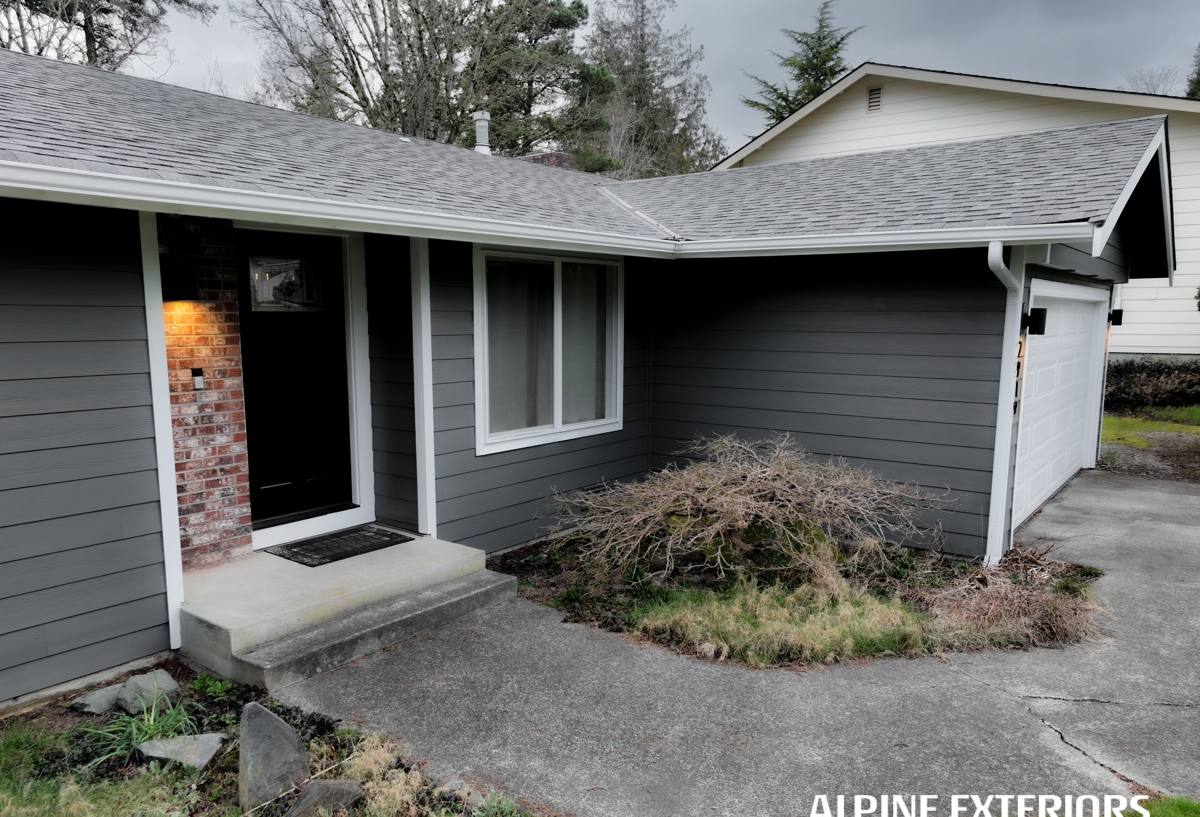
Why We Standardized on James Hardie for This Climate
We install James Hardie fiber cement siding exclusively — not vinyl, not LP SmartSide, not cedar or primed wood, not other fiber cement brands. That's not a marketing position; it's a decision built around exactly the three conditions above.
Fiber Cement That Doesn't Feed on Moisture
James Hardie's fiber cement is engineered specifically to resist moisture damage, which matters enormously in a climate where the siding is wet, damp, or humid for most of the year. Unlike wood-based products, it isn't a food source for the organic growth that thrives in Cordata's shaded, moist microclimates, and it doesn't swell, delaminate, or rot the way engineered wood siding can when water gets past the surface.
Climate-Engineered HZ Product Lines
James Hardie makes region-specific formulations under its HZ5 designation for wetter, harsher climates like the Pacific Northwest, as opposed to the HZ10 formulation built for hot, dry, or freeze-prone regions. Installing the version engineered for our actual weather — rather than a generic national product — is part of what "correct installation" means here.
ColorPlus Factory Finish
ColorPlus is a baked-on, factory-applied finish rather than a coat of paint rolled on at the job site. It's formulated to hold color and resist fading, chalking, and moisture intrusion at the coating level — which matters directly in a climate where salt air and UV exposure are constantly working on painted surfaces. It also comes with a stronger, more specific finish warranty than field-applied paint ever carries, because Hardie controls the application conditions instead of leaving it to weather on install day.
Non-Combustible Composition
Fiber cement doesn't burn the way vinyl or wood-based siding can. That's a genuine safety advantage independent of climate, and one reason we don't ask homeowners to weigh a cheaper, combustible product against it.
What a Correct James Hardie Installation Actually Involves
The material is only half the equation. Most premature siding failures we get called out to inspect — regardless of brand — trace back to installation shortcuts, not the product itself. In a climate like ours, those shortcuts show up faster.
Water Management Behind the Siding
Correct installation starts with a properly lapped weather-resistive barrier, correctly flashed windows, doors, and penetrations, and a drainage plane that gives incidental water somewhere to go instead of trapping it against the sheathing. This is the layer nobody sees once the siding is up, and it's the layer that determines whether wind-driven rain becomes a non-issue or a slow, hidden problem.
Fastener Pattern and Clearances
James Hardie publishes specific fastener spacing, minimum ground clearance, and clearance from roof lines, decks, and other siding for a reason — deviating from those specs is one of the most common ways an installation voids the manufacturer's warranty without the homeowner ever knowing. Proper clearance from grade and hard surfaces also keeps splash-back moisture away from the bottom course, which matters through a wet Whatcom County winter.
Joint Treatment and Caulking
Butt joints, trim intersections, and penetrations need to be treated with the right sealant and the right technique — not just caulked shut and painted over. Done wrong, these are the exact spots where wind-driven rain finds its way behind the cladding.
Cut Edges and Field Painting
Every field cut exposes raw fiber cement that needs to be sealed and touched up with a color-matched, manufacturer-approved product before it's closed in. Skipping this step is invisible on install day and shows up as a moisture problem years later.
Our Process on a Cordata-Area Home
We treat every project the same way structurally, whether it's a single wall repair or a full re-side, because the fundamentals don't change:
- On-site assessment: We look at existing siding condition, moisture history, trim and flashing details, and any moss or algae staining that points to chronic damp areas before we ever talk about product or price.
- Tear-off and substrate check: Removing the old siding lets us actually inspect the sheathing underneath for hidden rot or water damage instead of guessing from the outside.
- Water-resistive barrier and flashing: This layer gets installed and lapped to shed water down and out, with particular attention to window and door openings.
- James Hardie installation to spec: Correct fastener pattern, clearances, and joint treatment, following Hardie's published installation requirements for our climate zone.
- Trim, caulking, and touch-up: Cut edges sealed, joints treated, and color-matched where field painting is required.
- Final walkthrough: We go over the finished work with the homeowner before calling the job complete.
Comparing Siding Options for This Climate
We only install James Hardie, but homeowners deserve to understand what they'd be choosing between if they shopped this project around. Here's an honest comparison based on how each material behaves in a wet, salt-air, moss-prone climate like Cordata's:
| Material | Moisture Behavior | Finish Durability in Salt Air | Fire Resistance |
|---|---|---|---|
| James Hardie fiber cement | Engineered to resist moisture damage; won't rot or feed organic growth | ColorPlus factory finish resists fading and chalking | Non-combustible |
| Vinyl siding | Doesn't rot, but can warp, crack in cold snaps, and trap moisture behind it if installed loosely | Color is molded in but can fade and become brittle with long UV exposure | Combustible; can melt or warp near heat sources |
| LP SmartSide (engineered wood) | Wood-based; vulnerable to swelling and edge damage if moisture reaches the core | Requires factory or field coating maintenance over time | Combustible |
| Cedar / primed wood | Natural material; needs consistent sealing to resist rot and moss growth | Field-applied paint or stain needs regular reapplication | Combustible |
Cost Factors for a Cordata Siding Project
We don't quote prices without seeing the actual house, but the variables that drive cost on a Hardie project in this area are consistent from job to job:
| Factor | Why It Matters |
|---|---|
| Tear-off scope | Full removal and disposal of existing siding versus a partial re-side changes labor significantly |
| Substrate condition | Hidden rot or water damage found during tear-off adds repair work before new siding can go on |
| Product line and profile | Lap width, panel style, and shingle-style siding carry different material and labor costs |
| Trim and detail work | Homes with more corners, windows, and architectural detail take more time to flash and finish correctly |
| Access and site conditions | Slopes, tight lot lines, and mature landscaping affect staging and crew efficiency |
| Color and finish | Factory ColorPlus finishes versus field-primed-and-painted options affect both cost and long-term maintenance |
Living With It: Maintenance in a Moss-Prone, Salt-Air Environment
James Hardie siding installed correctly is genuinely low-maintenance, but "low-maintenance" doesn't mean "zero-maintenance" in this climate. A short annual routine keeps it performing the way it's designed to:
- Rinse siding gently once or twice a year to remove salt residue and surface grime — a garden hose is usually enough; avoid high-pressure washing directed straight at laps and joints.
- Keep an eye on shaded, north-facing walls and areas under tree cover where moss and algae tend to establish first.
- Trim back vegetation and tree limbs that keep a wall shaded and damp longer than the rest of the house.
- Check caulking at trim joints, windows, and penetrations every year or two and have any cracked or missing sealant redone before winter rains set in.
- Watch gutters and downspouts — overflow and splash-back onto siding is one of the most common causes of localized staining and moisture problems.
- Address any touch-up painting on cut edges or repaired sections promptly rather than letting bare fiber cement sit exposed.
Why a Crew That Already Works This Area Matters
Installation requirements don't change based on postal code, but judgment calls do. A crew that regularly works homes in Cordata and the surrounding Ferndale area already knows which wall orientations tend to hold moss, where wind-driven rain hits hardest on a given lot layout, and how the local moisture cycle should shape decisions about clearances, flashing, and drainage detailing. That familiarity doesn't replace following Hardie's published specifications — it means those specifications get applied with an accurate read on the conditions the siding will actually face for the next thirty-plus years.
It also matters for warranty support. James Hardie's transferable warranty is only as good as the installation it's backing, and a local crew that stands behind its own work is easier to reach if a question comes up five or ten years down the road than a contractor that isn't consistently working in the area anymore.
Common Mistakes We See on Re-Sides in This Climate
When we're called to inspect an existing installation — Hardie or otherwise — a handful of issues show up repeatedly in wet, coastal-influenced neighborhoods like Cordata:
- Insufficient clearance between the bottom of the siding and grade, decks, or roof lines, leading to chronic splash-back moisture
- Missing or improperly lapped flashing around windows and doors
- Unsealed or poorly sealed cut edges, especially around trim and penetrations
- Caulk used as a substitute for proper flashing rather than as a secondary seal
- Fastener patterns that don't match manufacturer specifications, risking both performance and warranty coverage
None of these are dramatic on install day. All of them become expensive once wind-driven rain and a long moss season have a few years to work on the gap they left behind.
If you're weighing a siding project on a Cordata-area home, we're happy to take a look and walk you through exactly what your house needs — no pressure, no obligation. Use the form below to request a free estimate.