 Ferndale
 Board & Batten Siding for Everson Homes
Everson sits along the Nooksack River in the farm country east of Lynden and Ferndale, and it has its own character compared to the towns closer to Bellingham Bay — more open fields, more distance between houses, more exposure on a wall that doesn't have neighboring structures or tree lines breaking up the wind. Board and batten has become a popular choice out here for exactly that reason: the vertical lines suit the farmhouse and barn-style architecture common in this part of the county, and they read as clean and modern on newer builds too. What matters more than the look, though, is that board and batten is a joint-heavy profile — every seam between a board and its batten is a place where wind-driven rain can try to work its way behind the siding. In a river valley that gets driving rain, salt-tinged air carried in off the Salish Sea during storm systems, and a moss season that runs most of the year on shaded walls, how that seam is built determines whether the siding lasts one wet season or three decades.
We install James Hardie fiber cement board and batten exclusively for Everson homes. It's not the only siding product on the market, but for a profile built entirely around vertical seams, in a climate that stays damp for months at a time, it's the one system we're willing to stand behind completely.
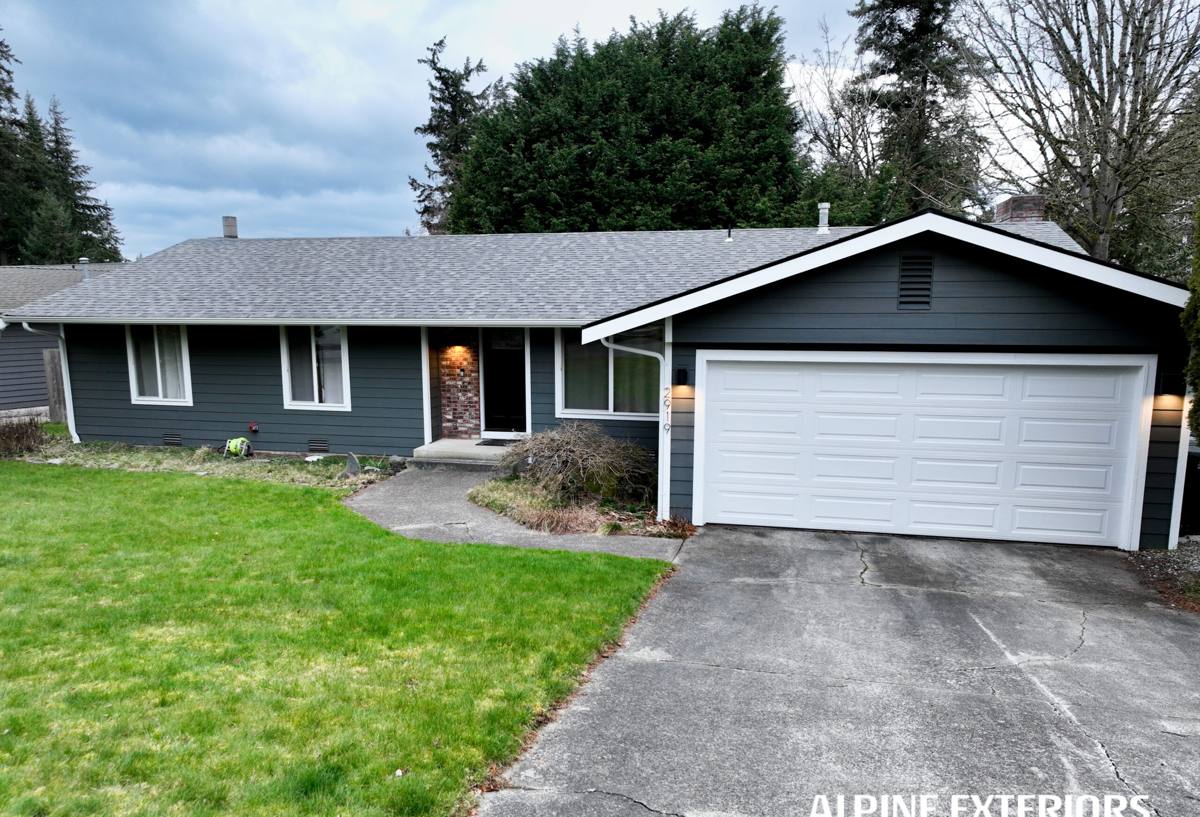
What the Everson Climate Asks of a Board & Batten Wall
Driving Rain Across Open Farmland
Everson's rural setting means less windbreak than a home tucked into a wooded lot or a denser neighborhood closer to town. Storms moving up the valley push rain sideways across open fields with little to slow it down, and a vertical siding profile gives that wind-driven rain a lot of joint length to test. A batten that's caulked tight instead of properly lapped, or nailed without the clearance the wall needs to shed water, becomes the weak point where moisture starts working its way in.
Salt-Tinged Air Moving Up the Valley
Everson isn't on the water the way Ferndale or Bellingham are, but the same weather systems that bring marine moisture off the Salish Sea move inland through the river valley, especially during the wetter months. That means fasteners, flashing, and any exposed metal on a board and batten wall still deal with a mild corrosive element over time, just at a lower level than a shoreline property. It's one more reason the fastener spec on this profile — corrosion-resistant, correctly sized, correctly spaced — isn't a place to cut corners.
A Long Moss and Mildew Season on Rural Walls
Shaded walls, tree lines along field edges, and the persistent dampness typical of this part of Whatcom County add up to a moss and mildew season that runs long here, same as it does closer to the coast. On a board and batten wall, that's a bigger concern than on lap siding, because moss and mildew tend to establish first in the narrow space where a batten meets a board — exactly where trapped moisture does the most damage if the joint isn't detailed to let it dry out.
River Valley Humidity and Freeze-Thaw Swings
Sitting low along the Nooksack River, Everson holds humidity a little longer after a storm than higher ground does, and it also sees sharper cold snaps in winter than towns right on the water. That combination — sustained dampness followed by an occasional hard freeze — is tough on any siding material that absorbs moisture at a cut edge or an unsealed seam, because water that freezes after soaking in expands and accelerates whatever damage was already starting.
Why James Hardie Is the Only System We Install on This Profile
Board and batten doesn't forgive a weak material the way a simpler lap profile sometimes can, because there are more seams, more fasteners, and more exposed edge per square foot of wall. That's a big part of why we don't offer LP SmartSide, vinyl, Cemplank, Allura, primed spruce, or cedar board and batten for Everson properties. Those are legitimate products, and other contractors install them competently — we simply made a professional call that one system, installed to spec, protects a homeowner better over the long run than a cheaper option that quietly shifts maintenance and repair costs onto them a few years down the line.
| Material | Behavior at Batten Seams | Maintenance in a River Valley Climate | Realistic Lifespan |
|---|---|---|---|
| James Hardie fiber cement | Dimensionally stable; doesn't swell or cup at the joint | Low; factory finish resists moss and fading | 30+ years with proper install |
| LP SmartSide (engineered wood) | More sensitive to moisture at cut edges and fastener holes | Moderate; edge sealing needs regular upkeep | 15-25 years, climate-dependent |
| Vinyl | Can gap or distort at battens with temperature swings | Low upfront, but hidden moisture issues are hard to spot | 20-30 years, variable |
| Cedar | Absorbs moisture readily at every seam without regular resealing | High; recurring painting or staining cycle | 15-25 years with consistent upkeep |
Fiber cement's core doesn't expand and contract with moisture the way wood-based products do, which matters most on a profile made up almost entirely of vertical joints. The factory-applied ColorPlus finish also means field painting is the exception rather than the rule — the only paint work involved is priming cut edges before installation, not maintaining a full-wall finish that has to hold up against valley humidity year after year.
What a Correct Board & Batten Installation Involves
The finished look of board and batten is straightforward, but a correct installation has a lot happening behind that surface, especially on an exposed rural property:
- House wrap or weather-resistive barrier installed and properly lapped before any siding goes up
- A drainage gap or rainscreen behind the siding so moisture that gets past the surface can dry out instead of sitting against the wall sheathing
- Boards fastened with corrosion-resistant fasteners at the spacing the manufacturer specifies, not just enough to hold the board in place
- Battens set with proper clearance rather than caulked tight, so the wall can shed water instead of trapping it against the board
- Correctly flashed and lapped transitions at windows, doors, corners, and the base of the wall
- Field-cut edges primed before installation to preserve the factory-cured ColorPlus finish everywhere else on the wall
Skip any one of these steps and the wall can still look right for a year or two. The problems that come from skipping them — staining along the seams, soft spots near the base, paint failure at the battens — take a few wet seasons to surface, which is exactly why a corner-cutting install can get away with it right up until the homeowner is the one paying to fix it.
Cost Factors for a Board & Batten Project in Everson
Board and batten typically costs somewhat more than a standard lap installation, mainly because of the extra material and labor the batten strips themselves require. The factors that move the price on a given Everson home are fairly consistent:
| Factor | Why It Matters |
|---|---|
| Wall square footage and home height | More surface area means more boards, battens, and fastening time |
| Existing siding removal | Tear-off of old cedar, vinyl, or engineered wood adds labor before the new install can start |
| Substrate condition | Rot or water damage found once old siding comes off needs repair before Hardie goes up |
| Trim and corner detail complexity | Farmhouse-style gables, dormers, and multiple roof lines add cutting and flashing work |
| Access and site conditions | Larger rural lots and outbuildings can add setup and material staging time |
We give every Everson homeowner a straightforward, itemized estimate rather than a vague range, because the real cost drivers on a given property — especially what's found once old siding comes off — are worth being specific about upfront.
Repair, Refresh, or Full Replacement
Not every board and batten wall in rough shape needs to come down entirely. A section damaged by a wind event, an isolated batten that's split or pulled loose, or trim around a window that's failed can often be repaired and matched into existing Hardie siding without touching the rest of the wall. But if water has been getting behind the siding for a while, or the home is still wearing an older, non-Hardie product that's reaching the end of its service life, patching it usually just postpones a larger job while hidden damage keeps spreading underneath. We'll walk a homeowner through which situation they're actually looking at before recommending either path.
Our Process for Everson Board & Batten Projects
The work starts with an on-site walkthrough — not a drive-by estimate — where we look at wall exposure, existing siding condition, trim and flashing details, and anything specific to the property's layout, like how much open field or windbreak surrounds it. From there we spec the right Hardie board and batten product and profile for the home, put together an itemized estimate, and schedule the work around the wetter months when we can, since a dry install window matters more on a joint-heavy profile than on most others. During the install itself, every batten clearance, fastening pattern, and flashing detail follows Hardie's spec rather than whatever's fastest, and we walk the finished job with the homeowner before calling it done. Straightforward, no surprises, and no upsell into a product we don't stand behind.
Why a Crew That Already Works Everson Matters
A lot of exterior problems in this part of the county trace back to installation details that only show themselves after a full wet season or two — which means a crew that hasn't worked much rural, river-valley property before is more likely to make the same mistakes twice, on two different homes, before they figure out what this climate actually requires. Working Everson regularly means we already know how differently an open farmland lot behaves compared to a sheltered in-town property, how far batten clearances need to account for wind exposure out here, and what the Nooksack Valley's humidity does to a wall assembly over years rather than weeks. That's the kind of judgment that doesn't show up on a spec sheet, and it's part of why the installation detail matters as much as the material choice itself.
If you're weighing board and batten for a home in Everson, we're glad to walk the property, look at what you're currently working with, and put together a straightforward, no-pressure estimate — just fill out the form below.