 Ferndale
 Why Birch Bay Roofs Take a Different Kind of Beating
Birch Bay sits right on the water, and that location cuts both ways. It's a beautiful place to own a home, but the roof over that home is doing more work than a roof ten miles inland in Ferndale or Lynden. Storms here don't just drop rain — they push salt air, wind, and moisture into a roof system from angles that inland homes rarely deal with. When a windstorm rolls through, the damage is often a combination of several stressors hitting at once, not one clean problem with one clean fix.
Salt Air and Slow Corrosion
Homes close to the shoreline are exposed to salt-laden air more or less constantly. Over time that air accelerates corrosion on exposed metal — flashing, nail heads, vent caps, gutter hardware. A storm doesn't cause this corrosion, but it exploits it. Fasteners and flashing that have been quietly weakening for years are exactly what gives way first when wind gets under a shingle edge or drives rain sideways into a seam.
Wind-Driven Rain Off the Water
Rain that falls straight down is manageable for almost any roof system. Rain that's being pushed sideways by wind coming off the water is a different problem — it finds its way under shingle tabs, around chimney flashing, and into any gap that would never leak in calmer weather. Birch Bay's exposure to open water means wind-driven rain during fall and winter storms is a regular occurrence, not a rare event.
A Long Moss Season
Whatcom County's wet season runs long, and Birch Bay's combination of moisture and mature tree cover on many lots keeps roofs damp for extended stretches. Moss doesn't just sit on top of shingles — it holds water against the roofing material, lifts shingle edges as it grows, and works its way into any gap a storm has already opened up. A storm-damaged roof with an existing moss problem tends to deteriorate faster than a clean roof would.
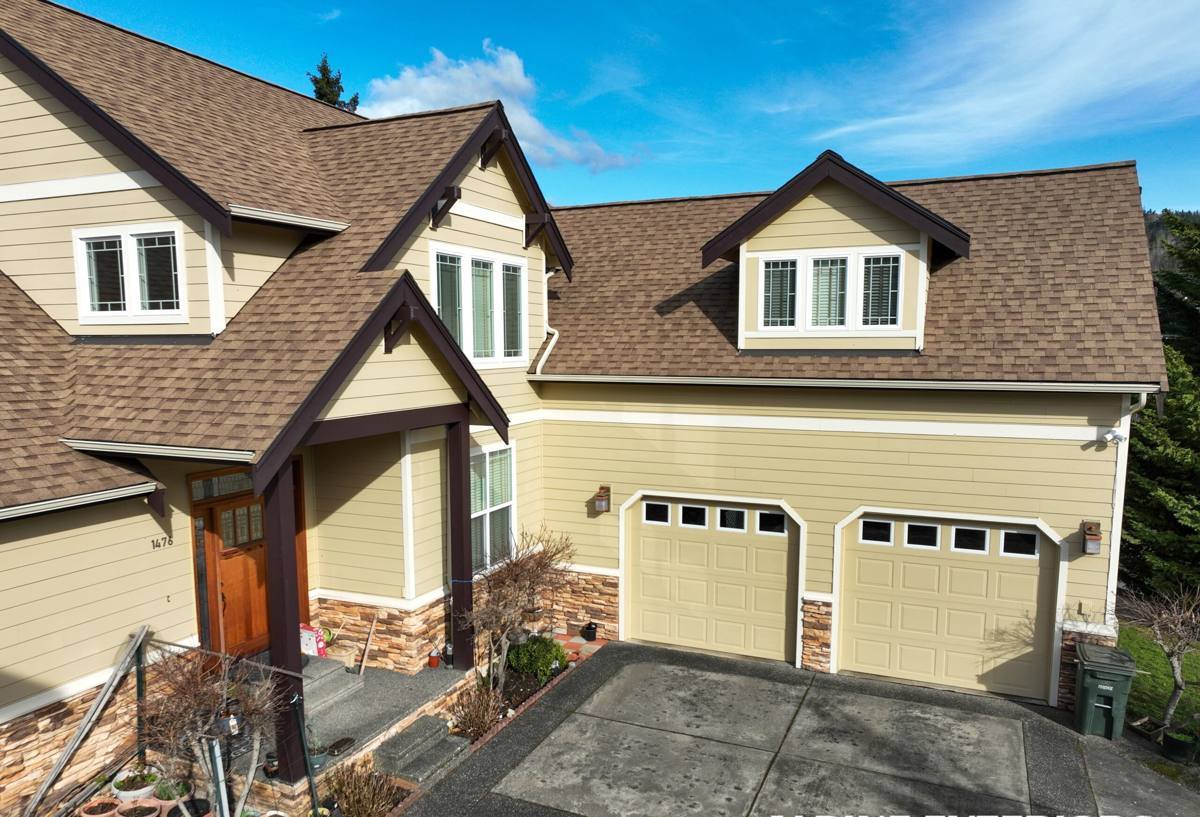
Signs Your Roof Has Storm Damage
Some storm damage is obvious. Most of it isn't. A roof can look fine from the driveway and still be letting water into the structure. After any significant wind or rain event, it's worth checking for the following:
- Shingles that are cracked, curled, creased, or missing entirely
- Granules collecting in gutters or at the base of downspouts
- Lifted or bent flashing around chimneys, vents, and skylights
- Soft or discolored spots on interior ceilings, especially near exterior walls
- A musty smell in the attic or upper floor that wasn't there before
- Gutters pulling away from the fascia or sagging under debris
- Visible daylight through the roof deck when viewed from inside the attic
None of these on their own means the roof is failing. Together, or after a known storm event, they're reason enough to have someone look before the next round of weather comes through.
What a Correct Storm Damage Repair Involves
The biggest mistake in storm repair isn't skipping the job — it's doing a partial version of it. A quick patch over a visible hole can stop a leak for a season and still leave the underlying problem in place.
Diagnosing the Full Scope, Not Just the Visible Spot
Wind and water damage rarely stay confined to the spot where they're first noticed. A missing shingle three courses up can be feeding water into a wall cavity nowhere near where the stain shows up on the ceiling. A proper repair starts with tracing the water's actual path, not just covering the entry point.
Matching Materials and Flashing Detail
Repairs need to tie into the existing roofing system correctly — proper shingle lap, correct flashing overlap at transitions, and fasteners rated for the exposure the roof actually sees. In a salt-air location like Birch Bay, that means using corrosion-resistant fasteners and flashing rather than whatever happens to be on the truck, even if it costs a little more up front.
Checking What the Storm Exposed, Not Just What It Broke
Once a section of roofing is opened up for repair, it's the right moment to check decking condition, underlayment, and ventilation in that area. Closing everything back up without that check means the next storm finds the same weak point.
Our Process for Storm Damage Repairs in Birch Bay
We keep this straightforward because homeowners dealing with storm damage usually have enough going on already.
- Inspection. We look at the roof, the attic, and the areas water could realistically have traveled — not just the spot that's obviously damaged.
- Temporary protection. If there's active exposure, we get it covered so the situation doesn't get worse while a repair plan comes together.
- Documentation. We photograph the damage clearly, which matters if you're filing an insurance claim.
- A written repair plan. You get a clear explanation of what's damaged, what needs to be replaced versus repaired, and what it will cost — before work starts.
- The repair itself. Done to match the existing roof system's materials and detailing, not just patched over.
- A post-repair check. We look at ventilation and drainage in the repaired area, since poor airflow or blocked drainage is often part of why damage happened in the first place.
Repair vs. Replace: What Actually Drives the Decision
Not every storm-damaged roof needs to come off. But not every damaged roof should be patched, either. The honest answer depends on a handful of factors.
| Factor | Leans Toward Repair | Leans Toward Full Replacement |
|---|---|---|
| Roof age | Under roughly 10-12 years, still within useful life | Near or past the material's expected service life |
| Extent of damage | Isolated to one section or slope | Spread across multiple slopes or the whole roof |
| Decking condition | Solid, dry decking under the damaged area | Soft, delaminated, or water-stained decking found during inspection |
| Material availability | Matching shingles or material still available | Discontinued material, visible mismatch would result |
| History of moss or repeated leaks | First significant issue | Pattern of recurring problems in the same areas |
We'll walk you through where your roof actually falls on this list rather than defaulting to the most expensive option. Plenty of storm-damaged roofs in Birch Bay genuinely just need a solid repair.
Why a Crew That Already Works in Birch Bay Matters
Birch Bay isn't identical to inland Whatcom County, and treating it that way shows up in the quality of the repair. Homes closer to the water deal with more wind exposure, more salt air, and often more tree cover than homes further inland, and each of those changes what "correct" looks like on a repair.
A crew that regularly works this area already knows to spec corrosion-resistant fasteners and flashing as a default, not an upsell. They know which roof orientations tend to take the worst of the wind-driven rain and check those areas more carefully. They're also familiar with the permit and code expectations that apply in Whatcom County, so a repair doesn't turn into a compliance problem later. That local familiarity is the difference between a repair that holds up through the next few storm seasons and one that needs revisiting.
Preventing the Next Round of Storm Damage
A repair is the right time to address the conditions that made the roof vulnerable in the first place.
Moss and Debris Management
Given how long the moss season runs in this area, keeping the roof clear of accumulated debris and addressing moss growth before it lifts shingle edges is one of the more cost-effective things a homeowner can do between storms.
Ventilation and Attic Airflow
Poor attic ventilation traps moisture, which shortens the life of roofing materials and makes them more vulnerable to wind damage over time. If a repair uncovers a ventilation issue, it's worth fixing at the same time rather than leaving it for later.
Flashing Upgrades
Older flashing that's already showing corrosion is a reasonable candidate for upgrading during a repair, even if it isn't the piece that failed. It's far cheaper to replace flashing proactively during an open repair than to reopen the same section of roof in another year or two.
Working With Insurance on a Storm Claim
Many storm damage repairs in Birch Bay go through homeowners insurance, and a few honest points are worth knowing going in. Insurers generally want clear documentation of the damage and a reasonable, itemized estimate — not an inflated one. Adjusters are also looking for damage that's actually storm-related versus damage from age or deferred maintenance, so a straightforward, well-documented assessment tends to move a claim along faster than a padded one. We provide the kind of photo documentation and written scope that holds up in that process, without promising a specific claim outcome, since that decision always sits with the insurer.
If a recent storm has you wondering about the roof, we're glad to take a look. We offer free, no-pressure estimates for storm damage repair in Birch Bay — you'll get a clear read on what's actually going on up there and what it would take to fix it right, with no obligation to move forward. Use the form below to get started.