 Ferndale
 Why Birch Bay Roofs Wear Differently
Birch Bay sits right on the water, and that changes what a roof has to deal with compared to a house a few miles inland in Ferndale or elsewhere in Whatcom County. The salt-laden air off the bay accelerates corrosion on fasteners, flashing, and any exposed metal. Add in wind-driven rain that comes sideways off the Strait during fall and winter storms, and you've got a roof system that gets tested from angles a standard installation manual doesn't always account for. Then there's the moss. Whatcom County's long, wet, mild-temperature stretch from October through April is close to perfect moss-growing weather, and roofs that don't get direct afternoon sun — common on tree-lined or west-facing lots near the bay — grow it fastest.
None of this means Birch Bay needs some exotic roofing system. It means the installation details that get skipped on an easier job — fastener selection, flashing sequencing, ventilation, underlayment coverage — actually matter here, and cutting corners on them shows up as a leak or a moss mat within a few years instead of never showing up at all.
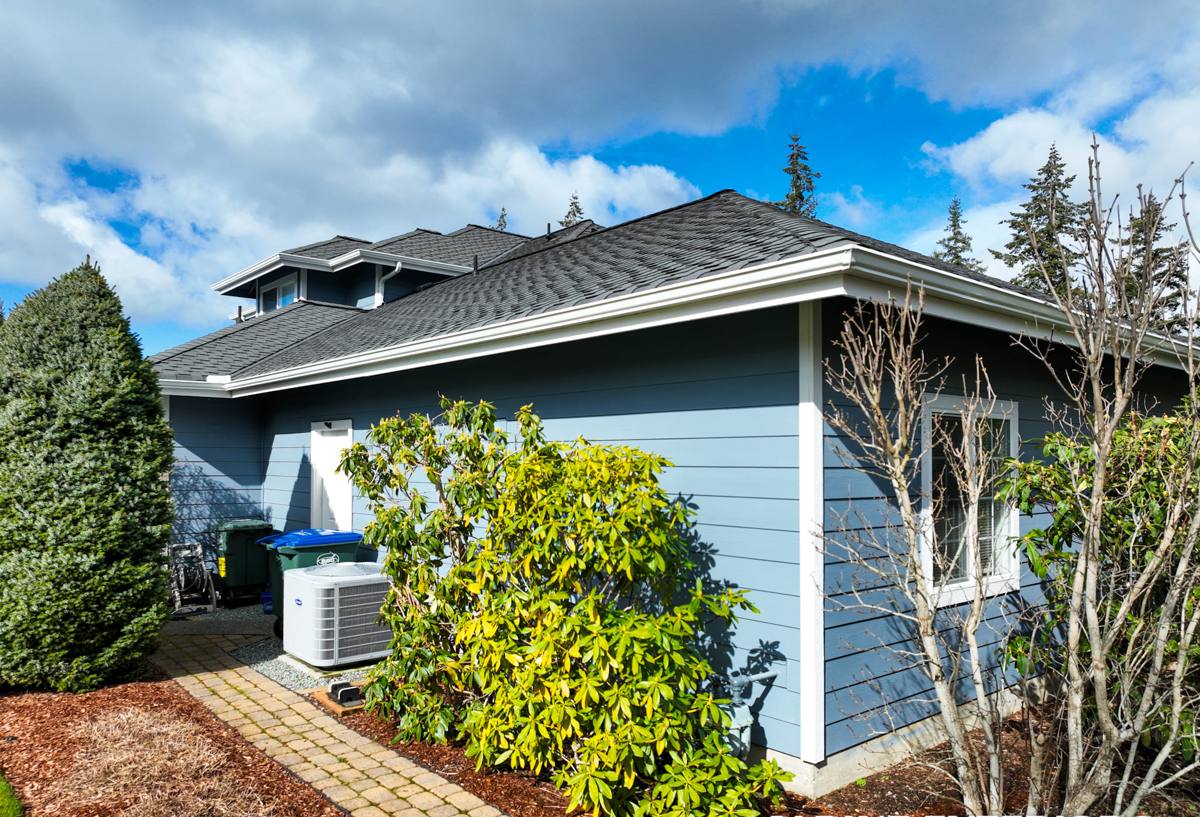
What a Correct New Roof Installation Actually Involves
A new roof is more than laying shingles over what's there. A proper install starts underneath and works up:
Tear-Off and Deck Inspection
We remove the old roofing down to the deck rather than layering over it. That's the only way to actually see what's underneath — soft spots, old water staining, rot around vent stacks or chimneys, and any deck sheathing that's delaminated from years of moisture cycling. In a coastal, high-rainfall area like Birch Bay, hidden deck damage is common enough that skipping this step is asking for a callback in a few years.
Underlayment and Ice-and-Water Protection
Underlayment is the roof's backup layer if wind ever drives rain under the shingles — which happens here more than in drier parts of the state. We run synthetic underlayment across the field and self-adhering ice-and-water shield at the eaves, valleys, and around every penetration, since those are the spots where wind-driven rain and ice-dam backup (on the colder snaps we do get) find their way in first.
Flashing
Flashing around chimneys, skylights, sidewalls, and valleys is where most roof leaks actually originate — not the shingle field. We use corrosion-resistant flashing and proper step-and-counter-flashing techniques rather than relying on caulk or sealant to do a metal detail's job. Given the salt air near the bay, we're deliberate about flashing and fastener material so it isn't corroding faster than the shingles above it.
Ventilation
A roof that can't breathe traps moisture in the attic, which shortens the life of the deck and the shingles from underneath — and it's a major contributor to moss and algae staining on the roof surface. We balance intake (soffit vents) and exhaust (ridge vents) so the attic actually moves air instead of just having vents installed for looks.
Shingle or Panel Installation
Correct nail placement, exposure, and pattern — done to the manufacturer's specifications, not just "close enough" — is what keeps a roof's wind rating and warranty intact. This is also where wind-driven rain performance is won or lost.
Roofing Material Options for a Coastal Whatcom County Home
Most Birch Bay homeowners choose between a few proven options. Here's how they generally compare for this specific climate:
| Material | How It Handles Salt Air & Rain | Moss Resistance | Typical Lifespan |
|---|---|---|---|
| Architectural asphalt shingle | Good, especially with corrosion-resistant flashing and fasteners | Moderate — benefits from good airflow and periodic cleaning | 25–35 years |
| Metal (standing seam or panel) | Very good when properly coated/fastened; sheds water fast | High — little for moss to grip | 40–60 years |
| Synthetic/composite shingle | Good; doesn't absorb moisture like organic materials | Moderate to good depending on product | 30–50 years |
We don't push one product on every home. The right call depends on the roof's pitch, how much shade it gets, the home's style, and the budget. What we won't do is install a system in a way that ignores this climate — for example, skipping ice-and-water shield in valleys to save time, or using standard fasteners where corrosion-resistant ones belong near the water. Those shortcuts save an afternoon and cost years off the roof.
Moss and Algae: Building It In From the Start
Moss doesn't show up because a roof is old — it shows up because moisture sits somewhere it shouldn't. A correct installation reduces future moss growth by getting three things right at once: adequate attic ventilation so the deck stays dry from underneath, proper shingle exposure so water sheds instead of pooling, and — where it makes sense for the home — zinc or copper strips near the ridge, which release trace metals that inhibit moss and algae growth as rain washes over them. None of this eliminates the need for periodic roof cleaning in a climate like ours, but it stretches the time between cleanings considerably.
Our Installation Process
- On-site assessment of the existing roof, attic ventilation, and any problem areas you've noticed
- Written estimate covering material options, scope, and timeline — no pressure to decide on the spot
- Tear-off of existing roofing and full deck inspection, with any rot or soft sheathing repaired before anything new goes down
- Installation of underlayment, ice-and-water shield, and flashing at all vulnerable points
- Installation of the chosen roofing material to manufacturer spec
- Ventilation check and correction if intake/exhaust is unbalanced
- Full site cleanup, including a magnetic sweep for stray nails
- Final walkthrough so you can see the completed work and ask questions before we call it done
What Drives the Cost of a New Roof
Every roof is priced on its own specifics, but these are the factors that move the number most:
| Factor | Why It Matters |
|---|---|
| Roof size and pitch | More surface area and steeper pitches mean more material and labor time |
| Number of existing layers | Multiple tear-off layers add disposal cost and labor |
| Deck condition | Rotted or delaminated sheathing found during tear-off requires repair before install |
| Material choice | Asphalt, metal, and composite carry different material and labor costs |
| Roof complexity | Valleys, dormers, chimneys, and skylights all add flashing detail and time |
| Accessibility | Tree cover, steep driveways, or tight lot access can affect setup and disposal logistics |
We give a firm, written estimate after seeing the actual roof — not a phone quote based on square footage alone — because two roofs of the same size can cost very differently depending on pitch, layers, and deck condition.
Why a Crew That Already Works in Birch Bay Makes a Difference
A roofing crew based out toward the water in Whatcom County, running jobs in Birch Bay and around Ferndale on a regular basis, brings a few practical advantages a traveling contractor doesn't:
- Familiarity with county permitting and typical inspection expectations for this area
- A working sense of which fastener and flashing materials hold up near the shoreline versus further inland
- Knowledge of local weather windows — when to schedule tear-offs to avoid getting caught mid-job by a rain system off the Strait
- Faster response if a warranty question or minor issue comes up after the job, since we're not driving in from out of the area
- Established relationships with local suppliers, which helps keep material lead times predictable
It also means we're not guessing about how a house near the bay behaves differently from one a few miles inland — we've seen it directly.
Signs Your Birch Bay Home May Need a New Roof
- Shingles that are curling, cracking, or losing significant granules
- Heavy moss growth that keeps coming back shortly after cleaning
- Daylight visible through the attic roof deck, or damp insulation after storms
- Missing or lifted shingles after a windstorm
- Visible sagging anywhere along the roofline
- Flashing that's rusted, cracked, or pulling away around chimneys and vents
- Your roof is approaching or past its material's expected lifespan and repairs are becoming frequent
Any one of these on its own might just need a repair. Several at once, or a roof that's simply old, usually means it's time to start planning for a replacement rather than reacting to the next leak.
Questions Worth Asking Before You Sign With Anyone
Whoever you hire, it's reasonable to ask for their state contractor license number, proof of liability insurance, and a written scope of work that specifies underlayment type, flashing approach, and ventilation plan — not just "shingles and labor." A vague one-line estimate is one of the more common ways homeowners end up with a roof that looks fine for a year or two and then starts causing problems.
If you're weighing a repair against a full replacement, or just want an honest look at what your roof needs, we're happy to come take a look. The estimate is free, there's no pressure, and you'll get a straight answer about what your roof actually needs — you can request one using the form below.