 Ferndale
 Why Decks Take a Beating Out Here
Whatcom County doesn't get extreme weather so much as it gets relentless weather. Ferndale sits close enough to Bellingham Bay that salt-laden air is part of daily life, and that same marine moisture pushes inland toward Sumas and the rest of the county for most of the fall, winter, and spring. Add a long, low-angle-sun moss season and you have a climate that is genuinely hard on exterior wood structures — decks especially, since they take rain from above, splashback from below, and constant ground moisture around their posts and footings.
Sumas sits further from the coast and a bit more exposed to cold snaps moving down from the north, so freeze-thaw cycling is a real factor there in a way it's slightly less pronounced closer to the water. Wood and fasteners that stay wet, then freeze, then thaw again over and over will fail faster than the same materials in a drier climate — even if the deck looks fine from a distance. That combination of moisture, moss, and freeze-thaw is the reason deck repair is one of the most common calls we get from homeowners in this area, and it's why a repair done without accounting for the local climate often has to be redone within a few years.
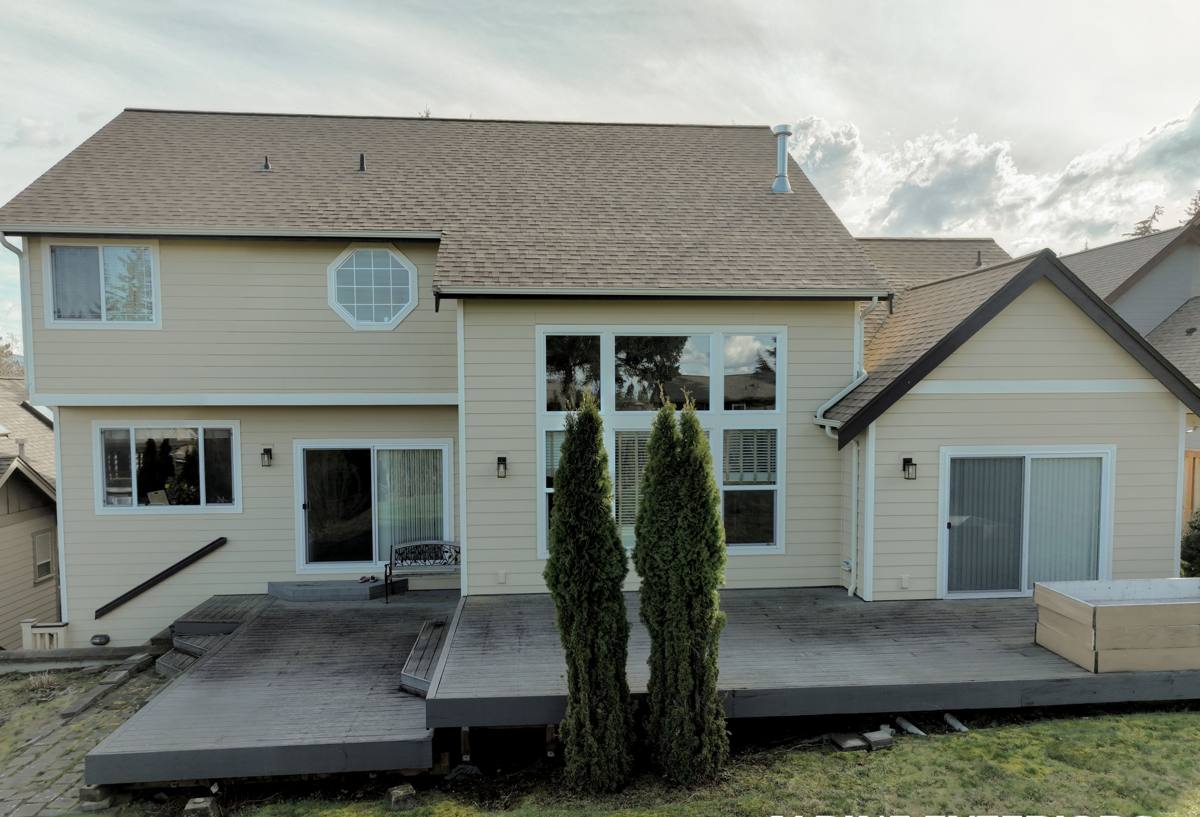
Signs Your Deck Needs Repair, Not Just a Cleaning
A lot of deck damage out here looks cosmetic at first — dark staining, green moss film, a board that feels a little spongy — but by the time it's visible on the surface, the damage underneath is usually further along than it looks. Here's what we check for and what homeowners should watch for between visits:
- Soft or spongy spots when you press down on a board, especially near the house or at board ends
- Visible gaps, cracking, or splitting where boards meet the ledger board (the board bolted to the house)
- Rust streaks running down from fasteners or joist hangers
- Wobble or movement in the railings when you lean on them
- Moss or algae buildup that stays damp for days after rain, especially on the shaded north or east side
- Gaps or separation where the deck meets the house siding or foundation
- Visible daylight or soft wood where posts meet the ground or a concrete footing
- A musty or mildew smell coming from underneath the deck
Any one of these on its own might be a simple fix. Several at once usually means moisture has been getting into the structure for a while, and it's worth a full inspection before it becomes a safety issue rather than a maintenance one.
The Ledger Board Is the One We Worry About Most
The ledger — the board that attaches the deck directly to the house — is the single most important connection on the whole structure, and it's also the one most exposed to hidden rot. Water tends to collect where the ledger meets the siding, and if flashing was missing or installed poorly when the deck was built, moisture can work its way in for years without showing an obvious sign outside. This is one of the first things we check on any repair call, because a deck can look structurally sound everywhere else while the ledger connection is quietly failing.
What a Correct Deck Repair Actually Involves
Deck repair gets treated as a simple job — swap a board, tighten a rail — and sometimes that's genuinely all it needs. But a repair that holds up through another decade of Whatcom County winters usually involves more than replacing what's visibly damaged. A thorough repair looks at:
- Structural framing — joists, beams, and posts checked for rot, not just the decking boards on top
- Ledger attachment and flashing — confirming the house connection is sealed and mechanically sound, not just cosmetically covered
- Fasteners and hardware — corroded screws, nails, or joist hangers replaced with hardware rated for the moisture and, where applicable, treated lumber contact
- Post bases and footings — checking for ground contact, standing water, or footings that have shifted or settled
- Railings and stairs — these take constant stress and are also where most fall-related injuries happen if they're loose
- Drainage — making sure water sheds off the deck and away from the house rather than pooling against the ledger or posts
Fixing a rotten board without addressing why it rotted just means you'll be back in the same spot in a few seasons. Our goal on every repair is to find and correct the actual moisture path, not just the symptom.
Deck Materials We See Around Whatcom County
Repair strategy depends a lot on what the deck is built from. Most homes in the Ferndale and Sumas area have one of three deck materials, and each behaves differently once it's had a few Pacific Northwest winters on it.
| Material | How It Ages Here | Repair Considerations |
|---|---|---|
| Pressure-treated lumber | Durable but prone to checking, splintering, and fastener corrosion over time; moss takes hold easily in shaded areas | Usually board-by-board replacement is straightforward; framing underneath needs a close look since treated lumber can rot quietly at connection points |
| Cedar | Naturally rot-resistant but the surface grays and softens without regular sealing; more prone to splintering as it ages | Matching weathered cedar tone takes care; structural members often outlast the surface boards |
| Composite decking | Resists rot in the boards themselves but can trap moisture against wood framing underneath if drainage wasn't planned for at install | Board repair is usually a color-match and fastener-system question; framing and ledger checks matter more since problems hide under a surface that looks fine |
None of these materials are wrong choices — each has trade-offs in maintenance, cost, and appearance. What matters for a repair is knowing how the specific material fails so we're not just patching the surface while missing what's happening underneath.
Our Deck Repair Process
We keep the process straightforward and don't push work that isn't needed:
- On-site inspection — we walk the full deck, check underneath where accessible, and test the framing, ledger, and posts, not just the surface boards
- Honest assessment — we tell you what's cosmetic, what's structural, and what can wait, in plain terms
- Written scope and estimate — you know what's being repaired and roughly what it involves before any work starts
- Repair work — board replacement, framing repair, fastener upgrades, flashing correction, and railing or stair work as needed
- Final check — we confirm the deck is solid, drains properly, and the repaired areas match the surrounding material as closely as practical
We're not trying to sell every homeowner a full deck replacement. If a targeted repair will genuinely hold up through another several winters, that's what we recommend.
Repair or Replace? What Actually Drives That Decision
This is the question almost every homeowner asks, and the honest answer is that it depends on how much of the structure is affected, not just how old the deck is.
| Factor | Leans Toward Repair | Leans Toward Replacement |
|---|---|---|
| Framing condition | Joists and beams are solid; damage limited to surface boards or a section of rail | Multiple joists or beams show rot or soft spots |
| Ledger connection | Ledger is sound once flashing is corrected | Ledger board itself is rotted or improperly attached to the house |
| Age and material | Deck is under 15-20 years old with isolated damage | Deck is older, undersized by current standards, or was built without proper flashing from the start |
| Footings and posts | Footings are stable and posts show only surface weathering | Footings have shifted, or posts show rot at ground contact |
| Scope of damage | Damage is localized to one area or side | Damage is spread across the whole structure |
We'll walk you through where your deck falls on that spectrum before recommending either direction — there's no benefit to us pushing a full replacement when a repair will genuinely do the job.
Permits, Code, and Safety
Structural deck repairs involving framing, ledger reattachment, or guardrails can fall under Whatcom County building code requirements depending on the scope of work. Guardrail height, baluster spacing, and stair rail requirements exist because deck failures and falls are genuinely dangerous, not as a formality. When a repair touches structural elements, we make sure the work meets current safety standards even if the original construction predates them — it doesn't cost much more to do it right, and it matters if anyone is ever standing on that deck during a full house gathering or a heavy wet-weather day.
Why Hiring a Crew That Already Works in Sumas Matters
Deck repair done by someone unfamiliar with this specific climate tends to miss the details that actually cause failures here — flashing that ignores how driving rain hits a ledger board at this latitude, fasteners that aren't rated for constant damp exposure, or framing repairs that don't account for how moss and moisture behave in shaded, low-airflow spots under a deck. We work on homes throughout Ferndale and out to Sumas regularly, so we're not guessing at how Whatcom County weather treats a deck over time — we're seeing it firsthand on jobs across the same climate your home sits in.
That familiarity also means a more accurate estimate. We're not learning the region on your project; we already know what tends to fail first, what tends to hold up, and where to focus the inspection so nothing gets missed.
If your deck has soft boards, rust stains, a wobbly rail, or you just haven't had it looked at in a few years, we're happy to come take a look. Reach out for a free, no-pressure estimate using the form below — we'll give you a straight answer on what it needs.