 Ferndale
 Composite Decking Built for Nooksack's Wet Ground and Long Wet Season
Nooksack sits in the river-valley country east of Ferndale, and that geography changes what a deck needs to survive out here. You're closer to the Nooksack River bottomlands than to open coastline, but Whatcom County's weather doesn't care much about the difference — driving rain off the Pacific, salt-tinged marine air pushed inland from Bellingham Bay, and a moss season that can run from October clear into May all reach properties out this way. Add in the shade from mature fir and cedar cover that's common on river-valley lots, and you get decks that stay damp longer than they would in a more open, sun-exposed yard.
Composite decking earns its keep in conditions like this. It doesn't absorb water the way wood does, it won't splinter or cup as it dries out between storms, and it holds up to the freeze-thaw swings that hit low-lying valley ground harder than they hit higher, better-drained lots. But composite is not maintenance-free, and it is not installer-proof. A poorly framed or poorly fastened composite deck will trap moisture, grow moss just as readily as wood, and fail at the connections long before the boards themselves wear out. This page is about what a composite deck actually needs to perform well on a Nooksack property, not just what the marketing on the board packaging says.
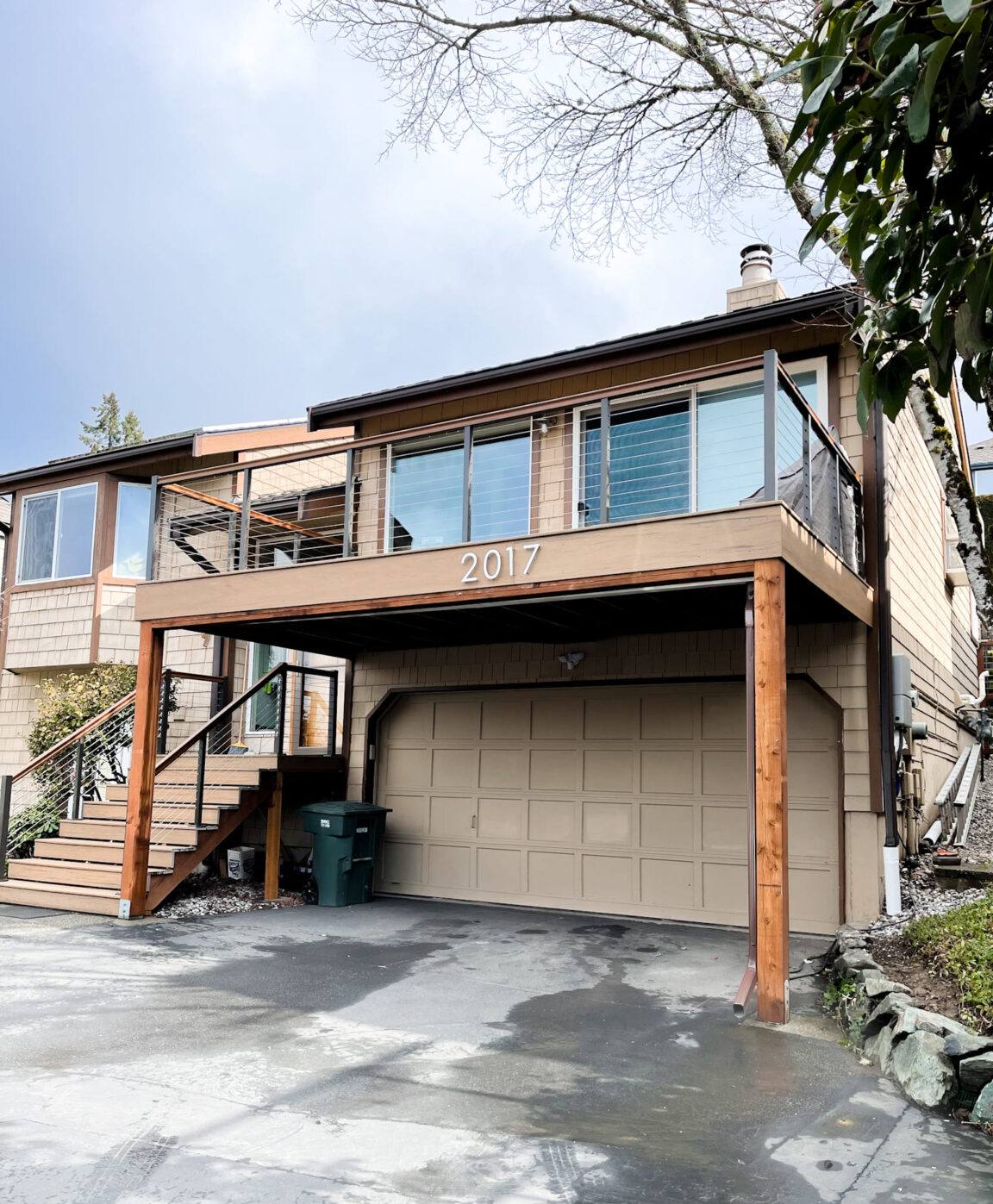
What Nooksack's Terrain and Moisture Mean for Your Deck's Substructure
The decking boards get all the attention, but the substructure underneath is what determines whether a deck lasts 10 years or 30. River-valley lots around Nooksack tend to have higher water tables and slower-draining soil than properties up on the bluffs closer to town. That matters for a few practical reasons:
- Ground clearance: Framing set too close to grade traps humid air underneath the deck, which is exactly what moss, algae, and mildew need to establish themselves on the underside of boards and on joists.
- Footing depth and drainage: Concrete footings need to be set below frost depth and away from standing water, and on soggier lots that sometimes means larger or deeper footings than a cookie-cutter plan calls for.
- Joist protection: Untreated or poorly wrapped joists are usually the first thing to fail on a "composite" deck, because homeowners assume the composite boards mean the whole structure is rot-proof. It isn't — only the visible decking is composite. The frame underneath is almost always still wood.
- Grading around the deck: If the yard slopes toward the house or toward the deck footprint, water pools right where you don't want it, accelerating everything above.
We look at drainage and grade before we ever talk board color. A deck that's built to shed water and breathe underneath will outperform one with premium decking sitting on a poorly protected frame.
Composite Decking Materials: What's Actually Different
"Composite decking" covers a range of products, and the differences matter more in a climate like ours than they would somewhere dry. The main categories:
| Type | Moisture Behavior | Maintenance | Best Fit For |
|---|---|---|---|
| Uncapped composite (older-style) | Wood-plastic blend can still absorb some moisture at cut edges; more prone to surface mold in shaded, damp spots | Occasional cleaning; edges need sealing at cuts | Budget-conscious projects with good sun exposure |
| Capped composite | Plastic shell resists moisture intrusion on the face and sides; cut ends are the vulnerable point | Periodic wash-down to prevent surface algae in shaded areas | Most Nooksack-area decks, especially shaded or river-adjacent lots |
| PVC (cellular) decking | No wood content, so it doesn't absorb water at all; least prone to mold from moisture retention | Lowest maintenance; still needs occasional cleaning of surface pollen and grime | Heavily shaded lots, decks near sprinklers, or homeowners who want the least upkeep |
| Pressure-treated wood (for comparison) | Absorbs and releases moisture constantly; drives the seasonal cupping, splitting, and graying you're trying to avoid by going composite | Annual cleaning and periodic staining/sealing | Lower upfront cost, higher ongoing labor |
Our standard recommendation for the Nooksack area is a quality capped composite for most lots, and we'll point shaded, low-airflow yards toward PVC decking specifically because it removes the moisture-absorption variable entirely. We don't push whichever product happens to be in stock — we look at your lot's sun exposure, tree cover, and drainage and match the material to those conditions.
Board Profile and Color Choices That Actually Matter Here
Darker, solid-color boards show pollen, cottonwood fluff, and algae streaking faster than variegated or lighter multi-tone boards, which is worth knowing before you commit to a color under mature trees. Grooved-edge boards paired with hidden fastener clips give a cleaner look and no exposed screw heads to trap moisture, but they also require consistent joist spacing and squared framing — another reason the substructure work has to be right before the boards go down.
Getting the Details Right: Fasteners, Flashing, and Airflow
Most composite deck problems we get called out to fix in Whatcom County aren't failures of the decking material — they're installation shortcuts. The details that actually determine longevity in our climate:
- Ledger board flashing: Where the deck attaches to the house, proper flashing keeps water from working its way behind the siding and into the wall framing. This is one of the most common failure points we find on older decks being replaced.
- Corrosion-resistant fasteners: With salt-tinged marine air reaching this far inland on a regular basis, standard fasteners corrode faster than they would in a dry inland climate. We use fasteners and hardware rated for coastal exposure, not the minimum-code option.
- Joist tape or joist protection: A strip of butyl tape over the top of each joist sheds water away from the wood and dramatically extends the life of the frame under composite decking.
- Board spacing: Composite expands and contracts with temperature more than people expect. Gaps that are too tight buckle in warm weather; gaps that are too wide catch debris and hold moisture. Manufacturer spec spacing, adjusted slightly for the specific product, gets this right.
- Airflow underneath: Skirting, if you want it, needs venting built in. Fully enclosed deck skirting without airflow is one of the fastest ways to grow moss and mildew on the underside of the frame in a valley climate like Nooksack's.
Moss, Algae, and the Long Wet Season
Whatcom County's moss season is long, and river-valley lots with tree cover get it worse than open, sun-exposed properties. Composite decking resists rot, but it does not resist surface growth — moss and algae will happily grow on top of a composite board the same way they grow on a roof or a fence, especially in shaded corners that stay damp for days after a storm. A few design and installation choices make a real difference in how much upkeep you'll deal with:
- Choosing a capped or PVC product over uncapped composite in shaded areas, since the sealed surface is easier to clean without scrubbing into the material
- Keeping overhanging branches trimmed back so the deck actually gets sun and airflow between rain events
- Directing downspouts and gutters away from the deck surface and substructure rather than letting them drain across it
- Sweeping debris off regularly through fall and winter so organic matter doesn't sit and compost on the boards
None of this eliminates cleaning entirely — no decking material does, in this climate — but it cuts down how often and how aggressively you need to do it.
Our Installation Process for Nooksack Homes
The same basic sequence applies to most composite deck projects, but the specifics get adjusted for your lot's drainage, sun exposure, and how the deck ties into the house:
- On-site evaluation of grade, drainage, existing structure (if replacing a deck), and the house's siding and framing where the ledger will attach
- Design and material recommendation based on shade, exposure, and how the space will actually be used
- Permitting and engineering as required by the county for footing size, ledger attachment, and guard rail height
- Footing and frame construction, including joist protection and corrosion-resistant hardware
- Ledger flashing and waterproofing at the house connection
- Composite board installation with manufacturer-spec fastening and spacing
- Rail, stair, and skirting installation with attention to ventilation
- Final walkthrough covering care and cleaning specific to the product installed
Cost Factors for a Nooksack Composite Deck
Every deck is different, and we won't quote a number without seeing the site, but these are the factors that move the price up or down on most projects:
| Factor | Why It Matters |
|---|---|
| Deck size and shape | Square footage and the number of corners, angles, or level changes affect both material and labor |
| Height off grade | Taller decks need more substantial footings, framing, and stair runs |
| Ground conditions | Soft, wet, or uneven ground on river-valley lots can require larger footings or additional excavation |
| Decking product tier | Entry-level capped composite, premium composite, and PVC decking span a wide price range |
| Rail system | Composite, aluminum, and cable rail all price differently and affect the overall look |
| Demolition and disposal | Replacing an existing wood deck adds tear-out and haul-away costs |
| Permit and engineering requirements | Larger or taller decks, or those attached to older homes, sometimes need engineered ledger connections |
Why Hiring a Crew That Already Works in the Ferndale and Nooksack Area Matters
A deck built to a generic national spec doesn't always hold up to Whatcom County conditions. Crews who work this area regularly already know how local building departments handle ledger attachment and guard rail requirements, what footing depths make sense on valley versus bluff lots, and which products actually perform once shade, moss, and driving rain get involved over a few winters — not just how they look on a showroom sample.
There's also a practical service side to hiring local: warranty work, seasonal cleaning advice, and follow-up questions are a lot easier to handle with a crew that's a short drive away rather than a company that installed your deck once and moved on to the next county. For a structure that's exposed to weather year-round, that ongoing relationship is worth something.
What to Check Before You Hire
- Are they licensed and insured to do deck construction in Washington, and can they show proof without hesitation?
- Do they pull permits and handle inspections, or leave that to you?
- Will they tell you why a product might not be a good fit for your specific lot, rather than upselling whatever they have on hand?
- Do they explain their fastening, flashing, and joist protection approach, or just talk about board color?
- Can they show you completed work in this climate, not just renderings or manufacturer photos?
Maintaining a Composite Deck in Nooksack's Climate
Composite decking cuts down on maintenance compared to wood, but "low maintenance" isn't "no maintenance," especially with our wet season. A realistic yearly routine:
- Sweep or blow off leaves, needles, and debris regularly through fall and winter rather than letting it accumulate
- Wash the deck surface at least once or twice a year with a soft-bristle brush and a cleaner rated for composite — pressure washers can damage the cap layer if used incorrectly
- Check and clear gaps between boards where debris and organic matter can collect and hold moisture
- Inspect railing connections, stair stringers, and any visible fasteners annually for corrosion or looseness
- Trim back overhanging branches to keep sunlight and airflow reaching the deck surface
- Address any moss or algae growth promptly rather than letting it establish, since it's far easier to clean off early than after it's taken hold
If you're weighing a new composite deck or replacing an aging wood one on a Nooksack-area property, we're happy to walk the site, look at your drainage and sun exposure, and put together a straightforward, no-pressure estimate. Use the form below to get started.