 Ferndale
 Why Siding Replacement Looks Different This Close to the Water
Homes in and around Lummi Nation sit close enough to Bellingham Bay and the Strait of Georgia that salt-laden air is part of daily life, not an occasional coastal event. Add Whatcom County's long wet season and the shaded, tree-covered lots common in this area, and you get three forces working on a house's siding at once: salt corrosion, sustained moisture exposure, and moss or algae growth that rarely gets a dry stretch long enough to fully clear out. A siding replacement out here isn't just about swapping old material for new — it's about choosing a product and installation method that can actually stand up to that combination year after year.
We see the same failure patterns repeatedly on homes near Lummi Nation: fastener corrosion on lower-grade metal siding, soft or delaminating wood-based products at ground level and around downspouts, and paint film failing early on siding that traps moisture instead of shedding it. None of that is a mystery — it's what happens when a product built for a drier, more sheltered climate gets installed in a marine environment. The fix isn't a better paint job. It's the right base material, installed with the right clearances and flashing details from the start.
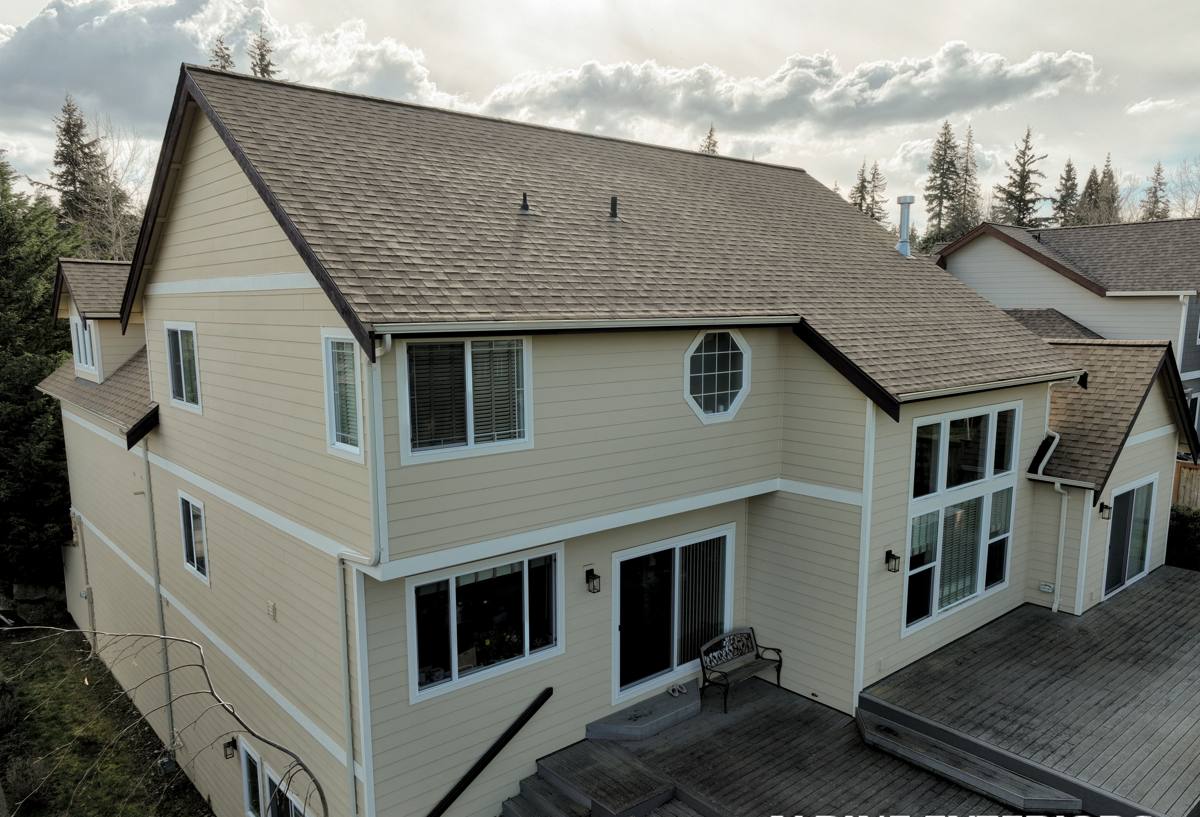
What Lummi Nation's Climate Actually Does to Siding
Salt Air and Fastener Corrosion
Salt spray carried inland on wind off the bay accelerates corrosion on anything metal — nail heads, trim fasteners, flashing, and staples. On many older homes here, you can see this rust bleeding through paint around every fastener point long before the siding itself has failed structurally. Once corrosion starts at a fastener, water tracks in behind the panel and the damage spreads from the inside out, which is often worse than it looks from the curb.
Driving Rain and Wind-Driven Moisture
Ferndale and the surrounding Whatcom County lowlands get rain that doesn't just fall straight down — winter storms push it sideways, and homes with exposed west and south elevations take the brunt of it. Siding with weak seams, inadequate lap coverage, or gaps at trim and window returns lets that wind-driven rain get behind the cladding. Once moisture is behind the siding, the wall assembly stays damp far longer in this climate than it would somewhere drier, which is exactly the condition that breeds rot and mold.
The Long Moss Season
Shaded lots, tree cover, and a climate that rarely dries out completely between fall and spring add up to a moss and algae season that can run eight months or more. Moss holds moisture directly against the siding surface, and on porous or textured materials it gets a grip that's hard to fully remove without damaging the finish underneath. Smooth, dense, factory-finished siding resists that grip far better than materials with an open or fibrous surface texture.
What a Correct Siding Replacement Involves Here
A proper replacement is more than pulling off old panels and nailing up new ones. In this climate, the details that get ignored are the ones that cause the next failure. Here's what we build into every Lummi Nation area job:
- Full tear-off and inspection of the sheathing underneath — soft spots and rot get repaired before anything new goes up, not covered over
- A correctly lapped weather-resistive barrier with proper flashing integration at every window, door, and penetration
- Rainscreen or drainage gap detailing where the wall assembly calls for it, so moisture that does get behind the cladding has somewhere to drain and dry
- Stainless or hot-dip galvanized fasteners rated for coastal exposure, not standard-grade fasteners that corrode within a few seasons
- Manufacturer-specified clearances at grade, roof lines, and decks so the siding never sits in standing water or constant shade-dampness
- Factory-finished panels with a warrantied, baked-on finish rather than field-applied paint, which holds up far better against salt exposure and UV
Skip any one of these and you're not really solving the problem that caused the old siding to fail — you're just delaying the same outcome by a few years.
Why We Only Install James Hardie Fiber Cement
We've made a deliberate call not to install vinyl, LP SmartSide, primed spruce, cedar, or other fiber cement brands like Cemplank or Allura — and in a climate like this one, that decision matters more than it would somewhere drier. Vinyl expands and contracts significantly with temperature swings and can warp or crack in sustained wind exposure; it also isn't structural, so it doesn't add anything to the wall assembly's resistance to wind-driven rain. Wood-based products like LP SmartSide and primed spruce are engineered wood at their core, and engineered wood with a compromised finish or a moisture intrusion point is vulnerable to swelling and rot — exactly the failure mode this climate is built to cause. Cedar is a beautiful, honest material, but it requires ongoing maintenance and refinishing to hold up against constant moisture, and most homeowners underestimate that upkeep until the siding's already showing damage.
James Hardie fiber cement is non-combustible, dimensionally stable, and doesn't absorb moisture the way wood-based or wood-fiber products do. Its ColorPlus factory finish is baked on and warrantied against fading and peeling, which matters directly here — a field-painted finish is the first thing salt air and constant damp weather go after. Hardie's HZ5 product line is engineered specifically for climates with freeze-thaw cycling and high moisture exposure, which describes Whatcom County's coastal weather well. It's not the only siding product on the market, but for a wall that has to perform through eight months of moss season and constant salt exposure without a maintenance repaint every few years, it's the one we're willing to put our name on.
Comparing Siding Options for This Climate
| Factor | James Hardie Fiber Cement | Vinyl | Wood-Based (LP SmartSide, Cedar) |
|---|---|---|---|
| Moisture resistance | Does not absorb water; won't swell or rot | Doesn't absorb water but seams and gaps allow water behind panels | Absorbs moisture at cuts, joints, and finish breaks |
| Salt air / corrosion resistance | Material itself doesn't corrode; needs coastal-rated fasteners | Material resists corrosion but can become brittle over time | Fasteners and finish both vulnerable to salt exposure |
| Moss and algae resistance | Smooth factory finish sheds growth better than porous surfaces | Resists moss fairly well but shows staining | Textured/porous surface holds moisture and moss |
| Finish durability | Factory-baked ColorPlus, warrantied against peeling/fading | Color molded through, but fades and chalks over time | Field-applied paint or stain, needs recoating every few years |
| Fire resistance | Non-combustible | Combustible, can melt or deform near heat | Combustible |
Signs Your Siding Needs Replacing, Not Just Repairing
Not every siding problem near Lummi Nation calls for a full replacement, but certain signs mean patching is just delaying the inevitable:
- Soft, spongy panels when you press on them, especially near the ground or under windows
- Persistent moss or algae growth that returns within weeks of cleaning
- Visible rust streaking from fasteners across multiple panels
- Paint or finish that's peeling or bubbling rather than just fading
- Warping, buckling, or gaps opening up at seams and corners
- Interior signs of moisture — musty smells, staining on interior walls near exterior corners
If you're only seeing one or two of these on an isolated section, a targeted repair might make sense. Multiple signs across several elevations usually mean the wall assembly underneath has been compromised for a while, and a full replacement is the more honest recommendation.
Our Process for Lummi Nation Area Jobs
We start with an on-site inspection, not a phone estimate — this close to the water, what's happening behind the siding matters as much as what's visible on the surface. From there:
- We assess the sheathing and framing once old siding is removed, and flag any repair work needed before new siding goes on
- We walk you through Hardie's HZ5 product options, ColorPlus finish colors, and trim profiles that fit the home
- We detail the weather barrier, flashing, and fastener plan specifically for the home's exposure — a south-facing wall with no tree cover gets treated differently than a shaded north wall
- We install to Hardie's published specifications, including clearances at grade and roof lines that many crews shortcut
- We walk the finished job with you before calling it complete
Because we work this area regularly, we already know which elevations tend to take the worst weather and which older homes nearby were built with siding details that don't hold up — that local pattern recognition is part of what a homeowner is paying for when they hire a crew that already knows the area, versus a contractor working here for the first time.
What Replacement Costs Depend On
We don't publish blanket per-square-foot pricing because it varies too much by house, but the real cost drivers on a Lummi Nation area job are consistent:
| Cost Factor | Why It Matters |
|---|---|
| Sheathing condition | Rot repair found during tear-off adds cost but is far cheaper to fix now than after new siding goes up over it |
| Home size and elevation count | More wall area and more corners, windows, and trim details mean more labor |
| Siding profile and finish | Lap width, texture, and color selection affect material cost within the Hardie product line |
| Trim and detail work | Homes with extensive trim, soffit, or fascia work require more precision and time |
| Access and site conditions | Tree cover, slope, and staging access affect labor time on many area lots |
We give you a firm, itemized quote after the on-site inspection — no surprise change orders for conditions we should have caught up front.
Ready for a Straight Answer on Your Siding
If your siding is showing rust streaks, spongy spots, or moss that won't quit, it's worth getting an honest look before winter's wind-driven rain finds its way in again. We'll walk your home, tell you what we actually see, and give you a straightforward, no-pressure estimate for a James Hardie siding replacement built for this exact climate. Use the form below to get started.