 Ferndale
 Why Marietta Homes Need Windows Built for This Climate
Marietta sits close enough to the water that homes here take a different kind of weather beating than houses further inland in Whatcom County. Salt-laden air off the bay works into window hardware and finishes year-round. Driving rain — the kind that comes in sideways during a fall or winter storm — tests every seal and flashing detail a window has. And the long stretch of grey, damp months that locals just call moss season keeps humidity pressed up against exterior walls for weeks at a time. Windows that were fine for a drier climate, or that were installed without real attention to water management, don't hold up well under that combination.
When we talk about "energy-efficient windows" for a Marietta home, we're not just talking about a good U-factor on a spec sheet. We're talking about a window and an installation that keeps water out, keeps moving air out, and keeps performing that way after five winters of salt air and driving rain, not just on install day.
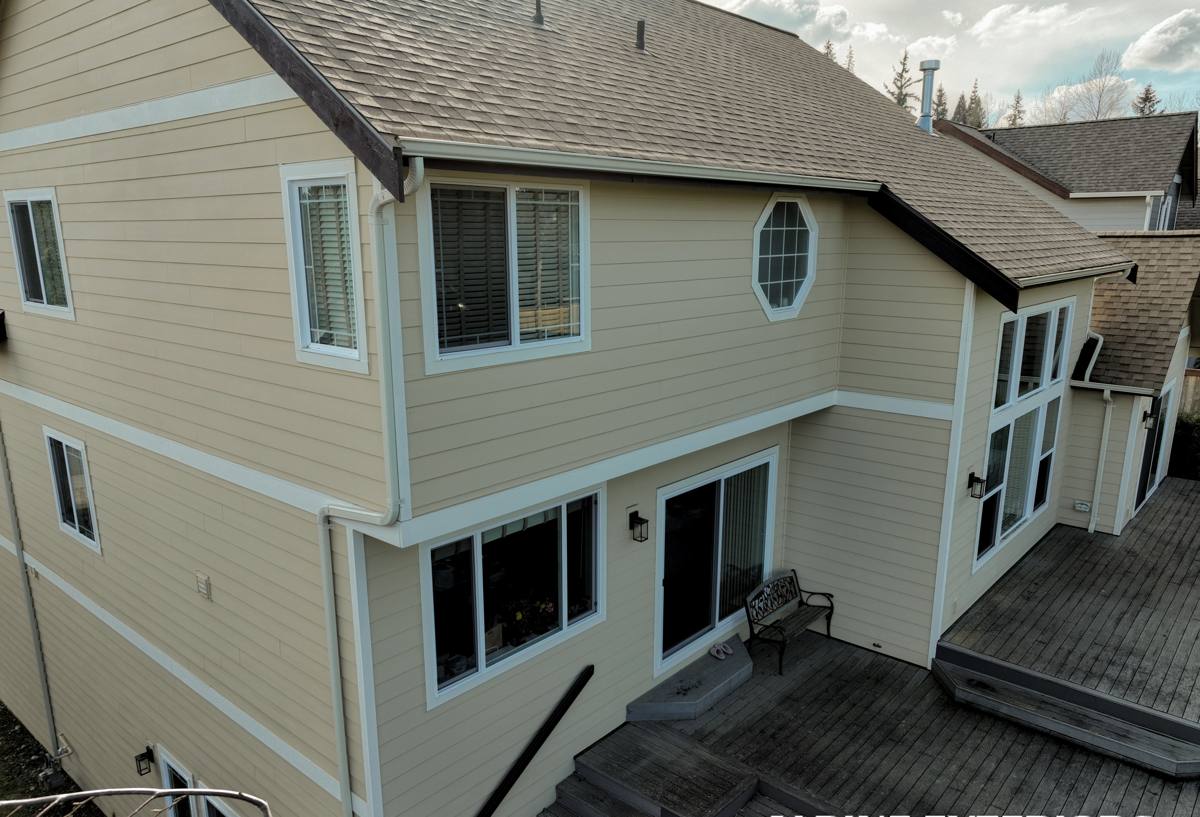
What Energy-Efficient Actually Means in This Climate
A window's efficiency comes from two things working together: the unit itself, and how it's installed. Either one done poorly undermines the other.
The Window Itself
- Low-E glass with argon fill — reduces heat loss through the glass, which matters most during our long heating season.
- Frame material — vinyl, fiberglass, and wood-clad all perform differently in salt air and constant moisture; more on that below.
- Multi-point locking hardware — pulls the sash tight against the weatherstripping, which matters a lot when wind is driving rain straight at the glass.
- Warm-edge spacer systems — the strip between panes of glass; a poor spacer is often where early seal failure and fogging start.
The Installation
A high-performance window installed with poor flashing or a gapped rough opening will underperform a mid-grade window installed correctly. In a climate that gets sustained driving rain, the flashing and sealant details around the window opening matter as much as the window's own rating — sometimes more. We treat these as one job, not two.
Signs Your Marietta Home's Windows Are Costing You Money
Most homeowners don't call us because a window shattered. They call because something feels off, and it's usually one of these:
- Cold drafts near the window frame even when the sash is fully latched
- Condensation forming between the panes (a sign the seal has failed, not just normal indoor humidity)
- Visible fogging or a milky haze in the glass corners
- Wood trim or sill staining, soft spots, or a musty smell nearby — often the first sign water is getting behind the frame
- Windows that are difficult to open, close, or lock, which usually means the frame has shifted or swollen
- A noticeably higher heating bill compared to similar homes nearby
Any one of these on its own might not be urgent. Several together, especially paired with visible staining, usually means water intrusion has already started — and that's a problem that grows quietly behind the wall until it doesn't.
Choosing the Right Frame Material for a Marietta Property
We get asked a lot whether vinyl, fiberglass, or wood-clad is "the best" window. The honest answer is that it depends on the home, the budget, and how much upkeep the owner wants to take on — but in a salt-air, high-moisture climate, some trade-offs matter more than they would elsewhere.
| Frame Material | Moisture & Salt-Air Behavior | Maintenance | Typical Trade-Off |
|---|---|---|---|
| Vinyl | Won't rot or corrode; handles salt air well | Low — occasional cleaning | Frame can expand/contract more with temperature swings; color/finish options are more limited |
| Fiberglass | Very stable in moisture and salt air; minimal expansion | Low | Higher upfront cost than vinyl |
| Wood-clad | Exterior cladding protects the wood, but any breach in the cladding lets moisture into the wood core | Higher — cladding seams and any exposed wood need monitoring | Best appearance for some homeowners, but least forgiving of installation mistakes in a wet climate |
| Aluminum | Corrodes faster in salt air unless heavily coated; conducts cold | Moderate | We generally steer Marietta homeowners away from uncoated aluminum for this reason — it's a real maintenance and efficiency trade-off here, not a knock on the material everywhere |
We're upfront about this table when we're standing in front of your house. There isn't one universally "right" answer — a fiberglass window on a wind-exposed side of the house and a vinyl window on a sheltered side is a perfectly reasonable mixed approach, and we'll tell you when that makes sense instead of upselling the priciest option across the board.
How Our Installation Process Works
The window is maybe 40% of the job. The other 60% is what happens in the rough opening before the window ever goes in, and how the exterior is sealed and flashed after.
1. Assessment and Measurement
We check the existing opening for rot, soft framing, or prior water damage before quoting the work — this is common enough on older Marietta homes that we build the check into every estimate rather than treating it as a surprise change order later.
2. Removal and Opening Prep
We remove the old unit carefully to avoid damaging siding or trim we plan to reuse, then inspect and repair the sheathing and framing underneath. Any soft or water-stained wood gets addressed here — installing a new window over a compromised opening just hides the problem.
3. Flashing and Water Management
This is the step that matters most in our climate. We install a sill pan and properly lapped flashing tape so that any water that does get past the exterior cladding drains back out instead of pooling at the sill or working into the wall cavity. In a region with sustained driving rain, this detail is the difference between a window that stays dry for decades and one that quietly rots its opening from the inside.
4. Setting, Shimming, and Sealing
The window is set level and plumb, shimmed to avoid racking the frame (which causes hardware and lock problems down the road), and sealed with the appropriate exterior sealant and backer rod — not just a bead of caulk over a gap.
5. Interior and Exterior Finish
Trim, insulation around the frame, and final exterior caulking or cladding integration are completed, and we walk the operation of every window with you before we consider the job done.
Local Considerations We Build Into Every Marietta Job
Salt Air
Proximity to the water means hardware, fasteners, and finishes corrode faster than they would further inland. We choose corrosion-resistant hardware and fastener grades for homes in this area rather than treating every job in Whatcom County the same.
Driving Rain
Wind-driven rain finds any gap in flashing or sealant that a calm rainfall never would. Our flashing details are built assuming wind-driven rain is normal weather here, not a rare event.
Moss Season
The long damp stretch of the year keeps humidity against exterior surfaces for weeks at a time. Good window installation includes making sure water sheds away from the sill and doesn't sit against wood trim, which is exactly the condition that lets moss and rot get a foothold.
What Affects the Cost of a Window Project
We don't publish fixed prices because every home and every opening is different, but these are the factors that actually move the number:
| Factor | Why It Matters |
|---|---|
| Frame material chosen | Vinyl, fiberglass, and wood-clad have different material costs |
| Number and size of openings | Larger or custom-sized windows cost more to fabricate and install |
| Condition of existing openings | Rot or framing repair adds labor beyond a straightforward swap |
| Full-frame vs. insert replacement | Full-frame replacement (removing down to the studs) costs more but is often the right call when there's water damage or the opening needs resizing |
| Glass package | Upgraded Low-E coatings or gas fills add modest cost for better performance |
| Trim and finish work | Matching existing interior or exterior trim adds labor |
Whole-home window replacements are a significant investment, and single-window repairs or replacements are far more modest — we'll walk you through where your project falls once we've seen the openings in person.
What a Correct Installation Should Always Include
- Inspection of the rough opening for rot or moisture damage before the new window goes in
- A properly installed sill pan and lapped flashing, not just caulk over the gap
- Level, plumb, and square setting with shims — not screwed in tight against a racked frame
- Corrosion-resistant fasteners and hardware appropriate for a coastal-influenced climate
- Continuous insulation around the frame, with no gaps that create cold spots
- Exterior sealant matched to the cladding material, applied with proper backer rod
- A walk-through where every window's operation is checked with you before the crew leaves
If a bid skips most of these steps, it's usually because they're being skipped on the job too — and in this climate, that shows up as water damage a few years down the line, not a warranty claim on day one.
Why Hiring a Crew That Already Works in Marietta Matters
Window installation done to a generic national standard is not the same as window installation done for this specific stretch of Whatcom County. A crew that regularly works in Marietta and the surrounding Ferndale area already knows which sides of a house typically take the worst of the wind-driven rain, how long the moss season actually runs here, and what salt exposure does to hardware over a handful of winters. That local pattern recognition shows up in small decisions — sealant selection, flashing lap direction, hardware grade — that a one-time or out-of-area installer has no reason to think about.
It also matters after the job is done. A local crew is easy to reach if a question comes up during the first hard rain of the season, and stands behind the work because the reputation is local, not a name on a truck passing through.
If your windows are drafty, fogged, hard to operate, or you're just planning ahead for a home in Marietta, we're happy to walk through your home and give you a straightforward, no-pressure estimate — including the material and installation trade-offs specific to your property. Use the form below to get started.