 Ferndale
 Why Point Roberts Windows Wear Out Faster Than Most
Point Roberts sits on its own peninsula at the edge of the Salish Sea, and that location is exactly what makes window performance so different here than it is a few miles inland. Homes take a steady dose of salt-laden air off the water, wind-driven rain that hits siding and glass sideways instead of straight down, and a moss season that can stretch from October well into spring. None of that is unique to any one house — it's the baseline every window on this peninsula has to survive, year after year.
Salt air is corrosive to metal hardware, weep systems, and cheaper fasteners long before most homeowners notice a problem. Driving rain finds any gap in flashing or sealant and pushes water uphill against gravity, which is why sill design and flashing detail matter more here than in a drier climate. And the long damp season that feeds the moss on your roof and siding also feeds condensation problems inside window frames that aren't detailed correctly. Any window product can look fine in a showroom. Whether it actually holds up on this stretch of Whatcom County coastline is a different question.
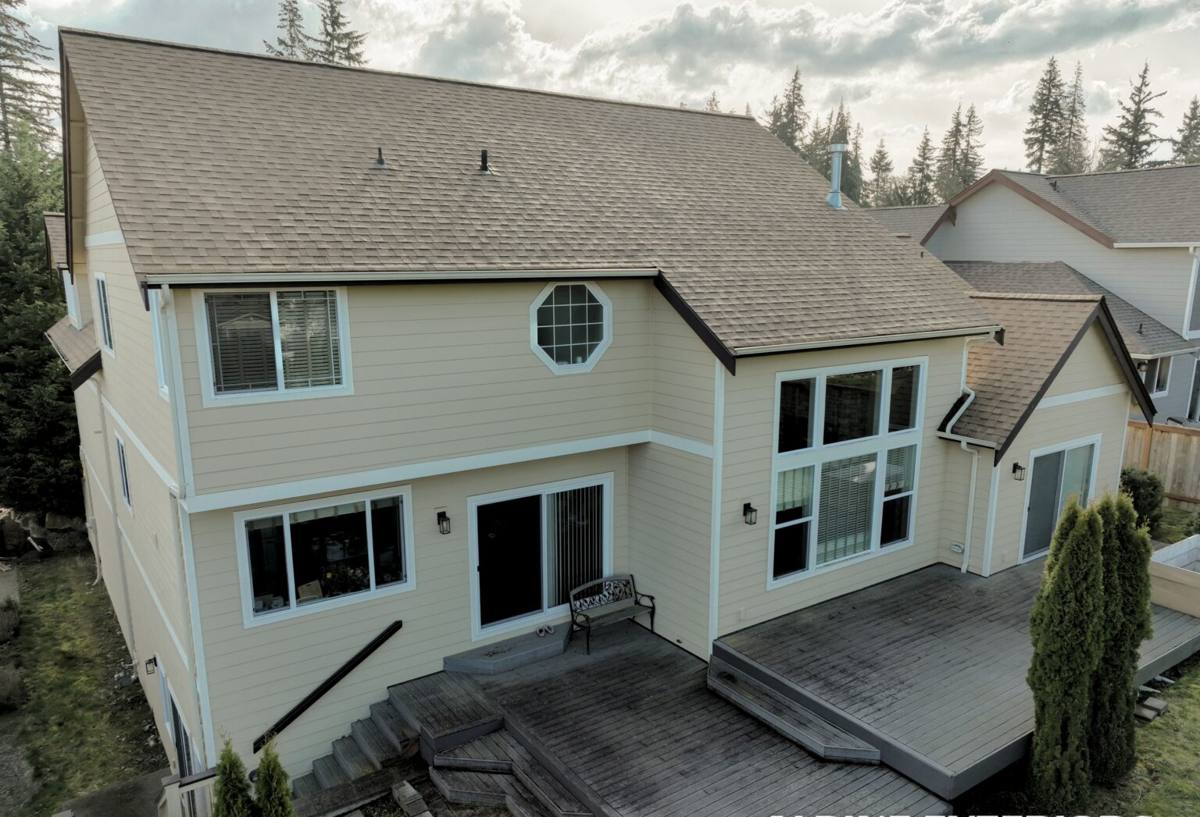
What "Energy-Efficient" Should Actually Mean Here
Energy efficiency gets marketed as a single number, but in a marine climate like this one it's really three separate jobs the window has to do at once:
- Keep heat in. Whatcom County's marine climate means the heating season is long even if temperatures rarely swing to extremes — a window's U-factor (how well it resists heat loss) matters more here than its solar heat gain coefficient, which is the number that gets more attention in hotter climates.
- Resist condensation. High outdoor humidity plus a warm indoor house is a recipe for moisture forming on glass and, worse, inside the frame cavity. A window with a poor condensation resistance rating will fog, drip, and eventually feed mold growth around the frame — right in step with moss season outside.
- Shed wind-driven water. Efficiency isn't just thermal. A window that lets rain past its weep system during a storm is losing you money in a different way — through rot, drywall damage, and eventually a bigger repair than the window itself.
A window rated for a dry inland climate can perform poorly on all three fronts out here even with a good-looking energy label. That's why we talk through actual performance ratings with homeowners rather than just quoting a brand name.
Frame Material Trade-Offs for a Salt-Air, High-Moisture Climate
There's no single "best" frame material — every option is a set of trade-offs, and the right call depends on the specific wall, exposure, and budget. Here's how the common choices stack up for a Point Roberts home:
| Frame Material | Salt-Air / Corrosion Resistance | Moisture Behavior | Maintenance |
|---|---|---|---|
| Vinyl | Good — won't corrode or rust | Doesn't absorb water; seams are the weak point | Low — occasional cleaning |
| Fiberglass | Very good — dimensionally stable in salt air and temperature swings | Excellent — resists warping and moisture absorption | Low |
| Wood / Wood-clad | Requires diligent upkeep near salt air and driving rain | Vulnerable if finish or cladding fails | Higher — periodic refinishing or caulk checks |
| Aluminum (uninsulated) | Prone to corrosion and condensation on frame | Poor thermal performance, conducts cold | Moderate |
We steer most Point Roberts homeowners toward vinyl or fiberglass for exposed, water-facing walls, simply because the maintenance burden of wood cladding in this exposure is real — not because wood windows are a bad product in general. It's a trade-off between upfront cost, appearance, and how much upkeep you want to sign up for on a house that already fights moss and salt spray on the exterior.
What About Triple-Pane?
Triple-pane glass adds real value on the most exposed, water-facing sides of a house — better condensation resistance and a warmer interior surface temperature. On more sheltered walls, a quality double-pane unit with a good low-E coating and warm-edge spacer often gets you most of the benefit for less money. We'll walk the house with you and point out where the upgrade is worth it and where it isn't.
Installation Details That Actually Matter Out Here
The window unit itself is maybe half the job. The other half is how it's installed, and in a driving-rain climate the installation details are what separate a window that lasts twenty-plus years from one that leaks behind the trim in five.
- Sill pan flashing that directs any water making it past the window back outside, not into the wall cavity.
- Proper flashing sequencing — the layers need to shingle correctly with the house wrap so water always sheds downward and outward, never behind the barrier.
- Corrosion-resistant fasteners and hardware rated for coastal exposure, not standard-grade hardware that starts pitting within a couple of seasons of salt air.
- Sealant selection matched to the substrate and expected movement — the wrong sealant can fail or crack loose in this climate's freeze-thaw and wet-dry cycling.
- Interior air sealing, which controls condensation risk as much as exterior sealing controls bulk water.
Skipping any one of these doesn't usually show up on install day. It shows up two or three winters later as a soft spot in the sill, a stain on the drywall below the window, or fogging between the panes.
The Point Roberts Access Factor
Point Roberts is geographically part of Washington but physically cut off from the rest of the state by land — reaching it by road means crossing the international border twice, once each way. That's not a trivia point, it's a real scheduling and logistics factor that affects who can reliably service this community and how well.
A crew that doesn't regularly work in Point Roberts has to build border crossing time into every trip, coordinate material deliveries around it, and often treats the peninsula as a special-case job rather than routine territory. That tends to show up as longer lead times, less flexibility on scheduling, and less familiarity with the specific conditions a Point Roberts home faces compared to a similar house a few miles away in Ferndale or Blaine. Crews who already build regular trips to the peninsula into their schedule can plan material orders, sequence multiple jobs on the same visit, and respond faster if something needs a follow-up.
How the Process Works
For a window project on a Point Roberts home, our process runs the same regardless of house size — we just scale the visits:
- On-site assessment. We look at existing window condition, framing, exposure on each side of the house, and any signs of past water intrusion or condensation staining.
- Measurement and product selection. We measure precisely and talk through frame material, glazing package, and performance ratings suited to that specific wall's exposure.
- Scheduling around access. Because of the border crossing, we plan material delivery and crew scheduling as a single coordinated trip rather than piecemeal visits.
- Removal and installation, including proper flashing, sill pan, air sealing, and corrosion-resistant hardware throughout.
- Final inspection and cleanup, checking operation, seal, and weatherproofing details before we consider the job done.
Signs Your Current Windows Are Already Costing You
Homeowners often wait until a window visibly fails, but there are earlier warning signs worth acting on sooner:
- Condensation or fog forming between panes of double-pane glass (a sign the seal has failed)
- Visible corrosion or pitting on hardware, latches, or hinges
- Drafts you can feel near the frame even when the window is fully latched
- Soft or discolored wood, drywall, or trim directly below or beside a window
- Difficulty opening, closing, or latching that didn't used to be there
- A noticeable jump in heating costs without a clear other cause
- Moss or dark staining creeping onto the window trim from the surrounding siding
What Affects the Cost
Every house is different, but the main cost drivers on a Point Roberts window project are consistent:
| Factor | Why It Matters |
|---|---|
| Frame material | Vinyl, fiberglass, and wood-clad carry different material costs and labor requirements |
| Glazing package | Double-pane vs. triple-pane, low-E coatings, and gas fill affect both price and performance |
| Number and size of openings | More or larger windows means more material and labor |
| Exposure and existing condition | Walls with heavy weather exposure or existing rot need more prep work before install |
| Access and scheduling | Coordinating border-crossing logistics factors into project timing |
We give straightforward, itemized estimates so you can see exactly what you're paying for and why — no inflated "good-better-best" packages designed to push you toward the most expensive option.
Why the Right Crew Matters More on This Peninsula
Point Roberts homeowners are, in a real sense, underserved by the standard contractor pool — many companies treat it as too much hassle to visit regularly, which limits your options and can mean settling for whoever's willing to make the trip rather than who does the best work. A crew that already has Point Roberts in its regular rotation brings two things a one-off visitor can't: familiarity with how salt air, driving rain, and the long moss season actually behave on homes in this specific spot, and a logistics plan that doesn't turn your project into the exception that gets delayed.
If your windows are drafty, fogged, corroding, or just old enough that you're wondering whether they're still doing their job, we're happy to take a look. Reach out for a free, no-pressure estimate using the form below — we'll walk the house, talk through what each window actually needs, and give you a straight answer either way.