 Ferndale
 Siding Repair in Lynden: A Different Kind of Wear Pattern
Lynden sits inland from the coast, but it still gets the full weather load that moves through Whatcom County: long stretches of steady rain, damp fall and winter air that never quite dries out, and the kind of humidity that keeps moss and algae established on north-facing walls for most of the year. Add the driving rain that comes with wind off the Strait and the Nooksack valley's own low-lying dampness, and you get a climate that is hard on siding in ways that are easy to miss from the ground.
Most siding repair calls we get in Lynden aren't dramatic. Nobody notices a storm blow a panel off the wall. What actually happens is slower: a seam opens a hairline gap, water gets behind the cladding instead of running off it, and by the time a soft spot or a stain shows up on the interior wall, the damage has been building for a season or more. Repairing siding correctly here means understanding that pattern, not just patching what's visible.
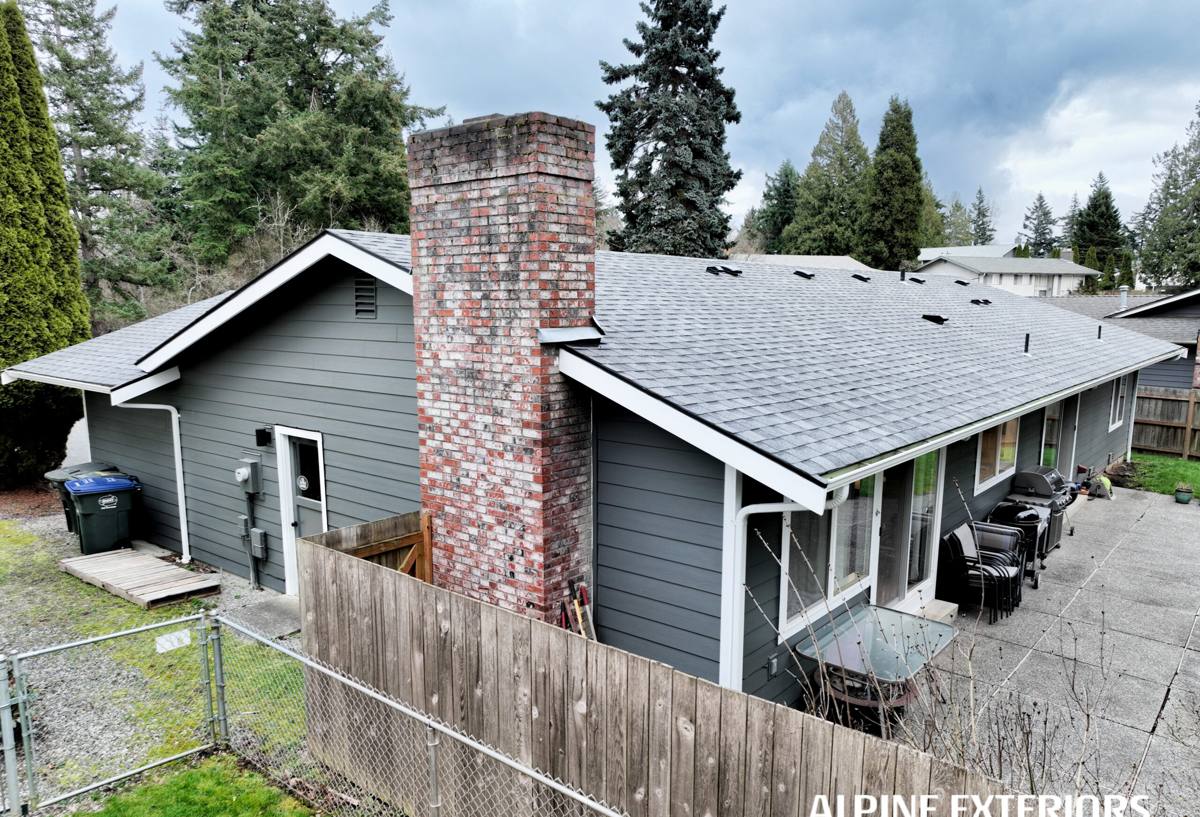
The Damage We See Most Often Around Lynden
Every siding material fails differently, but a few problems show up again and again on homes in and around Lynden:
- Moisture wicking at the bottom edge — siding installed too close to grade, decks, or hardscaping stays wet longer and swells, softens, or delaminates from the bottom up.
- Moss and algae growth — thick moss on north- and west-facing walls holds moisture against the surface, which accelerates rot on wood-based products and stains fiber cement if left untreated for years.
- Cracked or missing caulking — caulk is not a permanent seal; once it shrinks or separates at joints, trim, and penetrations, water has a direct path behind the siding.
- Panel delamination — common on wood composite and OSB-based products once moisture gets into the substrate; the layers separate and the panel loses structural integrity.
- Hairline cracking — fiber cement can develop small cracks from impact or settling; left alone, a crack becomes an entry point for water.
- Pest and rot damage at trim and corners — wood trim and untreated cut edges are the most common entry points for both moisture and insects on older siding systems.
Why a Correct Repair Isn't Just a Patch
Find the Water Path First
The visible damage is rarely the whole story. A stained or soft panel is usually the endpoint of a water path that started somewhere else — a failed piece of flashing, a gap at a window head, a seam that was never properly lapped. Replacing the damaged panel without finding and correcting that source just buys a few years before the same spot fails again. Any repair worth doing starts with tracing the problem back to its cause, not just covering the symptom.
Check What's Behind the Siding
On some repairs, the siding itself is fine and the problem is behind it — a torn or missing piece of weather-resistive barrier, incorrect flashing at a window or door, or house wrap that was never lapped correctly during the original install. A repair that only addresses the outer skin without checking the drainage plane behind it isn't a complete fix, even if it looks clean when it's done.
Match Material and Method, Not Just Color
Repairing siding well means the patch performs the same as the surrounding material — same expansion behavior, same fastening pattern, same drainage detail — not just a close paint match. This is one of the reasons mismatched or improvised repairs on wood composite and OSB-based siding tend to fail again faster than a repair done to the manufacturer's actual specification.
Repair or Replace? How We Make That Call
Not every damaged section needs a full re-side, and not every issue can be solved with a patch. We look at scope, cause, and material condition together before recommending either path.
| Situation | Usually Repairable | Usually Needs Replacement |
|---|---|---|
| Cracked or impact-damaged panel, isolated area | Yes — panel swap, matched material | Only if surrounding panels are also compromised |
| Water damage at one wall or corner | Yes, if substrate underneath is sound | If sheathing or framing has rot damage |
| Widespread delamination on wood composite siding | Rarely — usually a systemic material issue | Yes — patching won't stop the underlying failure |
| Failed caulking, open seams, no material damage yet | Yes — reseal and monitor | No |
| Siding is 20+ years old with scattered failures | Case by case | Often more cost-effective long term |
When repair makes sense, we do a repair. We're not trying to sell a full re-side to every homeowner who calls about one damaged panel — but we will tell you honestly when patch-and-monitor is just delaying a bigger job.
Our Process for a Lynden Siding Repair Call
- Inspection. We walk the exterior, looking past the obvious damage at flashing, trim, seams, and grading around the foundation.
- Diagnosis. We identify the actual water path or failure cause, not just the visible symptom, and explain it in plain terms.
- Honest scope and quote. You get a clear recommendation — repair, or replace if repair won't hold — with the reasoning behind it.
- The repair itself. Matched materials, correct flashing and sealing details, and fastening to the manufacturer's spec, not just "close enough."
- Check behind the wall when warranted. If there's any sign the barrier or sheathing was compromised, we address that before closing the wall back up.
What a Thorough Repair Estimate Looks At
- Extent of visible damage versus likely hidden extent
- Condition of flashing at windows, doors, and roof-to-wall intersections
- Grading and drainage at the base of the wall
- Whether the original siding material is still available or needs a compatible substitute
- Whether the damage is isolated or a sign of a systemic install issue elsewhere on the house
What We Install When Repair Isn't Enough
When a section of siding is too far gone to repair, or a homeowner decides it's time to stop patching an aging product, we install James Hardie fiber cement — and only James Hardie. It's non-combustible, holds a factory ColorPlus finish that doesn't need repainting on the schedule that wood and composite products do, and Hardie's HZ5 product line is engineered for the freeze-thaw, moisture-heavy climate that Whatcom County sees every winter. We don't install vinyl, LP SmartSide, or cedar, because we've seen how those products age under exactly the wet, moss-prone conditions Lynden deals with — and we'd rather stand behind one product we trust than sell whatever's cheapest that week.
That standard also shapes how we repair. If a home already has Hardie siding, a repair is usually a clean, durable fix because the material itself resists the moisture damage that drives most repair calls in the first place. If a home has an older wood composite or vinyl product with a failure, we'll patch it correctly — but we'll also be straight with you about whether that product is worth continuing to chase repairs on.
Why a Crew That Already Works Lynden Matters
Siding repair is a job where local familiarity actually changes the outcome. A crew based in Ferndale that regularly works Lynden and the surrounding county knows what this specific climate does to siding over years, not just what a manufacturer's manual describes in general terms. That means recognizing moss patterns that signal a drainage problem rather than just a cosmetic one, knowing which details tend to fail first on homes built during particular eras in this area, and not having to relearn the region's weather behavior on your dime.
It also means accountability. A crew that works this area regularly has a reason to do the repair right the first time — we're not driving in from out of the area for a one-off job. If something about a repair doesn't hold up, we're easy to reach and close by.
Between Repairs: What Homeowners Can Do
Good maintenance doesn't prevent every repair, but it slows down how fast damage develops and makes small problems easier to catch before they become expensive ones.
- Walk the exterior once or twice a year and look for gaps at caulked joints, trim, and penetrations
- Keep gutters clear so overflow isn't running down the siding face
- Trim back vegetation and keep sprinklers from hitting the siding directly
- Watch north- and west-facing walls for moss buildup and address it before it thickens
- Check that soil, mulch, or hardscaping isn't sitting against the bottom edge of the siding
- Note any soft spots, discoloration, or bubbling paint and have them looked at before the next wet season
If you're seeing damage, discoloration, or soft spots on your Lynden home's siding, we're glad to take a look and give you a straight answer on whether it's a repair or something bigger — no pressure, no upsell. Use the form below to request a free estimate.