 Ferndale
 Building a Deck That Can Actually Handle This Location
Homes on and around the Lummi Nation sit closer to open water than almost anywhere else we work in Whatcom County. That proximity is exactly why the property is beautiful — and exactly why an outdoor deck here takes more abuse than a deck built ten miles inland. Salt-laden air moves off the water and settles on every exposed surface. Wind-driven rain doesn't just fall straight down, it gets pushed sideways into fascia boards, ledger connections, and stair stringers that a typical deck design assumes will stay relatively dry. And the long, gray Pacific Northwest wet season gives moss, algae, and mildew months at a time to establish themselves on any surface that holds moisture.
A deck built without those specific conditions in mind will still look fine the day it's finished. The problems show up eighteen months to three years later — soft spots at the ledger, green film on the walking surface, corroding fasteners, boards that cup or gap unevenly. Composite decking, installed correctly for this environment, avoids nearly all of that. Installed generically, the same material can still disappoint a homeowner who assumed "composite" meant "maintenance-free anywhere."
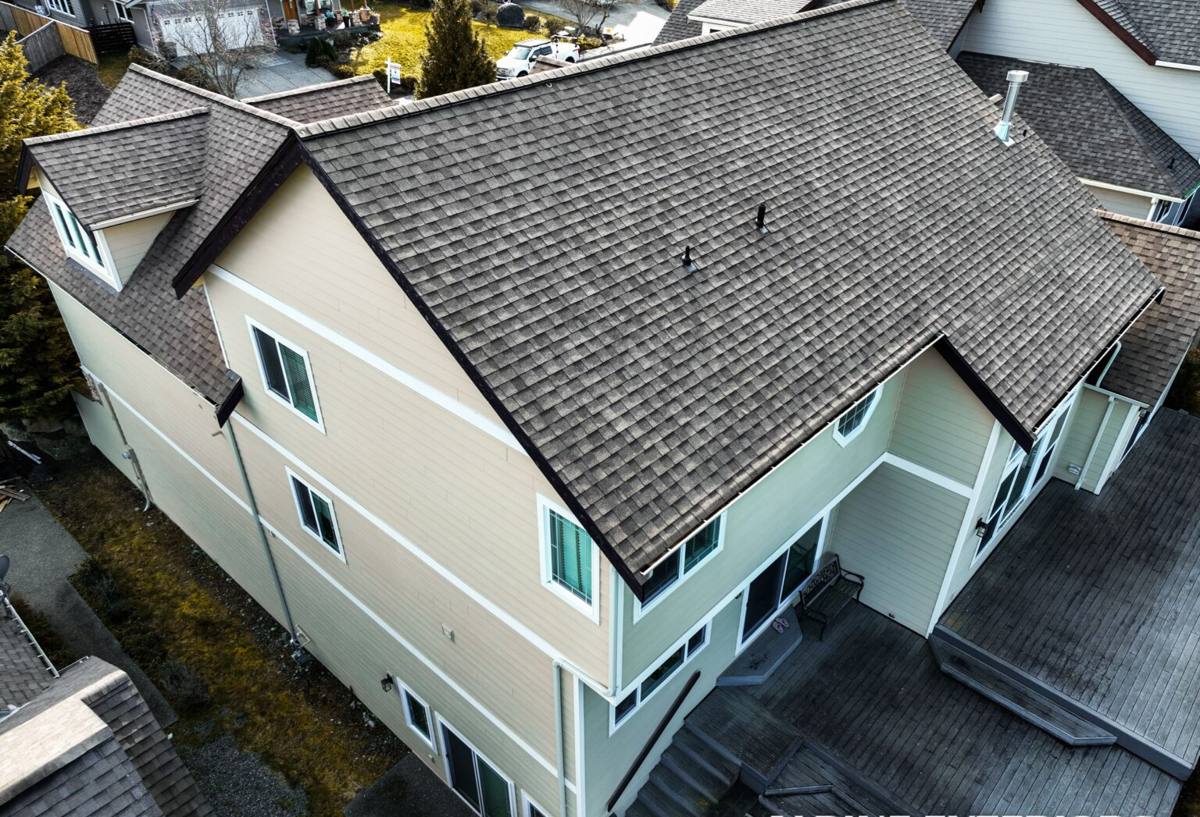
What Salt Air and Driving Rain Actually Do to a Deck
Salt air and metal components
Salt in the air accelerates corrosion on anything metal — fasteners, joist hangers, railing brackets, post bases. On a standard inland deck, mild-steel or basic coated hardware can last for years without issue. Near the water, that same hardware can start showing rust streaks and weakening within a couple of seasons. This matters more than most homeowners expect, because a deck's structural integrity depends on its hardware holding, not just its boards looking good.
Driving rain and hidden moisture
Rain that comes in at an angle finds its way into places vertical-fall rain never reaches: behind ledger boards, into end-grain cuts, under poorly flashed stair stringers, and into any gap where two framing members meet without a drainage path. Composite boards themselves don't rot, but the framing underneath them — and any wood trim used alongside them — absolutely can if water is allowed to sit against it.
The long moss season
Whatcom County's wet season stretches for months, and a shaded, low-airflow deck surface near the water gets even less chance to dry out between rain events. Moss and algae need three things to take hold: moisture, organic debris, and low sunlight — a description that fits a lot of decks around here for a good chunk of the year. Boards with a textured, low-sheen surface and a design that promotes drainage and airflow underneath resist this far better than boards installed flat against poor substructure ventilation.
Why Composite Makes Sense for This Environment
We don't push composite decking as a trend — we recommend it here because it solves specific problems this location creates. A quality capped composite board doesn't absorb water into its core the way real wood does, so it doesn't swell, splinter, or rot from the driving rain this area gets. It doesn't need annual staining or sealing, which matters when the boards are drying more slowly than they would inland. And it holds its color and surface texture through repeated exposure to salt air far longer than an unfinished or painted wood surface will.
That said, "composite" isn't one product. Cheaper, uncapped composite boards can still absorb moisture at the edges and are more prone to mold staining in a wet, shaded environment. We install capped composite specifically because the cap layer is what actually blocks moisture and resists the algae growth this climate encourages.
Composite vs. the Alternatives, for This Climate
| Factor | Capped Composite | Pressure-Treated Wood | Uncapped/Budget Composite |
|---|---|---|---|
| Moisture and rain resistance | Very good — sealed core, no swelling | Fair — treated but still absorbs water, especially at cuts | Fair — core can still take on moisture at edges |
| Salt air tolerance | Very good with correct fasteners | Moderate — fasteners and connectors corrode faster than the wood fails | Moderate — surface can chalk or stain |
| Moss/algae resistance | Good, especially textured caps | Poor — bare wood grain holds moisture and debris | Fair — more prone to surface mold than capped boards |
| Maintenance routine | Occasional wash-down | Annual cleaning, sealing, or staining | Periodic cleaning, watch for edge wear |
| Realistic lifespan here | 25+ years with proper substructure | 10–15 years before major repair | 15–20 years, variable by brand and grade |
What a Correctly Built Composite Deck Involves
The boards are maybe a third of the job. The parts that determine whether a deck survives this climate are mostly things you'll never see once it's finished.
Substructure and framing
Joists and beams need to be protected from moisture before decking ever goes down — joist tape or a comparable barrier over the top of each joist, correct flashing where the deck ties into the house, and framing spaced and treated to shed water rather than trap it. This is the single most common shortcut we see on decks that fail early: good boards on top of an unprotected frame.
Fasteners and hardware
Given the salt air, we use corrosion-resistant fasteners and connectors rated for coastal or marine-adjacent exposure, not standard-grade hardware. Hidden fastener systems also matter here — fewer surface penetrations through the board face means fewer points where water can work its way into the board core over time.
Drainage and airflow underneath
A deck built low to the ground or against a slope needs a real plan for water to get out from underneath it — grading, gaps, or a drainage system depending on the site. Poor airflow under a deck is one of the biggest contributors to the moss and mildew problems we see on otherwise well-built decks in this area.
Ledger connections
Where the deck attaches to the house is the single highest-risk point for water intrusion on any deck, and driving rain makes it worse here than in a typical inland install. Correct flashing at this connection isn't optional — it's the difference between a deck that lasts decades and one with hidden rot behind the siding within a few years.
Our Process, Start to Finish
We keep the process straightforward and give you a real look at your site before we quote anything:
- On-site assessment — we look at sun/shade exposure, prevailing wind and rain direction, existing framing (if it's a rebuild), drainage around the site, and how close the deck sits to standing water or open air exposure.
- Design and material selection — board tier, color, fastening system, railing style, and any picture-framing or accent details, sized to your budget and how the space will actually be used.
- Permitting — we handle what's required for the jurisdiction the property falls under, which can differ for reservation land compared to a standard Ferndale or county address.
- Demo and framing — full removal of any failing structure, followed by new or reinforced framing with moisture protection built in from the start.
- Deck installation — hidden fastening, correct board gapping for expansion, flashing at every transition point, and railing installed to code.
- Final walkthrough — we go over the finished deck with you, including what routine care it actually needs (and what it doesn't).
Why Hiring a Crew That Already Works This Area Matters
A lot of the decisions above aren't things you'd know to ask about — which is exactly the risk of hiring a crew that mostly builds decks well inland and treats this job like any other. A crew that's already done work on and around the Lummi Nation knows which side of a house typically takes the worst of the wind-driven rain, understands that hardware specs need to be upgraded for salt exposure, and isn't guessing about how permitting works when a property falls on reservation land versus a standard county address. That familiarity shows up in fewer callbacks and a deck that's still solid well past the point where a generic build would be showing problems.
Living With a Composite Deck Here: What Upkeep Actually Looks Like
Composite decking cuts maintenance dramatically compared to wood, but "low-maintenance" isn't "no-maintenance," especially with a long moss season working against you. A realistic care routine:
- Rinse or sweep the deck surface regularly through fall and winter to keep organic debris from sitting and feeding moss growth
- Wash with a soft-bristle brush and a composite-safe cleaner a couple of times a year, more often in shaded areas
- Keep gutters and downspouts near the deck clear so runoff isn't dumping extra water onto the surface or framing
- Check railing posts and stair connections annually for any looseness, since hardware is the first thing salt air affects
- Confirm nothing is blocking airflow underneath the deck — stored items, overgrown landscaping, or debris buildup all slow drying time
- Address any moss with a gentle wash rather than pressure-washing at close range, which can damage the board's cap layer
What Affects the Cost of the Job
We don't quote a job without seeing the site, but the honest range for a composite deck here depends on a handful of factors: square footage, whether existing framing can be reused or needs full replacement, board tier, railing material, stairs, and any added features like picture-framing or built-in lighting. A straightforward rebuild on solid existing framing costs meaningfully less than a full tear-out and rebuild with new footings — the framing condition, more than the boards themselves, is usually what moves the number.
If you're planning a new deck or replacing one that's showing its age, we're happy to come take a look and give you a straightforward, no-pressure estimate — just fill out the form below.