 Ferndale
 Lummi Island's Climate Is Harder on Siding Than Most of Whatcom County
Lummi Island sits out in the Salish Sea, and that changes what siding has to deal with compared to a house a few miles inland in Ferndale. Homes on the island face salt-laden air coming straight off the water, driving rain that hits walls at an angle instead of falling straight down, and — on the wooded and north-facing lots that make up a lot of the island — long stretches of shade that keep siding damp far longer after a storm than it would stay on an open, sun-exposed wall.
That combination adds up over the year. Whatcom County already gets a wet, mild, marine climate with a moss season that can run nine months or more. On Lummi Island, the salt air adds a second stressor on top of the moisture: it accelerates the breakdown of caulking, fasteners, and paint film, and it's harder on any siding material that depends on a painted or coated surface to keep water out. A siding replacement out here isn't just about swapping old boards for new ones — it's about choosing a product and installation approach that's actually built for what the island throws at a house.
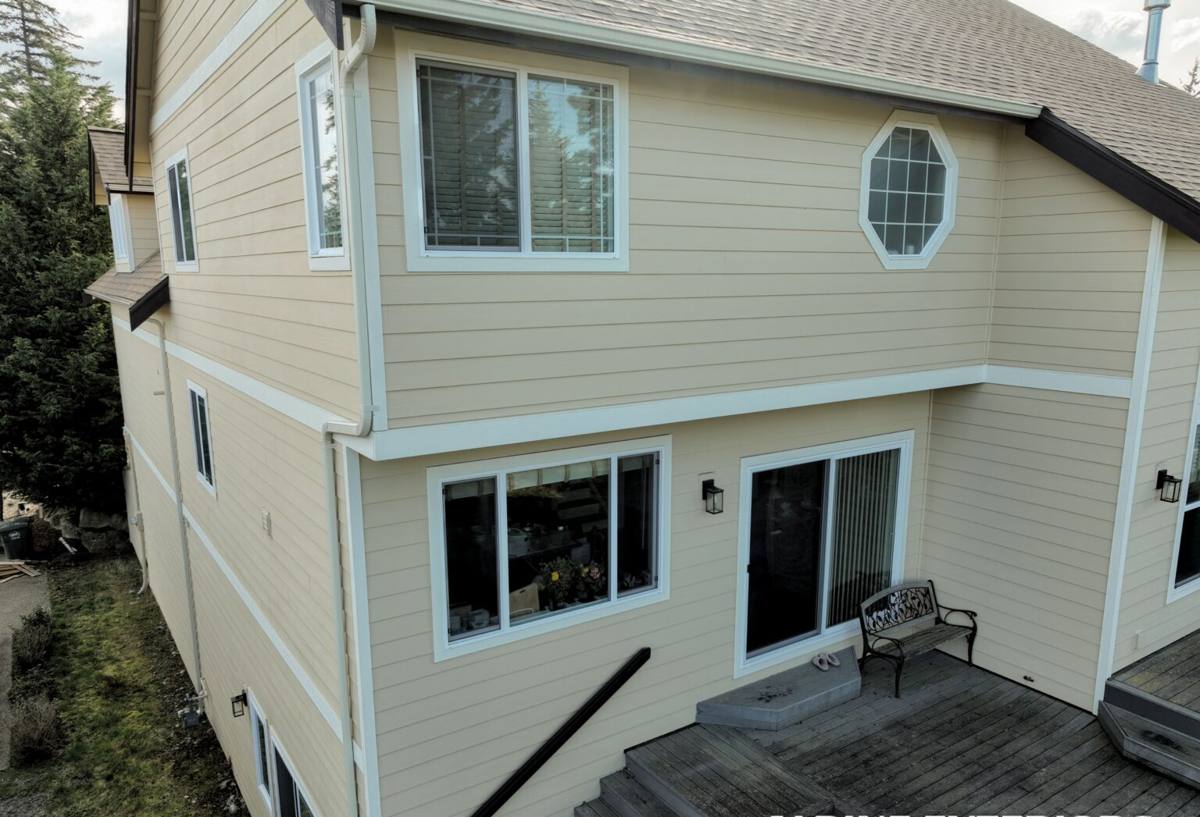
Signs Your Lummi Island Home's Siding Is Due for Replacement
Because of the shade and salt exposure common on the island, siding problems here can show up earlier and look different than the textbook version. Walk your exterior and look for:
- Soft or spongy spots when you press on siding, especially near the bottom courses and around windows and doors
- Persistent moss, algae, or dark streaking that comes right back within weeks of being cleaned
- Paint that's chalking, peeling, or bubbling, particularly on walls facing prevailing wind and rain
- Visible warping, cupping, or buckling boards, or panels that have pulled away from the wall plane
- Cracking or splitting at butt joints, corners, and around fastener heads
- Rust streaks bleeding from nail heads or trim fasteners — a sign the metal itself is failing
- Rot or soft framing discovered at outlets, faucet penetrations, or where trim meets siding
- A musty smell or visible staining on interior walls that back up to exterior siding
Any one of these can be a localized repair. Several at once, or rot found once you open a wall up, usually means the whole assembly — not just the surface material — needs to come off and be replaced correctly.
What a Correct Siding Replacement Actually Involves
Siding is a water management system, not just a finish. On a marine-exposed property like this, the parts you don't see matter as much as the boards you do:
Tear-Off and Sheathing Inspection
Once the old siding is off, the sheathing underneath gets inspected for rot, delamination, or soft spots — most commonly at the bottom wall plate, around old window and door openings, and anywhere a previous flashing detail failed. Damaged sheathing gets replaced before anything new goes up; covering it over just hides the problem.
Weather-Resistive Barrier and Flashing
A new weather-resistive barrier goes over the sheathing, lapped correctly so water sheds down and out rather than getting trapped behind it. Flashing gets installed at every window, door, and penetration, with kick-out flashing where a roofline meets a wall — one of the most commonly missed details and a common source of hidden rot on homes exposed to wind-driven rain.
Fastening and Clearances
Fastener type, spacing, and placement matter, and they're specified by the siding manufacturer for a reason — get them wrong and you create hundreds of small entry points for moisture. Siding also needs proper clearance from grade, roof lines, decks, and patios so water and debris don't sit against the bottom edge.
On a wooded, shaded lot — common on Lummi Island — that clearance and drainage detail is what determines whether a wall dries out between storms or stays damp long enough to grow moss and feed rot.
Why We Install James Hardie Fiber Cement on Lummi Island Homes
We install James Hardie fiber cement siding exclusively. We don't install vinyl, LP SmartSide, Cemplank, Allura, or primed wood siding, and on a property with this much salt and moisture exposure, that standard matters more than usual.
Fiber cement doesn't rot, and it isn't a food source for the mold and algae that thrive in shaded, damp conditions the way wood-based products can be. James Hardie's HZ product lines are engineered specifically for climate zones like the Pacific Northwest's, formulated to hold up to sustained moisture exposure rather than just tolerate it. The ColorPlus factory finish is baked on under controlled conditions and holds color and adhesion far longer than field-applied paint, which matters on a home that's harder to get a repaint crew and equipment out to.
Fiber cement is also dimensionally stable — it doesn't swell, shrink, and crack the way some wood-based and engineered wood products can when they cycle between wet and dry repeatedly, which is exactly the cycle a shaded, salt-air property goes through most of the year. Add a strong transferable warranty and a track record of decades in service when installed to spec, and it's the material we're willing to put our name behind out here.
The Ferry Factor: Why Island Logistics Change the Job
Lummi Island is only reachable by ferry, and that shapes how a siding job needs to be planned — not just how it's built. Material deliveries, dumpster drop-offs and pickups, and crew transport all have to work around ferry sailings and vehicle capacity. A contractor who hasn't planned for that can end up with a crew standing around waiting on materials, or a job that drags out over extra weeks because trips back and forth weren't accounted for.
We plan Lummi Island jobs around getting materials and crew over efficiently: staging deliveries to arrive in as few trips as possible, sequencing the tear-off and install so the crew has everything they need on-site once they're there, and building the schedule around sailing times rather than fighting them. It's a logistics problem as much as a construction one, and it's a lot smoother when the crew has actually worked the island before.
Our Siding Replacement Process
- On-site assessment. We walk the exterior, check for soft spots and rot, and look at drainage, grade clearance, and shade exposure specific to your lot.
- Scope and estimate. You get a written estimate covering tear-off, any sheathing repair allowance, the Hardie product and color, and the installation timeline.
- Logistics planning. Material deliveries, dumpster service, and crew transport get scheduled around the ferry so the job runs continuously once it starts.
- Tear-off and inspection. Old siding comes off and the sheathing underneath gets inspected and repaired as needed before anything new is installed.
- Weather barrier and flashing. New house wrap and flashing go in at every window, door, and penetration, with kick-out flashing at roof-to-wall intersections.
- Hardie siding installation. Installed to manufacturer fastening and clearance specifications, not shortcuts.
- Final walkthrough. We review the finished work with you before calling the job complete.
What Affects the Cost of a Lummi Island Siding Replacement
| Cost Factor | Why It Matters Here |
|---|---|
| Home size and wall complexity | More square footage, corners, and gables mean more material and labor |
| Condition of the sheathing | Shaded, moisture-prone walls more often need sheathing repair or replacement once opened up |
| Existing siding removal | Tear-off, disposal, and dumpster hauling all have to route through the ferry |
| Trim and flashing detail | Homes with more window/door openings and roof-to-wall intersections need more flashing work |
| Hardie product line and finish | Board profile, texture, and ColorPlus color selection affect material cost |
| Site access and staging | Driveway access, slope, and how close a delivery truck can get affects labor time |
Every property is different, which is why we quote off an actual on-site walkthrough rather than a phone estimate — especially on the island, where lot conditions vary a lot from one property to the next.
Why Hiring a Crew That Already Works Lummi Island Matters
A siding replacement is only as good as the details that go into it, and a contractor who's already worked the island understands the logistics, the shade-and-salt exposure pattern common to island lots, and how to sequence a job so it doesn't stall out waiting on a ferry sailing. That experience shows up in fewer surprises, a tighter timeline, and an installation that accounts for what actually wears out siding here rather than what wears it out somewhere inland.
We work throughout Whatcom County, including Ferndale and the surrounding communities, and Lummi Island jobs are a regular part of that work — not a special trip. If your home's siding is showing wear, or you'd rather replace it proactively before moisture damage sets in behind it, we'll come out, walk the property with you, and give you a straight, no-pressure estimate using the form below.