 Ferndale
 Why Nooksack Decks Wear Out Faster Than the Warranty Card Says
Most deck materials are rated and marketed based on lab conditions or a national average climate. Nooksack doesn't get a national average climate. Between the salt-tinged marine air that moves in off Bellingham Bay, the long stretches of driving rain that come sideways instead of straight down, and a moss season that can run from October well into April, the wood and hardware on a local deck take a beating that a spec sheet from a big-box store never accounted for.
We see the same failure pattern on deck after deck in this area: fasteners that rust and streak the boards years before the wood itself is done, joists that stay damp long enough for rot to start from the inside out, and ledger boards that were never properly flashed against the house. None of that is really a "deck is old" problem. It's a "deck was built for a different climate" problem. A correct replacement fixes that at the structural level, not just the surface.
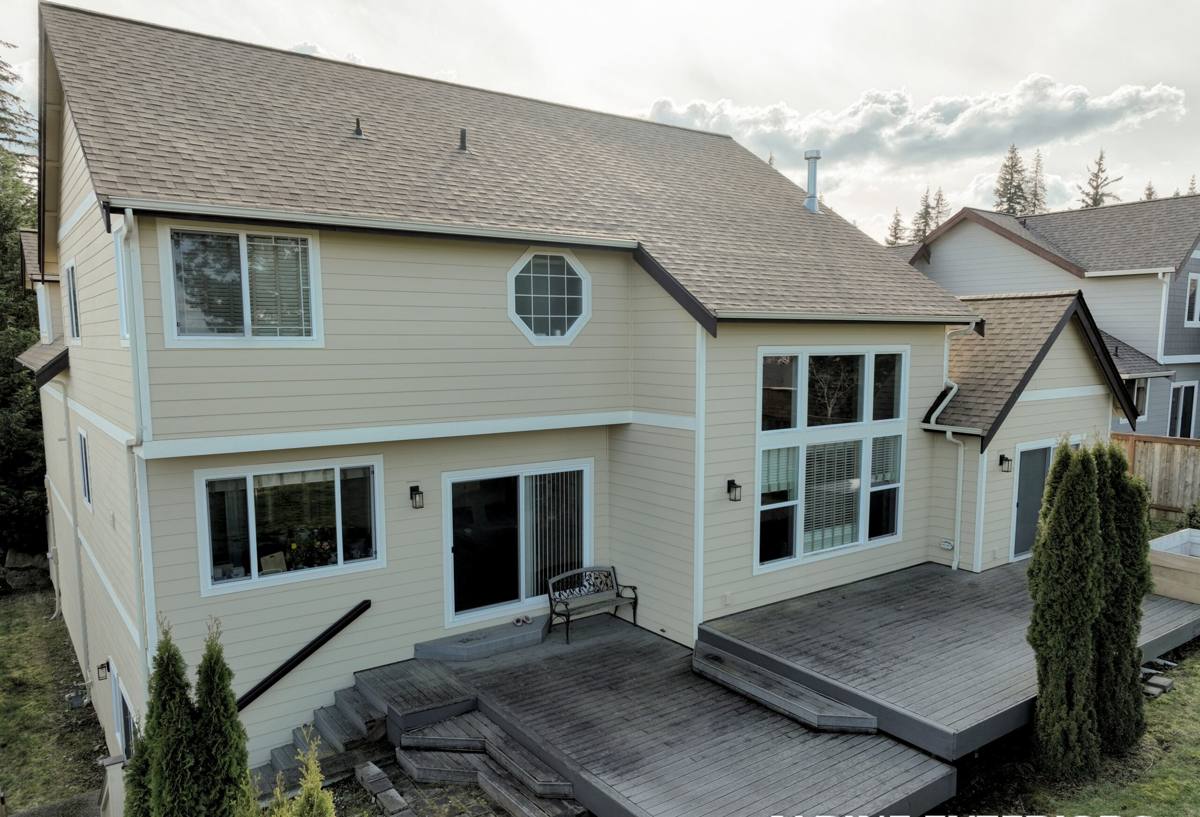
Signs You're Looking at a Replacement, Not a Repair
Homeowners often call about a repair and end up needing a replacement once we're actually underneath the boards. It's worth knowing the difference before you spend money on the wrong fix.
- Deck boards feel spongy, spring back slowly, or show soft spots when you press a screwdriver into them
- The ledger board — where the deck attaches to the house — shows staining, gaps, or soft wood around the bolts
- Support posts have visible checking, splitting, or soft ends near ground contact
- Joists sag between supports or show black streaking, which usually means trapped moisture
- Railings wobble at the post connections, not just at the top rail
- Moss or algae keeps coming back within weeks of cleaning, even in the same spots
- Fasteners are rusted, backing out, or have left dark stains bleeding down the board face
One or two of these on an otherwise solid deck can often be repaired. Several of them together, especially anything involving the ledger or main support posts, usually means the structure has been compromised long enough that patching it is a short-term fix on a long-term problem.
What a Correct Deck Replacement Actually Involves
Framing and Structure First
The decking boards are the part everyone notices, but the framing underneath is what determines whether the deck lasts five years or twenty-five. We size and space joists for the actual load and span, not just to match what was there before, and we use structural screws or approved connectors instead of relying on nails that loosen over time with the freeze-thaw and wet-dry cycling common to this climate.
Ledger Flashing — The Detail Most Decks Get Wrong
The single most common failure point on decks in this region is the ledger board connection to the house. If it isn't flashed correctly, water gets behind the ledger and stays there, invisible until the wood has already started to rot. We flash every ledger connection with proper step or Z-flashing and a water-resistant barrier between the ledger and the house sheathing, so rain that's driven sideways by wind doesn't have a path to sit and soak in.
Footings and Posts
Whatcom County's frost depth and soil drainage matter more here than in drier climates. Footings that are undersized or set too shallow can heave or settle over a wet winter, which is often why an older deck develops a slight lean or bounce even if the boards themselves look fine. We set footings to code depth for this area and use post bases that keep wood off the concrete, so posts aren't sitting in standing water after every storm.
Fasteners and Hardware
This is a small line item that causes a disproportionate number of callbacks in coastal and marine-air climates. Standard galvanized fasteners corrode faster here than inland, leaving rust streaks and eventually losing holding strength. We use stainless or coated fasteners rated for the decking material and for exposure to salt-influenced air, which costs a little more up front and saves the deck's appearance and structural integrity for years.
Choosing the Right Decking Material for This Climate
There's no single "best" decking material — there's the right material for your budget, maintenance appetite, and how much moss and moisture exposure the deck's location gets. Here's how the common options actually compare once you factor in what a wet, moss-prone climate does to them over time.
| Material | Moisture & Moss Behavior | Maintenance | Typical Lifespan Here |
|---|---|---|---|
| Pressure-treated wood | Absorbs moisture readily; needs sealing to resist moss and rot | Annual cleaning and re-sealing recommended | 10–15 years with upkeep |
| Cedar | Naturally rot-resistant but still needs finish maintenance in wet shade | Periodic staining/sealing; moss removal in shaded areas | 15–20 years with upkeep |
| Composite decking | Doesn't absorb water like wood, but surface moss/algae can still grow in shaded, damp spots | Occasional washing; no sealing needed | 25–30 years |
| PVC/capped polymer decking | Fully moisture-resistant surface; least hospitable to moss growth | Lowest maintenance of the group | 25–30+ years |
We install all of these and won't push you toward the highest-margin option. Where we do steer clients away from something is uncapped composite in heavily shaded, moisture-trapped spots — the exposed core on older-generation composite products can wick moisture at cut ends and fastener holes, which shows up as swelling and mold staining faster than a capped or PVC product would in the same spot. That's a maintenance and moisture-behavior trade-off worth knowing before you buy, not a reason to avoid composite altogether.
Railings, Stairs, and Code Requirements
Replacement is also the right time to address railing and stair issues, because they're structural, not cosmetic. Washington's residential code sets minimum railing heights, baluster spacing (to prevent a 4-inch sphere from passing through), and guardrail requirements for any deck surface elevated above a certain height. Stair stringers need to be sized for the actual rise and run, not eyeballed — undersized stringers are one of the more common issues we find on older decks that were built without a permit. We build railings and stairs to current code as part of every replacement, which also matters if you ever sell the house and a buyer's inspector walks the deck.
Permits and Local Requirements
Deck replacement in Whatcom County, including the Ferndale and Nooksack area, generally requires a building permit once the deck is elevated above grade or attached to the house structurally — the exact threshold depends on size and height, and it can vary based on your specific property and jurisdiction. We handle the permit application and inspection scheduling as part of the job, so you're not the one tracking down paperwork or trying to interpret code language. Skipping the permit might save a little time up front, but it becomes a real problem at resale when an unpermitted structure shows up on a title report or inspection.
Our Process, Start to Finish
- On-site assessment — we inspect the existing deck's framing, ledger, footings, and posts, not just the surface boards, so the quote reflects what's actually needed
- Written estimate — a clear breakdown of demolition, framing, decking material, railings, and any permit or inspection fees, with no vague allowances
- Permit filing — we submit and manage the permit so the project is inspected and legal from the start
- Demolition and disposal — the old deck comes out, including anything hidden underneath that turns out to be compromised
- Framing, flashing, and footings — the structural work that determines how long the new deck actually lasts
- Decking, railings, and stairs — installed per manufacturer spec and current code
- Final walkthrough — we go over the finished deck with you, including basic care guidance suited to your specific material and site conditions
Living With a New Deck Through Moss Season
Even a well-built, well-flashed deck benefits from a little seasonal attention here. A few habits keep it looking and performing like new through the wet months:
- Sweep debris off the deck surface regularly in fall — wet leaves trap moisture against boards and accelerate moss growth
- Keep gutters and downspouts clear so roof runoff isn't dumping directly onto or under the deck
- Trim back vegetation that shades the deck surface, since shaded, damp areas are where moss establishes first
- Rinse composite or PVC decking a couple of times a year to prevent surface algae buildup
- Check fastener heads and railing connections once a year for early signs of corrosion or loosening
Why It Matters That We Already Work in Nooksack
A deck built by a crew that's never worked in this specific climate tends to make the same avoidable mistakes: standard fasteners instead of corrosion-resistant ones, ledger flashing that's technically installed but not detailed for wind-driven rain, or decking material chosen without accounting for how much shade and moisture a particular spot actually gets. We're not guessing at how Whatcom County weather treats a deck — we've replaced enough of them in and around Ferndale and Nooksack to know which details matter here and which ones are just extra cost. That local experience shows up in fewer callbacks, not in a fancier sales pitch.
If your deck is showing its age or you're just not sure whether it needs repair or replacement, we're happy to take a look and give you a straight answer. Reach out for a free, no-pressure estimate using the form below.