 Ferndale
 Bellingham Siding, Installed by a Crew That Already Works This County
Bellingham sits on Bellingham Bay in Whatcom County, and its housing stock ranges from older homes on the hillsides above the water to newer construction spread out toward the county's edges. What almost every one of those homes shares is exposure to the same set of conditions: salt-tinged marine air coming off the bay and the Salish Sea, rain that arrives sideways as often as it falls straight down, and a moss and mildew season that can stretch across most of the year on shaded or north-facing walls. We're based just up the road in Ferndale and work Bellingham regularly, and we install one siding system here: James Hardie fiber cement. This page is about that one service, in this one place, and what it actually takes to get it right.
This isn't a general overview of siding options. It's a look at what Bellingham's specific climate does to an exterior wall, what a correct James Hardie installation involves in response to that, and why a crew that already works this area day to day tends to catch the details a crew passing through for one job might not.
What Bellingham's Climate Actually Does to Siding
Salt Air and Coastal Exposure
Homes near the bay, and plenty that aren't right on the water, get regular exposure to salt-laden air moving in off the Salish Sea. Salt accelerates the breakdown of lower-grade paint finishes and speeds up corrosion in fasteners and trim hardware. Over years, that exposure shows up first as chalking, fading, and finish failure at seams and cut edges, the thinnest points in any coating system.
Driving Rain
Rain in this part of Whatcom County rarely falls straight down. Wind pushes it sideways into lap joints, trim intersections, and window and door details, which puts more demand on a siding system's water management than the raw rainfall total suggests. A siding job that looks fine from the street can still be letting water behind the cladding at a joint that wasn't flashed correctly.
A Long Moss Season
Mild temperatures, shade from mature trees, and near-constant moisture add up to a moss and mildew season that can run most of the calendar year on north-facing and tree-shaded walls. Anything that stays damp for extended stretches becomes a growth surface, and an inorganic material gives that growth less to feed on than an organic one does once a finish is compromised.
Why James Hardie Fiber Cement Is What We Install Here
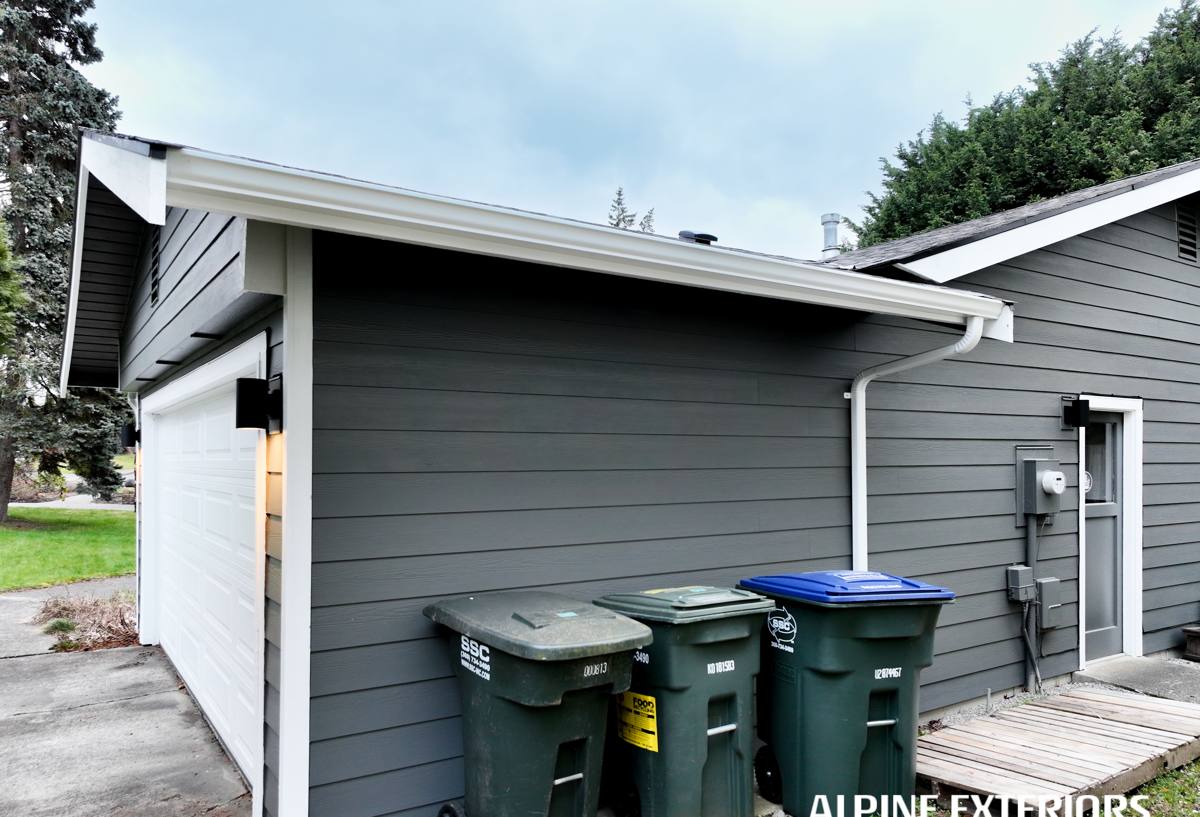
James Hardie siding is a cement-based composite of portland cement, sand, and cellulose fiber, formed into planks or panels and cured. The core is inorganic, so it doesn't absorb water and swell the way wood-based products can, and it doesn't have an organic component for fungus or moss to feed on directly. Most of what we install carries the factory-applied ColorPlus finish, a baked-on coating cured under controlled conditions rather than brushed on in the field.
We don't install LP SmartSide, vinyl, Cemplank, Allura, primed spruce, or cedar. That's a professional standard, not a claim that every one of those products fails on every house. It reflects what we've seen hold up, and what we've seen struggle, on tear-offs and service calls in this exact climate over time. Fiber cement's inorganic core, combined with a factory finish that isn't relying on field-applied paint to keep water out, gives a wider margin for error under sustained coastal moisture than the alternatives we've moved away from.
The HZ5 Product Line
James Hardie makes region-specific formulations, and the HZ5 line is engineered for climates with heavier moisture exposure and more freeze-thaw cycling than the national average. That's a closer fit for coastal Whatcom County than a generic formulation built for a drier region, and it's the baseline we work from for Bellingham homes.
What Correct Installation Involves
The material is only half the equation. James Hardie siding performs the way it's engineered to only when the installation follows the manufacturer's specifications closely, and that's also what keeps the warranty intact. On a Bellingham job, given the wind-driven rain this area sees, we pay particular attention to a short list of details that are easy to rush and expensive to get wrong.
- Correct fastener type, spacing, and depth, since over-driven or under-driven fasteners are a common cause of early siding failure.
- Proper clearance from grade, roofline, decking, and any horizontal surface, so water has somewhere to go instead of wicking into the bottom edge of a board.
- Lap joints and butt joints sealed and flashed to the manufacturer's spec, not just caulked over as a shortcut.
- House wrap and flashing integration at every window, door, and penetration, since these are the points where wind-driven rain finds its way in first.
- Field-cut edges sealed before installation, since a factory finish only protects the surfaces it was applied to.
- Correct panel and plank orientation relative to prevailing wind and rain exposure on each elevation of the house.
None of that is unique to Bellingham. What is specific to this area is how much less forgiving the climate is of skipped steps. A flashing detail that might go years without causing a visible problem in a drier region can show up as a soft spot behind the siding within a couple of wet seasons here.
Our Process on a Bellingham Job
We walk the property in person before quoting anything, because the right approach depends on the home's age, its existing siding condition, its orientation to prevailing wind and rain, and how much shade it gets. From there, our process generally follows the same sequence on every job:
- Inspection and estimate: we look at the existing exterior, note any signs of trapped moisture or substrate damage, and give a written estimate based on what we actually see, not a generic price sheet.
- Tear-off: removing the old siding down to the sheathing lets us find and address hidden moisture damage before it's covered up again, which matters more in a climate that's been driving water into wall assemblies for years.
- Substrate repair: any rot or compromised sheathing gets addressed before new siding goes on, since covering a moisture problem instead of fixing it just delays the same failure.
- House wrap and flashing: a correctly detailed water-resistive barrier and flashing system goes in before a single piece of siding is hung.
- Hardie installation: fastening, clearances, joint sealing, and orientation are handled to manufacturer spec, elevation by elevation.
- Final walkthrough: we go over the finished job with the homeowner and address anything that needs attention before calling it done.
Why a Local Crew Matters for This Kind of Job
A siding job is only as good as the judgment calls made on site, and a lot of those calls come down to how a crew has seen a particular detail perform in this specific climate over time. A crew that already works Bellingham and Ferndale regularly has watched how flashing details hold up through an actual wet season here, which elevations tend to take the worst of the wind-driven rain on homes near the bay, and where moss tends to establish first on shaded walls. That kind of familiarity doesn't replace following the manufacturer's spec, but it does shape where extra attention gets paid on a given house.
There's also a practical side to being local: warranty work, follow-up questions, and any adjustment needed after a first real wet season are all easier to handle with a crew that's a short drive away rather than one that finished the job and moved on to a different region.
Cost Factors on a Bellingham Re-Side
| Factor | What It Affects | Why It Matters in Bellingham |
|---|---|---|
| Tear-off vs. overlay | Labor scope and access to sheathing | Tear-off is the only way to catch hidden moisture damage common under older siding here |
| Substrate condition | Repair cost before new siding goes on | Years of wind-driven rain can rot sheathing behind failing siding without visible warning signs |
| Home orientation | Which elevations need the most attention to detail | Walls facing prevailing wind and rain take more sustained moisture load than sheltered elevations |
| Trim and finish selection | Material cost and finish longevity | Factory ColorPlus finishes resist salt air and UV longer than field-applied paint |
| Site access and home complexity | Labor time and equipment needs | More corners, dormers, and trim mean more joints exposed to driving rain |
Exact pricing depends on the home itself, which is why we give real numbers after walking the property rather than quoting a flat rate over the phone.
Signs a Bellingham Home May Need New Siding Sooner Than Expected
- Persistent moss or dark staining on the same section of wall every year, even after cleaning.
- Soft spots, visible warping, or boards that have separated at a joint.
- Paint or finish that's chalking, peeling, or fading unevenly, especially on walls facing the bay.
- Higher heating bills than a home's size would suggest, which can point to moisture-compromised insulation behind the siding.
- Visible gaps at trim, window, or door intersections where caulking has failed.
Any one of these can be minor on its own. Several showing up together, especially on a home that hasn't had its siding inspected in years, is worth a closer look before it becomes a larger repair.
A Free, No-Pressure Estimate
If you're looking at siding options for a Bellingham home, we're glad to come take a look, tell you honestly what we see, and give you a straight estimate for James Hardie fiber cement done correctly for this climate. Use the form below to schedule a free, no-pressure estimate.