 Ferndale
 Windows Built for What Nooksack Weather Actually Does
Homes in the Nooksack area sit close enough to the water and the lowland river corridor that they take a specific kind of weather punishment: salt-laden air drifting in off Bellingham Bay and the Strait, wind-driven rain that hits window walls sideways instead of straight down, and a long gray moss season that keeps everything damp for months at a stretch. None of that is dramatic on its own. What it does is find every weak seam in a window installation over time — a flashing lap that's an inch too short, a bead of sealant that skipped a corner, a sill pan that was never installed at all. In this climate, those small shortcuts don't stay small.
Window installation is one of those jobs that looks the same whether it's done right or done wrong — until the first hard winter storm proves which one you got. We install windows the way this stretch of Whatcom County requires: correct flashing sequence, a sealed and sloped sill pan, and enough attention to the water path behind the trim that the window is still performing the way it should ten and fifteen years from now.
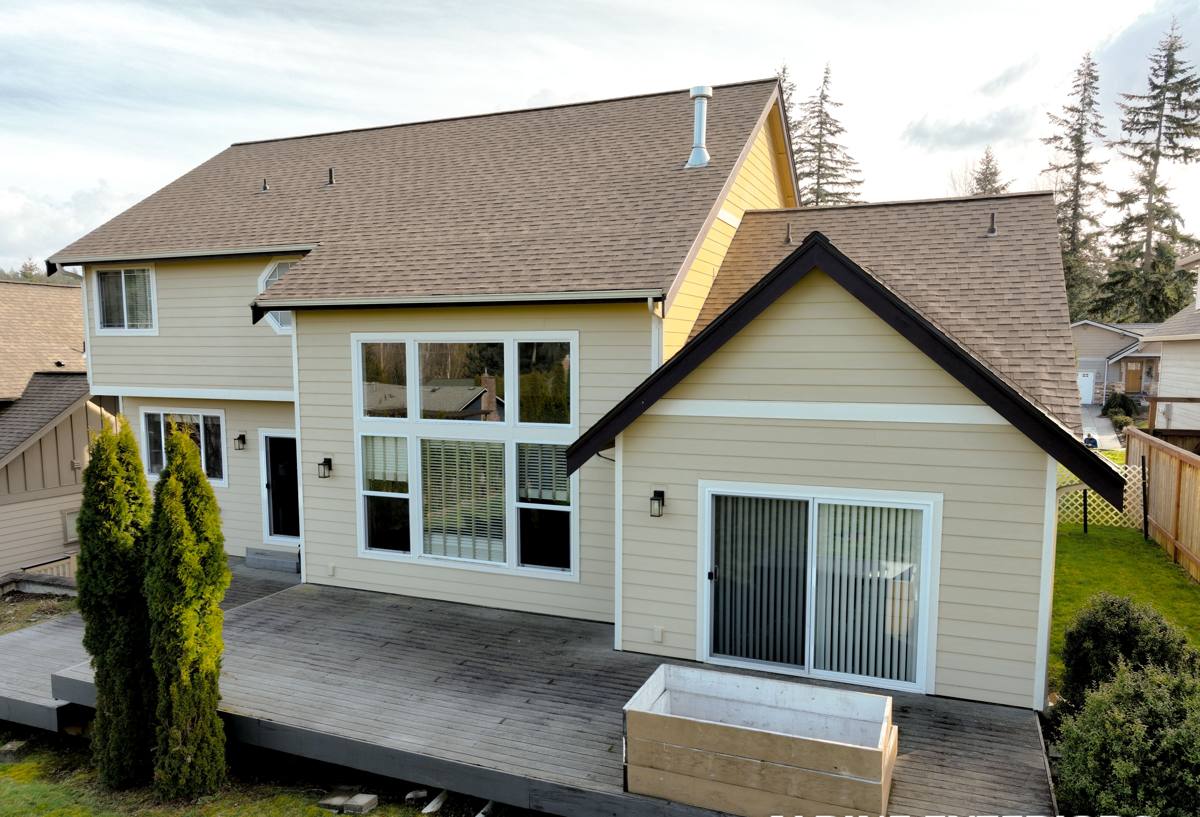
What Nooksack-Area Homes Need From a Window Job
A handful of local conditions shape how we approach every window we install in this neighborhood:
- Salt-influenced moisture: air carrying salt and moisture accelerates corrosion on unprotected fasteners and hardware, and it degrades cheap sealants faster than drier inland climates do.
- Driving, wind-pushed rain: storms off the water don't just fall on a window, they push against it — water finds its way sideways into gaps that would never leak in a calmer climate.
- Extended damp season: long stretches of overcast, moist air mean any wood trim, sheathing, or framing that gets even a little wet has fewer chances to dry out before the next system rolls through.
- Moss and organic buildup: moss holds moisture against siding and trim edges around window openings, which is exactly where a marginal seal will fail first.
None of these are reasons to install a "special" window. They're reasons to install a normal, good window correctly — with the water management details that matter most in a wet coastal county.
Why the Opening Matters More Than the Window
Homeowners often shop for the window itself — brand, glass package, frame material — and that's a reasonable place to start. But the rough opening is where most failures actually begin. A quality window set into a poorly flashed, poorly sloped, or poorly sealed opening will leak eventually. A modest window set into a correctly built opening will perform for decades. We spend more time on the opening than most homeowners expect, because that's where the job is actually won or lost.
What a Correct Window Installation Involves
Every full-frame window replacement or new install we do follows the same sequence, regardless of window brand:
- Remove the old unit carefully and inspect the framing, sill, and sheathing underneath for rot, soft spots, or prior water intrusion before anything new goes in.
- Repair any damaged framing or sheathing — this is non-negotiable in a climate where hidden rot is common around older window openings.
- Install a sloped sill pan so any water that gets past the window sheds outward and down, away from the framing, instead of pooling against it.
- Apply flashing tape and building paper in the correct shingle-lap order — starting at the sill, then jambs, then head — so water always drains over the layer below it, never behind it.
- Set the window plumb, level, and square, shimmed correctly so it operates smoothly and doesn't stress the frame.
- Seal and insulate the perimeter gap with an appropriate low-expansion foam or backer rod and sealant, avoiding rigid foams that can bow a frame out of square.
- Finish exterior trim and caulking with a sealant rated for this climate's UV and moisture exposure, not a generic all-purpose caulk that hardens and cracks within a couple of seasons.
- Test operation and seal before we consider the job finished — every sash should open, close, and lock without binding.
Skip or shortcut any one of these steps and the window can still look fine on installation day. The failures show up later, usually as staining on interior trim, a musty smell in the wall cavity, or soft drywall below the sill — by which point the repair is bigger than the original job would have cost.
Choosing the Right Window for This Climate
We don't push one brand as the only option, because the right choice depends on the home, the budget, and what the homeowner values. What we do insist on is matching the product to the exposure. A window on a wall that takes direct wind-driven rain off the water needs a tighter, better-tested unit than one on a sheltered, covered porch elevation. We'll walk each opening with you and talk through what actually makes sense for that specific wall.
Frame Material Trade-Offs
| Frame Type | Moisture Behavior | Maintenance | Typical Fit |
|---|---|---|---|
| Vinyl | Won't rot; seams and welds matter more than the material itself | Low — occasional cleaning | Most budget-conscious full replacements |
| Fiberglass | Very stable in wet/dry cycling, minimal expansion movement | Low | Homes wanting a longer service life without wood upkeep |
| Wood-clad | Good if cladding and flashing are perfect; interior wood still needs care | Moderate to high | Homeowners prioritizing interior wood appearance |
| Aluminum | Conducts cold and can condense in this climate without a thermal break | Low | Specific architectural or commercial-style applications |
We steer most homeowners in this area away from bare aluminum frames without a thermal break, and away from wood-clad units on walls with heavy direct rain exposure, unless the homeowner specifically wants that look and understands the added upkeep. That's a maintenance and moisture-behavior call, not a knock on any manufacturer — every one of these materials has a place, it just depends on the wall.
Glass and Weatherstripping
Double-pane, low-E glass is the practical standard for this climate — it cuts heat loss through a long heating season and reduces interior condensation on cold, damp mornings, which is a common complaint in older single-pane homes here. Weatherstripping quality matters as much as glass rating: a window with excellent glass but a weak compression seal will still let wind-driven rain whistle and weep at the sash line during a real storm.
Signs Your Current Windows Are Already Losing the Fight
Because failures build slowly in this climate, homeowners often live with a problem for a year or two before recognizing it as a window issue rather than a general drafty-house issue:
- Fogging or moisture between double-pane glass (a failed seal, not something that can be repaired — the sash needs replacing)
- Soft or discolored trim or drywall below or beside a window
- Visible daylight or a draft you can feel with a hand near the frame on a windy day
- Sashes that stick, won't stay open, or don't latch flush
- A musty smell near a window that shows up mainly during the wet months
- Moss or dark streaking building up on trim immediately around the frame
Any one of these on its own isn't an emergency. But in this climate, they tend to compound — a small gap lets in moisture, the moisture feeds moss and rot, and the rot makes the next repair bigger. Catching it early is what keeps a window job a window job instead of a framing repair.
Our Process for Nooksack-Area Window Jobs
We keep the process straightforward because homeowners deserve to know what's happening at each stage:
- On-site assessment — we look at every opening being discussed, not just the window itself, including trim, siding condition, and any visible water staining.
- Honest scope and pricing — if we find hidden rot or a larger issue once we open a wall, we tell you before proceeding, not after the invoice.
- Scheduled install with weather awareness — we plan window openings around forecasted dry windows where possible, since an open wall cavity shouldn't sit exposed to driving rain.
- Full flashing and sealing per opening — no shortcuts on the sequence described above, regardless of how many windows are on the job.
- Final walkthrough — we operate every window with you and point out anything you should know about care or warranty coverage.
Cost Factors for Window Installation
Every job is different, but the same handful of factors drive most of the cost variation we see on window jobs in this area:
| Factor | Why It Matters |
|---|---|
| Number of openings | More windows spread fixed costs (crew setup, disposal) across more units, often lowering the per-window cost |
| Hidden framing damage | Rot found once the old window is removed adds labor and material that can't be quoted until the wall is open |
| Window size and type | Larger units, bay/bow configurations, and custom shapes cost more in both material and install labor |
| Frame material chosen | Vinyl, fiberglass, and wood-clad units carry different material costs before labor is even factored in |
| Exterior trim scope | Full trim replacement around the opening adds cost versus reusing sound existing trim |
| Access and elevation | Second-story or hard-to-reach openings take more setup time and sometimes equipment |
We'd rather walk your specific home and give you real numbers than quote a broad range that doesn't mean much either way. Hidden framing issues are the one variable we genuinely can't price until the old window is out, which is why we always flag that possibility up front.
Why Local Experience on This Specific Job Matters
Window installation isn't a specialty skill in the abstract — plenty of crews can hang a window. What separates a good result here is knowing how Whatcom County's specific weather pattern behaves against a specific wall orientation, and building the flashing and sealing details to match. A crew that mostly works drier inland climates can do everything "by the book" and still under-detail a job that needs to handle sideways rain off the water and a five-to-six-month damp season. We work this area regularly, which means we're not guessing at how a wall performs here — we've seen how these openings age, what fails first, and what holds up.
That local pattern recognition is also why we don't treat every window the same way regardless of which wall it sits on. An opening on an exposed, water-facing elevation gets more attention to flashing lap and sealant choice than one tucked under a deep eave on a sheltered side. That's not upselling — it's matching the work to the actual exposure, which is exactly the kind of judgment call that only comes from doing this job repeatedly in this specific climate.
Maintenance That Protects the Investment
A properly installed window needs very little upkeep, but a few habits extend its life meaningfully in this climate:
- Rinse salt residue and grime off frames and glass periodically, especially on wind-exposed elevations
- Keep gutters and downspouts clear so water isn't sheeting down over window heads
- Clear moss and debris from trim and sills before it holds moisture against the surface long-term
- Re-caulk exterior trim joints if you notice cracking or gaps, rather than waiting for a leak to show up inside
- Operate every window at least once each season so hardware doesn't seize from disuse
If your windows are original to the house, showing fog between panes, or you've noticed staining or drafts, it's worth having them looked at before another wet season sets in. We're happy to come take a look, walk you through what we see, and put together a straightforward, no-pressure estimate for your home — just fill out the form below.