 Ferndale
 Why Decks in Sumas Wear Out Faster Than Homeowners Expect
Sumas sits in a part of Whatcom County where the weather doesn't let up for long. Moisture-heavy marine air moves through the region most of the year, rain falls steadily rather than in short bursts, and there's enough shade and dampness on most lots to keep moss and algae active for a good chunk of the calendar. None of that is unusual for this corner of Washington. But it's hard on an outdoor structure that's exposed to weather from every direction, all year, with nowhere to dry out.
A deck built to a generic national standard, or built fast during a home's original construction, often shows its age here well before it should. Ledger boards trap water against the house. Joists that never fully dry stay damp long enough for rot to take hold. Fasteners corrode from the inside out before the surface boards look bad at all. By the time a homeowner notices soft spots or staining, the framing underneath is frequently further gone than the decking on top suggests.
Replacing a deck correctly in this climate isn't about picking a nicer board. It's about building the whole structure — framing, fasteners, flashing, and surface — to actually shed water and dry between rain events, instead of just holding moisture a little longer than the last deck did.
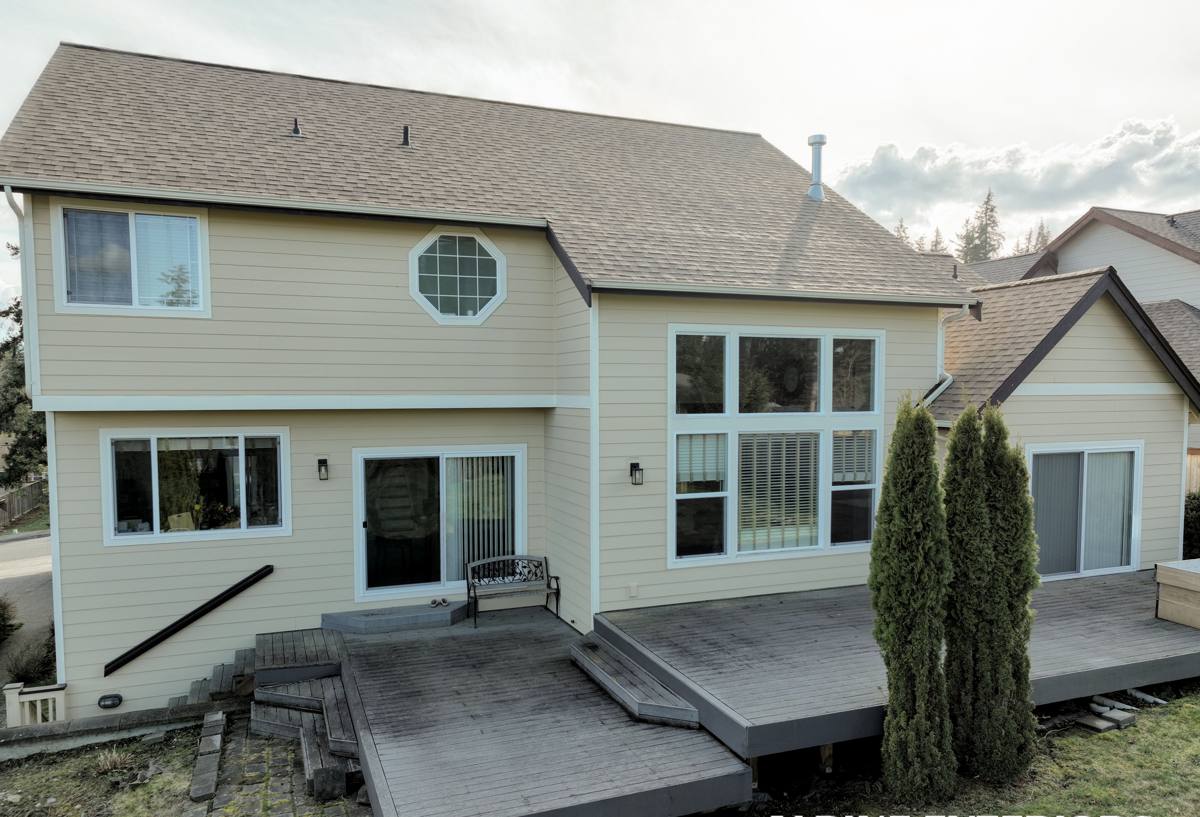
What a Correct Deck Replacement Actually Involves
A full deck replacement is more than swapping old boards for new ones. Done right, it addresses every layer of the structure, since the surface decking is usually the last part to fail — not the first.
The parts that matter most
- Ledger connection — the point where the deck attaches to the house. This needs proper flashing so water is directed away from the house framing, not funneled into it.
- Framing and joists — pressure-treated lumber sized and spaced for the actual load and span, not just what was there before.
- Footings and posts — checked for frost heave, rot at grade contact, and whether they still meet current code depth and bearing requirements.
- Fasteners and hardware — corrosion-resistant hangers, screws, and connectors rated for the treated lumber being used. Mismatched hardware is one of the most common hidden failure points we find on older decks.
- Decking surface — wood, composite, or PVC, chosen based on how the deck is used, how much sun and shade it gets, and how much upkeep the homeowner actually wants to do.
- Railings and stairs — rebuilt to current code, which has often changed since an older deck was originally permitted.
Skipping any one of these to save money up front is how a "new" deck ends up with the same problems in five or six years instead of twenty or more.
Choosing a Decking Material for This Climate
There's no single "best" decking material — there's a best fit for how a homeowner uses the deck and how much maintenance they want to commit to. In a climate with this much rain and moss pressure, the trade-offs matter more than they would somewhere drier.
| Material | Upfront Cost | Maintenance | How It Handles This Climate |
|---|---|---|---|
| Pressure-treated wood | Lowest | Annual cleaning, periodic sealing/staining | Needs consistent upkeep or moss and graying set in fast; can warp/split if neglected |
| Cedar or other natural wood | Mid | Regular sealing to hold color and resist moisture | Naturally more rot-resistant than treated lumber, but still an organic material in a wet climate |
| Capped composite | Mid-high | Occasional washing, no sealing/staining | Shrugs off moisture and moss far better than wood; won't rot or splinter |
| PVC/synthetic | Highest | Lowest of all options | Fully moisture-proof surface; best choice for shaded, damp, low-sun lots |
We'll walk through this with you honestly rather than steering you toward whatever has the best margin. If you want a natural wood look and you're willing to clean and seal it on a schedule, that's a legitimate choice. If you'd rather not think about your deck between now and the next replacement, composite or PVC earns its higher price tag here more than it would in a drier state.
A word on all-wood decks in shaded, damp yards
We'll still build a wood deck when that's what a homeowner wants — it's a reasonable, time-tested choice. But on lots with heavy shade or limited airflow, we tell clients up front that wood will need more frequent attention to stay ahead of moss and moisture staining than it would on a sunnier, more open site. That's not a knock on wood — it's just the honest maintenance math for this kind of setting.
Moss, Moisture, and the Damage You Can't See From the Surface
Moss on a deck isn't just a cosmetic issue. It holds water against the board surface long after the rest of the yard has dried, which speeds up wood decay and makes the surface slick and genuinely dangerous underfoot. On older wood decks, we routinely find moss growth that's been masking soft, decayed boards underneath for a season or more before anyone noticed.
The moss season here runs long — often much of the fall through spring stretch — which means a deck with poor drainage or heavy shade rarely gets a real chance to dry out between rain events. Gaps between boards that have closed up over time, debris trapped in the framing, and low airflow underneath all make it worse. Part of a correct replacement is making sure the new structure doesn't repeat those same drainage mistakes: proper board spacing, joist tape or equivalent protection on framing, and grading underneath the deck that actually lets water move away instead of pooling.
Our Deck Replacement Process
- On-site assessment. We inspect the existing deck's framing, ledger, footings, and decking to determine what's actually salvageable versus what needs to come out — most of the time it's a full tear-off once we're in there.
- Design and material discussion. We talk through decking material, railing style, size or layout changes, and a realistic budget range before anything is finalized.
- Permitting. We handle the permit application and inspection scheduling required for the jurisdiction the property falls under.
- Demolition. Careful removal of the old structure, checking the ledger and house framing behind it for hidden water damage while it's exposed.
- Framing and flashing. New ledger flashing, joists, and footings built to current code — not just matched to what was there before.
- Decking, railing, and stairs installed. Final surface work, fastening, and railing installation to the material and layout agreed on up front.
- Final inspection and walkthrough. We confirm the work passes required inspections and walk the finished deck with the homeowner before calling the job done.
Permits and Code Requirements
Most deck replacements that involve new framing, footings, or a structure attached to the house require a building permit, and inspections at key stages along the way. This isn't paperwork for its own sake — it's what confirms the footings are deep enough, the ledger connection is done safely, and the railings meet current height and spacing requirements. Older decks were sometimes built before current code existed, or without a permit at all, so a full replacement is often the point where a deck actually gets brought up to modern safety standards for the first time. We handle the permitting and inspection process as part of the job so homeowners aren't left navigating it on their own.
Signs Your Deck Needs Replacing, Not Just Repairing
Not every deck problem means a full replacement — sometimes a board swap or railing repair genuinely solves it. But certain signs point to a structure that's past the point of patching.
- Soft, spongy, or bouncy spots when you walk across the deck
- Visible rot or dark staining at the ledger board where the deck meets the house
- Posts or footings that have shifted, settled, or show rot at ground contact
- Railings that feel loose or flex under normal pressure
- Persistent moss or algae that returns within weeks of cleaning
- Fasteners that are rusted, backed out, or crumbling when touched
- The deck is old enough that it predates current code and was never brought up to standard
If you're seeing more than one or two of these, it's worth having someone look at the framing underneath before deciding between a repair and a replacement.
What Affects the Cost of a Sumas Deck Replacement
| Factor | Why It Matters |
|---|---|
| Deck size and layout | More square footage and multiple levels or stairs add material and labor |
| Decking material chosen | Composite and PVC cost more upfront than wood but need far less upkeep |
| Condition of existing framing | Hidden rot at the ledger or posts can mean more structural work than expected |
| Footing and code requirements | Older decks sometimes need new or deeper footings to meet current standards |
| Railing style and stairs | Cable, glass, or custom railing designs cost more than standard baluster rail |
| Site access | Decks on slopes, over grade changes, or with tight access can add labor time |
We give a written, itemized estimate after the on-site assessment — not a guess over the phone — because too many of these factors only become clear once we can see the actual framing.
Why It Matters to Hire a Crew That Already Works in Sumas
A deck replacement isn't a generic build-anywhere project. A crew that's worked other properties in Sumas and the surrounding Ferndale area already knows how the local weather pattern behaves through the seasons, what kind of moss and moisture problems show up repeatedly on decks in this part of Whatcom County, and which construction details actually hold up here versus which ones look fine on paper but fail early in this climate. That's the difference between a deck built to a generic checklist and one built for the conditions it will actually face for the next twenty-plus years.
We're also familiar with the local permitting process for this area, which keeps the project moving instead of stalling on paperwork or inspection scheduling. And because we're local, if a question comes up two or three years after the job is done, we're not hard to find.
Get a Free, No-Pressure Estimate
If your deck is showing its age, feels soft in places, or you're just ready for something built to actually handle Whatcom County weather, we're happy to take a look. There's no cost and no pressure — just an honest assessment of what your deck needs and what a correct replacement would involve. Use the form below to request your free estimate.