 Ferndale
 Why Sandy Point Homes Need More From Their Siding
Sandy Point sits close enough to the water that the weather behaves differently than it does even a few miles inland toward Ferndale proper. Homes here take on salt-laden air off the Strait of Georgia, steady wind-driven rain through the fall and winter, and long stretches of gray, damp conditions that keep exterior surfaces wet far longer than a sunnier climate would. Add in the shade from mature evergreens common to the area and you get a textbook moss-and-mildew environment for several months of the year. None of that is unusual for this part of Whatcom County, but it is more aggressive than what a typical suburban installation manual assumes, and it's why the siding choice and the installation details matter more here than they do on a sheltered inland lot.
Salt air is the piece people underestimate most. It doesn't just sit on the surface — over years it works into fasteners, seams, and any exposed wood fiber, accelerating corrosion and rot in ways that inland homes never experience. A siding system that's rated "fine for the Pacific Northwest" in general isn't automatically fine for a near-beach lot like Sandy Point.
What Salt Air, Rain, and Moss Do to the Wrong Material
Wood and engineered wood siding
Traditional wood siding and engineered wood products like LP SmartSide rely on an engineered or primed wood substrate. Wood fiber absorbs moisture, and moisture plus salt plus shade is exactly the combination that feeds rot, delamination at cut edges, and moss growth on north-facing walls. These products can perform reasonably well in dry, well-ventilated settings — but a wet coastal lot with tree cover asks more of the product than its warranty and maintenance schedule are really built for.
Vinyl siding
Vinyl handles moisture itself well enough since it doesn't absorb water, but it has two weak points that show up on coastal properties: it flexes and can warp or buckle in the temperature swings and wind loads a waterfront-adjacent lot sees more of, and its color is baked all the way through a thin material that fades and chalks under UV and salt exposure over time. It's also more prone to wind uplift at panel edges in exposed, gusty locations, which is common near open water.
Why this matters before you pick a product
None of this means these products are junk — they work fine in plenty of settings. It means a homeowner near Sandy Point is choosing siding for a harder environment than the national average, and that should change the decision.
Why We Install Only James Hardie Fiber Cement Here
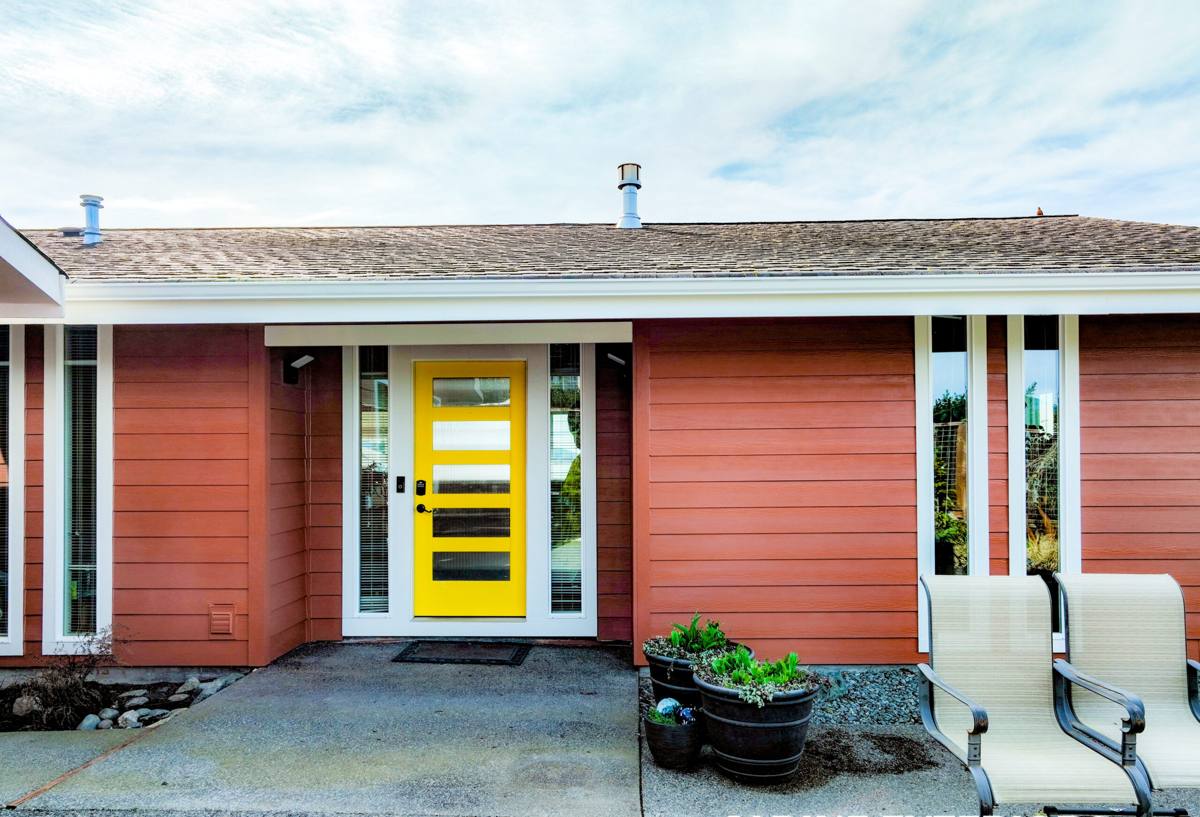
We standardized on James Hardie fiber cement siding for every home we side, and it's an especially easy call in a location like Sandy Point.
Non-combustible, moisture-stable core
Fiber cement is made from cement, sand, and cellulose fiber — it doesn't have wood's capacity to absorb and hold water the way solid or engineered wood does, and it won't feed rot or delamination the way a wood-based product can when it stays damp for weeks at a stretch, which is exactly what happens on a shaded, moss-prone lot through a Whatcom County winter.
ColorPlus factory finish
Hardie's ColorPlus finish is baked on in a controlled factory process, with more UV and weather resistance built in than field-applied paint typically achieves. On a property fighting constant salt exposure and damp, that finish holding up without early fading or chalking is a real, visible difference over the years — not just a marketing line.
Climate-engineered HZ product lines
James Hardie engineers its siding by climate zone. The HZ5 line is built for wetter, moderate climates like ours — it's formulated and tested for regions that see the rain volume and humidity Whatcom County gets, rather than a one-size-fits-all national spec. That's the version we install on Sandy Point homes.
A warranty that actually transfers
Hardie backs its products with a strong, transferable limited warranty. If you sell the home, that coverage moves with it — which matters for buyers evaluating a waterfront-adjacent property where siding condition gets scrutinized during inspection.
What a Correct Installation Involves in This Location
Fiber cement performs the way it's supposed to only when it's installed to spec. On a coastal lot, a few details matter more than they would inland, because the margin for error is smaller.
- Weather-resistive barrier and flashing: A continuous, correctly lapped moisture barrier behind the siding, with proper flashing at every window, door, and roof intersection, so wind-driven rain never gets a path behind the panels.
- Correct clearances: Manufacturer-specified gaps between the siding's bottom edge and the ground, roofline, decks, and patios, so splash-back and standing moisture don't sit against the material.
- Corrosion-resistant fasteners: Stainless steel or otherwise corrosion-rated fasteners near the water, since salt air is hard on standard galvanized nails and screws over time.
- Proper joint and seam treatment: Tight, correctly caulked or flashed seams at every butt joint and corner, since a poorly sealed joint is where moisture problems start.
- Field-cut edge sealing: Any factory edge that gets cut on site needs to be sealed per Hardie's specs — an unsealed cut edge is a weak point for moisture intrusion.
- Ventilation behind the cladding: Adequate airflow in the wall assembly so damp conditions don't get trapped against the back of the siding for weeks at a time.
Skip any one of these on a sheltered inland lot and you might get away with it for years. Skip one on a Sandy Point property and the salt air and rain exposure will usually find it faster.
How the Materials Compare in This Environment
| Factor | James Hardie Fiber Cement | Vinyl | Wood / Engineered Wood |
|---|---|---|---|
| Salt air and moisture resistance | Strong — cement-based, doesn't absorb and hold water | Doesn't absorb water, but seams and fasteners still corrode | Weak — wood fiber absorbs moisture, feeds rot |
| Wind and temperature stability | Rigid, holds shape and fastening | Can warp, buckle, or lift in gusty coastal exposure | Generally stable, but panel warp is a known failure point |
| Fire resistance | Non-combustible | Combustible | Combustible |
| Finish durability against sun and salt | Factory-baked ColorPlus finish, slower to fade/chalk | Color is through-body but chalks and fades with age | Paint/finish needs more frequent recoating |
| Moss and mildew susceptibility on shaded walls | Low — non-organic surface, still needs periodic washing | Low, but grime/mildew film shows on textured panels | Higher — organic material feeds growth if kept damp |
| Long-term maintenance burden | Lower once installed correctly | Low, but panel replacement is common after storm damage | Higher — recoating, spot repair, moisture monitoring |
Our Process for a Sandy Point Project
1. On-site assessment
We look at the home's actual exposure — how close it sits to open water, prevailing wind and rain direction, tree cover and shading, and the condition of the existing wall assembly — before we talk product or price.
2. Product and color selection
We walk through the appropriate Hardie product line and ColorPlus color options for the home, factoring in how the finish will hold up given the specific exposure of that lot.
3. Removal and wall prep
Old siding comes off, and we check the sheathing and framing underneath for any moisture damage before anything new goes up — no installing over a problem you can't see.
4. Installation to manufacturer spec
Weather-resistive barrier, flashing, clearances, fastening, and joint treatment are all done to James Hardie's published installation requirements, not a shortcut version of them.
5. Final walkthrough
We go over the finished job with the homeowner, including basic care and what to watch for given the site's exposure, before we consider the project done.
Maintenance in a Moss-Prone, Salt-Air Environment
Fiber cement is low-maintenance compared to wood, but "low-maintenance" isn't "no-maintenance," especially this close to the water. A periodic gentle wash — garden hose and soft brush, not a high-pressure blast that can force water behind panels or damage the finish — keeps salt residue and algae film from building up on shaded elevations. Keep gutters clear and grade sloped away from the foundation so water isn't sitting against the bottom courses. Trim back vegetation that's shading a wall and keeping it damp longer than it needs to be. None of this is heavy work, but it's worth doing on a schedule given how much longer surfaces here stay wet compared to a drier inland property.
Why Local Experience in Sandy Point Matters
A crew that's worked coastal Whatcom County properties knows which walls take the worst of the wind-driven rain, how far up a wall salt spray realistically travels, and where moss tends to establish first on a shaded elevation — and they build the installation details around that, rather than following a generic spec sheet and hoping it holds up. That local pattern recognition is the difference between a siding job that looks right on install day and one that's still performing the way it should a decade later, after a few more winters off the water than a typical inland home will ever see.
If you're weighing a siding project on your Sandy Point home, we're happy to take a look at the property, talk through what the exposure calls for, and put together a free, no-pressure estimate — no obligation, just a straight answer on what your home needs.