 Ferndale
 New-Construction Windows Are a Different Job Than Replacement Windows
When people say "new-construction windows," they mean something specific: windows with a nailing fin (also called a flange) that gets set into an open stud opening and fastened directly to the sheathing before the weather-resistive barrier and siding go on. That's different from a replacement or "insert" window, which gets fitted into an existing frame after the original siding and trim are already in place. On a new build or a full tear-down-to-the-studs remodel in Lynden, you almost always want the flanged, new-construction type — it gives us a clean shot at building the drainage plane correctly from the framing out, instead of working around what's already there.
That distinction matters more than it sounds like it should, because most of what determines whether a window leaks five or fifteen years from now isn't the window itself — it's the flashing and sequencing around it. New construction gives us the chance to get that right the first time, with no shortcuts forced by an existing wall.
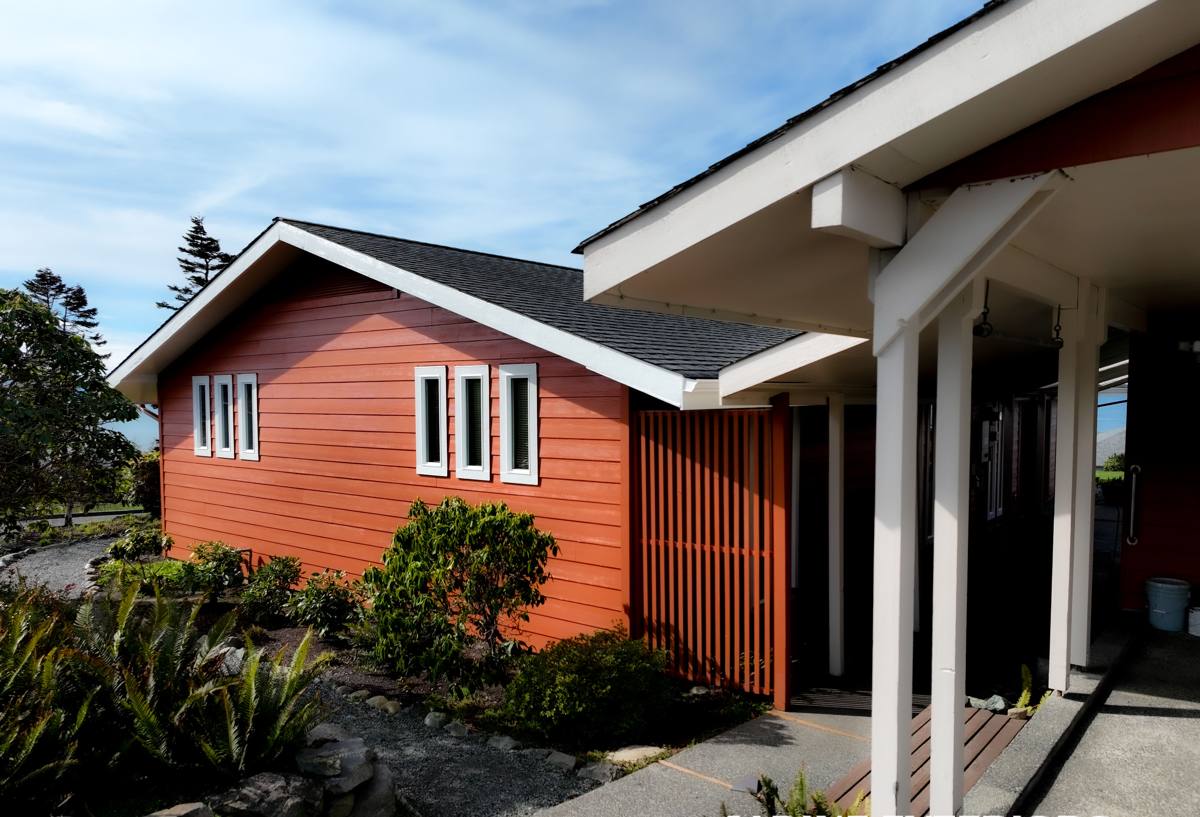
What Lynden's Climate Actually Asks of a Window Install
Lynden and the rest of Whatcom County sit in a marine climate with a few local quirks that change how we approach a window opening compared to a drier part of the state.
Driving Rain, Not Just Rain
Winter storms coming off the Pacific don't just drop water straight down — they push it sideways into wall assemblies, especially on west- and south-facing elevations. A window that's only sealed with caulk around the trim, with no real drainage path behind it, will eventually take on water during a hard blow. The fix isn't a thicker bead of sealant; it's a flashing sequence that assumes water will get behind the trim and gives it a way back out.
Salt Air, Even Inland
Lynden is a few miles inland, but Whatcom County as a whole sits close enough to Bellingham Bay and the Strait of Georgia that salt-tinged marine air reaches most of the county, especially on windy days. Over years, that air is hard on unprotected steel fasteners and cheap hardware — which is why we pay attention to corrosion-resistant fastener specs on window installs here, not just on homes right on the water.
A Long, Wet Moss Season
Whatcom County's gray season runs long. On north-facing walls and anywhere water sits instead of draining, moss and algae get a foothold on sills, trim, and siding. It's mostly a maintenance and appearance issue, but it's also a sign of a drainage problem — if a sill is holding moisture long enough to grow moss, it's holding moisture long enough to eventually cause rot underneath the finish.
Outflow Wind Events
Whatcom County occasionally gets cold, dry outflow winds funneling down out of the Fraser Valley in winter. These events bring sharp temperature swings and real wind load, which is one more reason we don't cut corners on fastening schedules or rely on foam alone to hold a window plumb and secure.
The Flashing and Drainage Sequence That Actually Keeps Water Out
This is the part of a new-construction window install that homeowners rarely see and general contractors don't always spell out — but it's the part that determines whether the window performs for decades or starts showing water stains in five years.
Sill Pan First
Before the window ever goes in, the rough opening sill gets a sloped, back-dammed pan flashing. Its job is simple: if any water ever does get past the window — through a failed seal, wind-driven rain, or normal condensation — it lands on the pan and drains back out to the exterior instead of soaking into the framing.
Shingle-Lap Order with the Weather-Resistive Barrier
Flashing tape and the weather-resistive barrier (WRB) have to be layered like shingles on a roof — each piece overlapping the one below it — so water always sheds downward and outward, never into a seam that traps it. Head flashing goes last, over the top of the WRB, with a drip edge that kicks water away from the wall instead of letting it run down behind the trim.
Compatible Materials, Not Whatever's on the Truck
Flashing tape, sealants, and the WRB itself aren't all chemically compatible with each other, and some combinations fail to bond in the cool, damp conditions we install in for most of the year here. We match tape and sealant systems to the WRB on the job and to the temperature we're actually installing in, rather than defaulting to one product for every house.
Choosing Window Performance Specs for a Whatcom County Build
Window shopping for a new build usually starts with style and price, but performance numbers matter just as much in this climate — particularly condensation resistance, given how much of the year runs cool and damp here.
| Performance Factor | Why It Matters in This Climate | What We Generally Recommend |
|---|---|---|
| U-Factor | Controls heat loss through the glass and frame during cold outflow wind events and the long heating season | Lower U-factor (well below code minimum where budget allows), especially on north and east elevations |
| Condensation Resistance (CR) | High interior humidity plus cool glass surfaces can fog or sweat windows in our damp winters | Higher CR rating, particularly in kitchens, bathrooms, and bedrooms |
| Air Infiltration Rating | Wind-driven rain often rides in on air leakage, not just through the glass | Tighter air infiltration numbers, paired with correct installation — a good rating on paper still leaks if the flashing is wrong |
| Frame Material | Needs to handle repeated wet-dry cycling and occasional cold snaps without warping or sticking | Vinyl or fiberglass for most budgets; fiberglass where larger sizes or darker exterior colors are planned |
| Glazing / Low-E Coating | Our region gets more heat-loss days than heat-gain days most of the year | Low-E glazing tuned for heat retention rather than solar heat gain rejection |
How We Install New-Construction Windows in Lynden
The process is straightforward, but every step exists for a reason:
- Verify every rough opening against the window schedule before delivery — wrong openings are far cheaper to fix on paper than after a window shows up.
- Dry-fit each window in its opening to confirm square, level, and correct reveal before any flashing goes on.
- Install the sloped, back-dammed sill pan flashing.
- Set the window, shim it to plumb and level without distorting the frame, and fasten it per the manufacturer's schedule — not a guess.
- Flash the jambs and head in proper shingle-lap order, tied into the WRB.
- Insulate the gap between frame and rough opening with a low-expansion foam that won't bow the frame out of square.
- Air-seal the interior side separately from the exterior weatherproofing — the two are not the same job.
- Walk the opening before siding covers it up, so any issue gets caught while it's still an easy fix.
Coordinating with Your Builder or General Contractor
On a new build, windows go in after framing, sheathing, and the WRB are up, and before siding starts — which means our schedule has to mesh with the framing crew's and the siding crew's, whether that's us doing both or another trade. We show up on the GC's timeline, flag any rough-opening issues immediately instead of letting them become a change order later, and protect openings if there's a weather delay between window-set and siding. Since siding is our trade too, we also make sure the window flashing ties cleanly into whatever siding profile is going over it — that handoff is where a lot of leaks start on jobs where the two trades never talk to each other.
Mistakes We See on New Builds in This Area — and Avoid
Most window leaks we get called out to inspect trace back to one of these, not to a bad window:
- Caulk used as the primary water barrier instead of a real flashing sequence
- No sill pan, or a sill pan that isn't back-dammed and just lets water run straight into the framing
- Flashing tape and WRB layered in the wrong order, so water gets funneled into a seam instead of away from it
- Fasteners over-driven or under-driven, which can bow the frame and cause the sash to bind or seals to fail early
- Standard can foam used to "lock" a window in place, expanding enough to push the frame out of square
- Installation that skips the manufacturer's written instructions, which can also void the window's warranty
- Flashing tape and sealant products mixed without checking chemical compatibility
Why a Local Lynden and Ferndale Crew Matters
A crew that already works this area knows which elevations on a typical Lynden lot take the worst of the wind-driven rain, understands the outflow wind pattern that shows up most winters, and has already worked through Whatcom County's inspection expectations on other new builds nearby. That's the kind of thing you can't fully get from a crew driving in from outside the county for one job. We're not guessing at what this climate does to a wall assembly over time — we're dealing with it on houses down the road from each other, year after year.
If you're planning new-construction windows for a build in Lynden, we're glad to walk the plans or the framed openings with you and give you a straightforward, no-pressure estimate — just fill out the form below.