 Ferndale
 What Kendall's Climate Actually Does to a House
Kendall sits inland from Ferndale in a part of Whatcom County that gets more rain days, more shade cover, and more standing moisture than people expect. Homes out here take a slower, quieter kind of beating than coastal storm damage — it's not one bad storm that ruins siding, it's years of wet-dry cycling, shaded north walls that never fully dry out, and moss that gets a foothold and doesn't let go.
Driving Rain and Wind-Driven Moisture
Whatcom County's weather pattern pushes rain sideways more often than most people realize, and Kendall's tree cover and topography can funnel wind into specific wall faces. Siding that relies on paint film alone to stay watertight — rather than a manufactured, factory-cured finish — is the first to show it: hairline cracks at butt joints, swelling at cut edges, and paint failure around nail heads within a handful of years.
Moss, Shade, and a Season That Doesn't End
Between fall and late spring, a lot of Kendall properties simply don't get enough direct sun to dry siding out between rain events. That's exactly the environment moss, algae, and mildew want. Wood-based and wood-fiber siding products absorb moisture and give organic growth something to root into; the wrong siding choice here means pressure-washing and re-treating on a schedule instead of an occasional chore.
Moisture-Laden Air Off the Sound
Even away from the immediate shoreline, Whatcom County's marine air carries moisture and salinity further inland than people assume, and it doesn't take direct ocean exposure for that air to accelerate corrosion on fasteners and degrade poorly-sealed seams over time. It's one more reason the fastening and flashing details matter as much as the siding material itself.
Why We Standardized on James Hardie for This Area
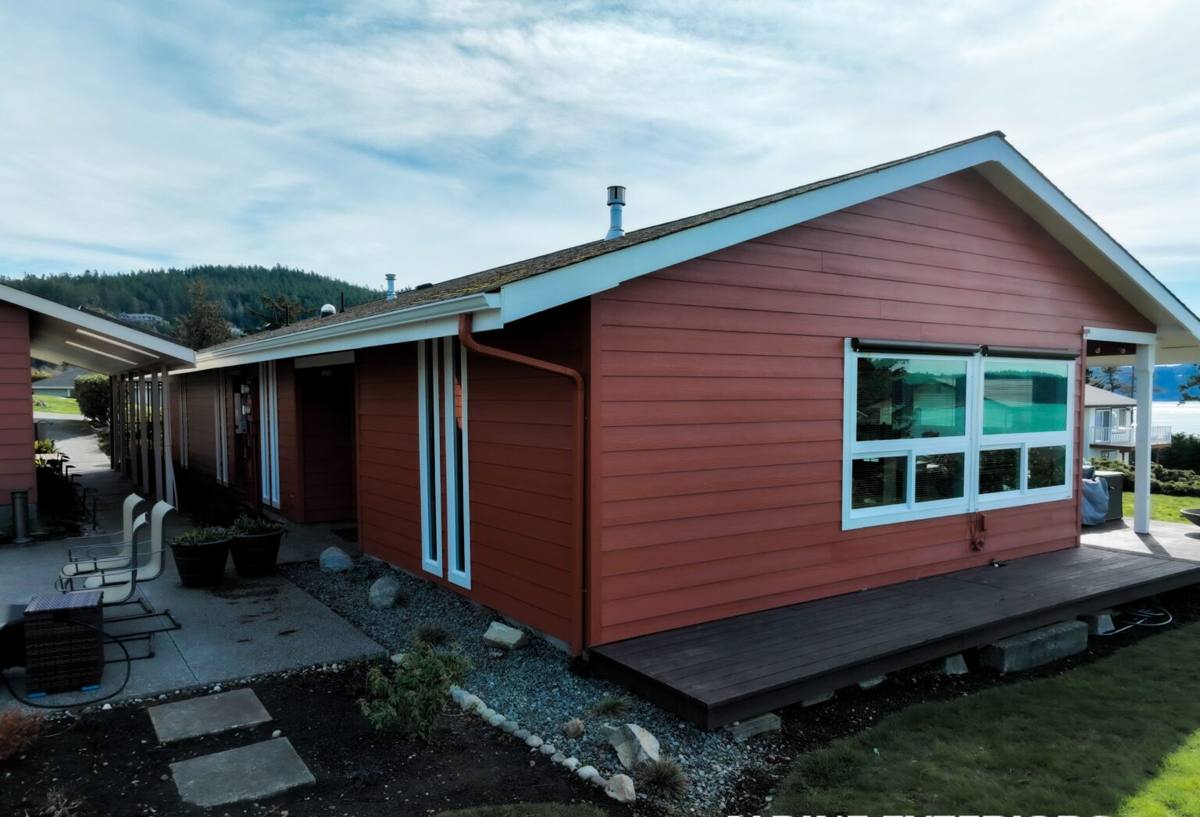
We only install James Hardie fiber cement siding — not vinyl, not LP SmartSide, not cedar or primed spruce. That's not a marketing position, it's a decision based on what actually holds up under the conditions described above. Hardie's fiber cement core doesn't absorb water the way wood-based products do, it won't feed mold or moss the way organic sheathing can, and it's non-combustible, which matters more every wildfire season in the Pacific Northwest.
The HZ5 Product Line
James Hardie engineers its siding by climate zone, and the HZ5 line is built for regions like ours — moisture, freeze-thaw cycling, and moss and mildew pressure. It's not a generic product sold everywhere; the moisture-management engineering in the panel and the finish is specific to what a house in Whatcom County actually has to survive.
ColorPlus Factory Finish
Most of what fails first on lower-grade siding is the paint, not the substrate. Hardie's ColorPlus finish is baked on in a controlled factory environment rather than field-applied on a wet, cold jobsite, which means better adhesion, more consistent coverage, and a finish that's engineered to resist the fading and cracking that shaded, damp walls accelerate.
What a Correct Installation Actually Involves
Hardie siding is only as good as the install behind it. A huge share of the "Hardie problems" homeowners hear about trace back to installation shortcuts, not the product. On a Kendall home, we pay particular attention to a few details that matter more here than in drier climates.
Rain Screen Gap and Drainage Plane
A drainage gap between the siding and the water-resistive barrier lets any moisture that does get behind the panel drain and dry out instead of sitting against the wall sheathing. Given how long walls stay damp in Kendall's shade and rain pattern, skipping this is one of the fastest ways to trap moisture where you can't see it until it's a bigger problem.
Fastening and Fastener Selection
Corrosion-resistant fasteners, correct nail placement, and proper depth (not overdriven, not underdriven) all affect how the panel performs over decades, not just years. Overdriven nails crack the fiber cement's outer seal and create a moisture entry point exactly where you don't want one.
Joints, Caulking, and Flashing
Butt joints, window and door flashing, and penetrations (vents, hose bibs, light fixtures) are where water actually gets in on most homes, regardless of siding brand. We flash every penetration and use sealants rated for the movement and moisture cycling this climate puts them through, not whatever's fastest off the shelf.
Clearance From Grade and Hard Surfaces
Hardie siding needs proper clearance from the ground, roofline, and any concrete or paved surface. In a climate where standing moisture and splash-back are constant, that clearance is what keeps the bottom courses from sitting in wet conditions season after season.
Why Not Vinyl or LP SmartSide Here
We get asked this often enough that it's worth answering plainly. Vinyl siding is inexpensive and low-maintenance in the sense that it doesn't need painting, but it expands and contracts significantly with temperature swings, can crack in cold snaps, and doesn't offer the same fire rating or impact resistance as fiber cement. LP SmartSide is a wood-strand product — better than old wood siding in some respects, but it's still an engineered wood product, and wood-based cores are more vulnerable to the exact moisture and organic-growth pressure Kendall's climate applies year-round. Both are legitimate products with a place in the industry. We simply don't think either is the right long-term answer for homes that sit in this much rain and shade, so we don't install them.
Comparing Siding Options for a Kendall Home
| Factor | James Hardie Fiber Cement | Vinyl | LP SmartSide / Wood-Based |
|---|---|---|---|
| Moisture absorption | Minimal; cement-based core | None, but seams can trap moisture behind panel | Higher; wood-strand core can swell |
| Moss/mildew resistance | Strong, factory-cured finish | Moderate; surface can still host growth | Lower; more prone to organic growth if finish fails |
| Fire rating | Non-combustible | Combustible | Combustible |
| Finish durability | Factory-baked ColorPlus finish | Color molded through, can fade/chalk | Field or factory paint, depends on product |
| Typical repaint interval | 15+ years with ColorPlus | Never repainted, but can't be repainted if faded | 7-10 years typical |
Our Process on Kendall Projects
The process doesn't change much house to house, but the sequencing matters, especially with weather windows in this area being narrower than people expect.
- Site walk and assessment — we look at existing siding, sheathing condition, trim, and any moisture damage before quoting anything.
- Scope and material selection — lap width, shingle vs. plank, trim profile, and ColorPlus color, matched to the home and any HOA or neighborhood expectations.
- Tear-off and sheathing check — we don't cover up rot or compromised sheathing; if we find it, we address it before siding goes back on.
- Weather barrier and rain screen install — this step is where most long-term performance is decided, and it's not one we shortcut.
- Hardie panel installation — correct fastening, flashing, and clearances at every course.
- Trim, caulking, and final detailing — the finish work that determines how clean the house looks and how well it sheds water.
- Walkthrough and cleanup — we review the finished work with the homeowner before calling the job done.
What Affects the Cost of a Hardie Project in This Area
| Cost Factor | Why It Matters Locally |
|---|---|
| Tear-off vs. install over existing siding | Existing wood or wet sheathing often needs to come off given Kendall's moisture history |
| Home size and story count | More wall area and higher elevations mean more scaffolding, labor, and material |
| Siding profile (lap, shingle, panel) | Shingle and mixed-material designs take more labor time than straight lap |
| Trim and detail work | Corner boards, window trim, and fascia detailing add material and labor |
| Access and site conditions | Slope, tree cover, and driveway access affect equipment staging on rural Kendall lots |
Maintaining Hardie Siding in Kendall's Climate
- Rinse siding gently once or twice a year to keep moss spores and organic buildup from establishing, especially on shaded north- and west-facing walls
- Keep gutters clear so overflow doesn't run down and pool against siding courses
- Trim back vegetation and tree limbs that keep wall sections shaded and damp longer than necessary
- Inspect caulking at joints and trim every couple of years and re-seal where it's cracked or pulled away
- Watch for any staining or soft spots near grade, which can signal a drainage or clearance issue worth addressing early
Why It Matters to Hire a Crew That Already Works Kendall
Kendall isn't downtown Ferndale, and it isn't the coast — it has its own microclimate driven by tree cover, elevation, and distance from town services. A crew that already works this area knows which wall orientations need extra attention, how local moisture patterns behave, and how to plan install timing around a wetter, shorter dry-weather window than a crew coming from outside the county might assume. That local familiarity shows up in fewer surprises mid-project and a install that's actually built for the conditions the house will face, not a generic template.
If you're weighing a siding replacement or new build in Kendall, we're happy to walk the property, look at what's there now, and give you a straight answer on what it needs. Reach out for a free, no-pressure estimate — there's a form right below to get started.