 Ferndale
 Windows Built for the Fairhaven Climate, Not Just Any Climate
Homes in the Fairhaven area sit close enough to the water that the weather isn't the same weather you'd design a window installation around inland. Salt-laden air off the bay works into aluminum hardware and unsealed wood over time. Driving rain, pushed sideways by wind off the water, tests every joint and sill in a window assembly that a calmer climate would never expose. And the long stretch of gray, damp months that Whatcom County sees every year keeps humidity high against exterior walls for weeks at a time, which is exactly the condition moss and mildew need to take hold around window frames and trim.
Energy-efficient windows are marketed everywhere, but "energy-efficient" is a spec sheet term. What actually matters for a Fairhaven home is whether that window, once installed, keeps water out, resists the salt air's slow corrosion of hardware, and doesn't trap moisture behind the trim where it can quietly rot sheathing you won't see until the drywall stains. We treat those as the same job, because in this climate they are.
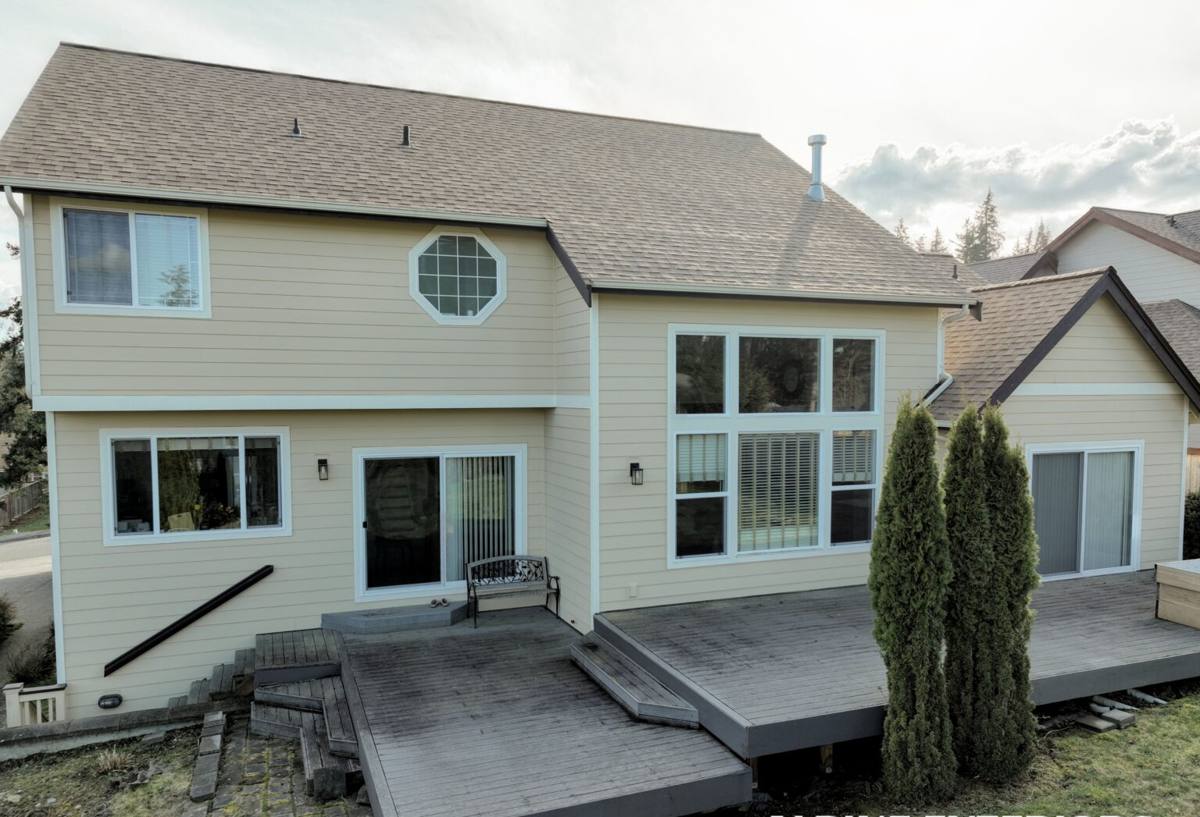
What a Correct Energy-Efficient Window Job Actually Involves
A window replacement is really three separate systems working together: the glass unit, the frame and hardware, and the installation detailing that ties the window into your home's water and air barrier. Get one wrong and the other two don't matter.
The Glass Unit
Modern efficient windows use double- or triple-pane insulated glass units (IGUs) with a low-emissivity (low-E) coating and an inert gas fill, usually argon. The coating reflects radiant heat while still letting visible light through, so the room stays brighter without the summer heat gain or winter heat loss you get from older single-pane or clear-glass units.
The Frame and Hardware
Frame material determines how the window handles our specific weather over the next 15-25 years, not just how it performs on day one. Hardware — locks, hinges, balance systems — needs to be rated for coastal exposure, or salt air will start pitting and seizing it well before the glass unit itself has any problems.
The Installation Detail
This is the part homeowners rarely see and the part that fails most often. Proper flashing integration, correctly lapped house wrap, sill pans that direct any incidental water back out rather than into the wall cavity, and sealant used as a backup rather than the primary defense — these details are what keep driving rain from ever becoming a wall problem. A premium window installed with poor flashing will leak. A modest window installed correctly usually won't.
Signs Your Fairhaven Home's Windows Are Underperforming
- Visible condensation or fogging between the panes of a double-pane unit — the seal has failed and the gas fill is gone
- Cold drafts near the window frame even when the window is fully latched
- Soft or discolored trim and sill wood, especially on the sides that take the most wind-driven rain
- Moss or dark streaking building up on the exterior trim faster than on the surrounding siding
- Hardware that's stiff, corroded, or won't lock smoothly — a common early sign of salt-air wear
- Noticeably higher heating bills compared to similar-sized homes nearby, with no other explanation
- Windows that are original to a home built before the 1990s, before efficient glass and modern flashing practices were standard
Frame Material Comparison for Coastal Whatcom County Homes
| Material | Coastal/Salt-Air Behavior | Maintenance | Typical Lifespan |
|---|---|---|---|
| Vinyl | Won't rust or corrode; performs well in salt air | Low — occasional cleaning | 20-30 years |
| Fiberglass | Very stable in temperature swings and moisture; excellent coastal performance | Low | 30-40 years |
| Wood (unclad) | Handsome but needs protection from driving rain and humidity | High — repainting/sealing on a regular cycle | Varies widely with upkeep |
| Wood-clad (vinyl or aluminum exterior) | Good, provided cladding seams and corners are sealed well | Moderate | 25-35 years |
| Aluminum | Conducts cold and is prone to hardware corrosion near saltwater without a quality finish | Moderate | 20-30 years |
We don't push wood-clad or aluminum options on homes exposed to direct bay wind and rain unless the homeowner understands the upkeep it takes to keep them performing — it's less about the material being bad and more about matching the material's maintenance demands to how much attention the home's exposure actually requires.
What Drives Cost on a Fairhaven-Area Window Job
| Factor | Why It Matters Here |
|---|---|
| Frame material | Fiberglass and higher-grade vinyl cost more upfront but reduce long-term maintenance in salt air |
| Glass package | Triple-pane and upgraded low-E coatings add cost but pay back faster in a home with constant wind exposure |
| Number of openings replaced at once | Doing a full house at once is more efficient per-window than spreading it across several smaller jobs |
| Condition of existing flashing and sheathing | Homes with prior water intrusion may need sheathing repair before new windows go in — this is found during assessment, not guessed at in advance |
| Window size and configuration | Larger units, custom shapes, and multi-panel assemblies take more labor and precision to seal correctly |
| Access | Second-story or hard-to-reach openings add setup time |
We give a firm, itemized number after a real in-person look — not a phone estimate — because the flashing condition behind your existing trim is the single biggest variable, and it's not visible from the driveway.
Our Process for Fairhaven-Area Window Replacement
- On-site assessment. We look at existing frame condition, check for signs of past water intrusion around sills and corners, and note which elevations take the most direct wind and rain.
- Product selection. Based on the home's exposure, we walk through frame material and glass package options that fit the budget and the actual weather that wall sees — not a one-size answer for every window.
- Prep and removal. Old units come out carefully so we can inspect the sheathing and framing underneath before anything new goes in.
- Flashing and sill pan work. This is where a lot of installers cut corners. We build in proper drainage paths so any water that gets past the exterior surface has somewhere to go besides your wall cavity.
- Window installation and sealing. Units are set plumb and square, shimmed correctly, and sealed as backup to the flashing system — not as the only line of defense.
- Interior and exterior trim finish. Trim is refit and finished to match, with attention to any spots that showed prior moss or moisture staining.
- Final walkthrough. We check operation, locks, and weatherstripping on every opening before we call the job done.
Why a Crew That Already Works Fairhaven Matters
Window installation isn't a generic skill that transfers evenly from a dry inland climate to a bay-adjacent one. A crew that regularly works homes in the Fairhaven area already knows which elevations tend to take the worst of the driving rain, what moss buildup around older trim usually means underneath, and how quickly unprotected hardware corrodes when it's exposed to salt air year-round. That's not something you can fully explain over a phone estimate — it's something that shows up in how the flashing gets detailed and which frame materials get recommended for which side of the house.
We're based out of Ferndale and work throughout Whatcom County, including the Fairhaven area, so the climate conditions driving this page aren't theoretical to us — they're the same conditions we're accounting for on every job nearby.
Keeping New Windows Performing After Installation
- Rinse salt residue off frames and glass periodically, especially on wind-facing elevations
- Keep weep holes (small drainage openings along the bottom of the frame) clear of debris and moss
- Check exterior sealant lines once a year for cracking or separation, particularly after a hard winter
- Operate locks and hardware regularly rather than leaving windows painted or sealed shut, which hides early corrosion
- Trim back vegetation and clear moss from nearby siding and trim so moisture doesn't sit against the window frame
- Address any new drafts or fogged glass promptly — waiting rarely makes a seal failure cheaper to fix
Get a Straight Answer for Your Home
If your windows are original to the house, fogging between the panes, or just feel drafty no matter the season, it's worth having a local crew take an honest look before you decide what to do. We'll tell you plainly what we see — including if replacement isn't actually the most urgent fix — and give you a clear, itemized estimate with no pressure attached. The form below gets you a free assessment for your Fairhaven-area home.