 Ferndale
 Everson's Climate and What It Does to Siding
Everson sits inland along the Nooksack River corridor, which gives it a slightly different weather personality than the shoreline towns nearby — but "inland" in Whatcom County still means wet. The same weather systems that soak Ferndale and Bellingham push through Everson too, and prevailing winds off Bellingham Bay and the Strait of Georgia carry salt-tinged moisture farther inland than most homeowners assume. Add in months of low-angle sun, heavy shade from mature trees on many Everson lots, and a moss season that can stretch from fall through spring, and you have a climate that is genuinely hard on exterior wall systems.
Driving rain is the biggest factor. It doesn't just fall — wind pushes it sideways into lap joints, butt seams, and anywhere a fastener penetrates the siding. Over years, water that gets behind a wall system does more damage than water that hits the face of it. Moss and algae growth on the north and shaded sides of a house holds moisture against the surface even longer, which is exactly the condition that breaks down poorly installed or poorly chosen siding materials. None of this means Everson homes are doomed to siding failure — it means the installation has to be done correctly, with materials built for this kind of exposure, from day one.
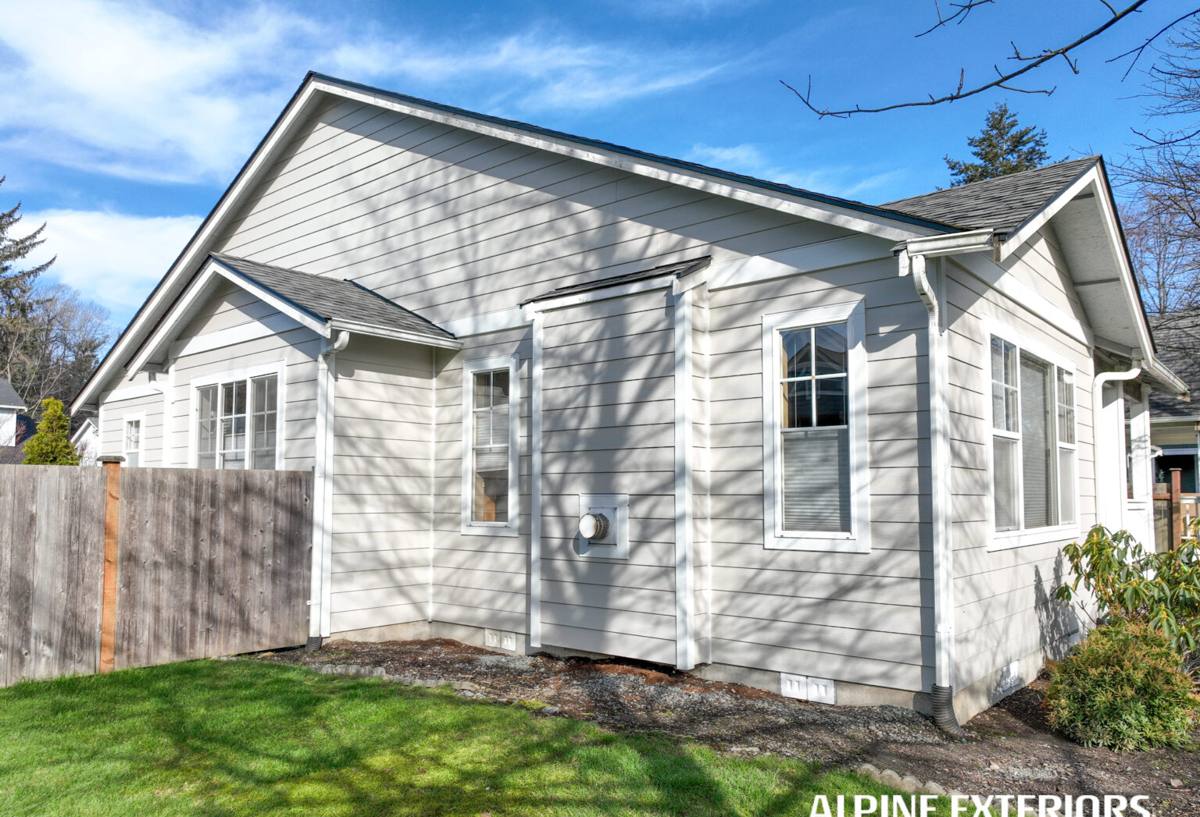
Why Siding Installation Quality Matters More Than the Material Alone
We say this to every homeowner we talk to: the best siding product on the market, installed wrong, will fail faster than a mediocre product installed right. Siding is a system — the housewrap or weather-resistive barrier underneath, the flashing at every window, door, and penetration, the fastening pattern, the gaps and clearances, and the caulking and trim details all have to work together. A crew that rushes the water-management details behind the siding is setting a house up for rot years down the road, even if the boards on the wall look great on installation day.
This is why we spend as much time talking about what's behind the siding as what color it is. In a climate like Everson's, the barrier system and flashing details are doing as much work as the siding material itself.
Why We Install Only James Hardie Fiber Cement
We made a deliberate decision as a company to install James Hardie fiber cement siding exclusively, and nothing else. We don't install vinyl, LP SmartSide, Cemplank, Allura, or primed wood siding — not because those products have no place in the market, but because after years of working on homes in this climate, we settled on one system we can stand behind fully and install to a single high standard, every time.
James Hardie fiber cement is non-combustible, dimensionally stable in wet-dry cycling, and available with a factory-applied ColorPlus finish that resists the fading and moisture intrusion that plague field-painted materials. Hardie also engineers specific product lines (HZ5 and HZ10) for different climate zones, which matters in the Pacific Northwest's wet weather. The trade-off is that fiber cement is heavier, less forgiving of installation shortcuts, and costs more upfront than vinyl or engineered wood. We think that trade-off is worth it for a Whatcom County home, and we'd rather install one product exceptionally well than spread ourselves across several and get good at none of them.
What This Means for You as a Homeowner
It means every quote we write is for the same underlying material system. You're not choosing between "good, better, best" siding brands with us — you're choosing colors, board profiles, and exposure widths within one product line we trust. That simplifies the decision and lets us focus our conversation on fit and installation quality instead of relitigating material choice on every job.
What a Correct Siding Installation Involves
Moisture Barrier and Flashing
Before a single piece of siding goes up, the wall needs a continuous weather-resistive barrier, properly lapped shingle-style so water sheds downward and outward. Every window and door opening gets flashed so water is directed out and away from the framing, not trapped behind the trim. Any penetration — hose bibs, electrical, vents — needs its own flashing detail. This is the step that's invisible once the job is done, and it's the step that determines whether a house stays dry for 30 years or develops hidden rot in 8.
Fastening and Clearances
James Hardie publishes specific fastening schedules — nail type, spacing, and placement — and specific clearance requirements between the bottom of the siding and grade, roofing, decks, and other horizontal surfaces. Skipping these clearances is one of the most common causes of premature siding failure we see on older homes, because standing water and splash-back at ground level saturate the bottom courses over and over.
Trim, Caulking, and Finish Details
Corner boards, trim around openings, and butt joints all need to be sealed correctly, with the right caulk and the right gaps left for the material to expand and contract with temperature swings. Rushed trim work is often where a siding job looks fine for the first year and starts showing gaps, cracking caulk, or staining by year three.
Our Installation Process, Start to Finish
For an Everson project, our process generally runs through these phases:
- Assessment and measurement — we walk the exterior, check the existing wall condition, identify any rot or moisture damage under the current siding, and take precise measurements.
- Product and color selection — we walk you through James Hardie board profiles, exposure widths, and ColorPlus color options that fit your home and neighborhood.
- Tear-off and inspection — removing the old siding lets us actually see the sheathing and framing underneath, which is when hidden moisture damage from years of driving rain often turns up.
- Repair as needed — any damaged sheathing or framing gets repaired before anything new goes up. We don't install new siding over a compromised wall.
- Weather-resistive barrier and flashing — installed to spec, with particular attention to window and door openings.
- Siding installation — installed to James Hardie's fastening schedule and clearance requirements.
- Trim, caulking, and final detail work — the finish work that determines long-term appearance and water resistance.
- Final walkthrough — we review the completed work with you before calling the job done.
James Hardie Product Lines for Everson Homes
Most Everson homes we work on use one of a few core Hardie products, depending on the home's style and the homeowner's preference:
| Product | Look | Best Fit |
|---|---|---|
| HardiePlank lap siding | Traditional horizontal lap, several exposure widths | Most standard homes; the most common choice |
| HardiePanel vertical siding | Vertical panel, often with board-and-batten trim | Accent walls, gables, farmhouse-style exteriors |
| HardieShingle siding | Staggered or straight-edge shingle profile | Craftsman or cottage-style homes |
| HardieTrim boards | Corner boards, window and door trim | Used alongside any of the above for a finished look |
All of these come with the factory ColorPlus finish in a range of colors, which matters in a climate like ours — a factory-baked finish handles the freeze-thaw and wet-dry cycling of a Whatcom County winter far better than a field-applied paint job repainted every several years.
Cost Factors for Siding Installation in Everson
We don't publish blanket pricing because every home is different, but these are the factors that actually move the number on a quote:
| Factor | Why It Matters |
|---|---|
| Home size and wall complexity | More corners, gables, and dormers mean more cutting, trim, and labor time |
| Condition of the existing wall | Rot or moisture damage found during tear-off requires repair before new siding goes on |
| Product selection | Lap siding, panel siding, and shingle siding carry different material and labor costs |
| Access and site conditions | Steep lots, mature landscaping, or limited equipment access add time |
| Trim and detail scope | Extensive trim work, accent walls, or custom color selections add to the total |
The only way to get a real number is a walk-through of your specific home — which is exactly what a free estimate is for.
Signs Your Everson Home Needs New Siding
A few warning signs are worth a call before they become bigger problems:
- Soft or spongy spots when you press on the siding, especially near the bottom courses
- Visible warping, buckling, or gaps between boards
- Paint that's peeling or bubbling repeatedly in the same spots, which often points to moisture trapped behind the siding
- Persistent moss or algae growth that comes back quickly after cleaning
- Rising energy bills that could point to a compromised wall system letting conditioned air escape
- Visible rot, staining, or discoloration around window and door trim
- Siding that's simply reached the end of its expected service life and is due for a proactive upgrade
Catching these early usually means a straightforward siding replacement. Waiting on them often means sheathing and framing repair on top of the siding work — a bigger job and a bigger bill.
Why Hire a Crew That Already Works in Everson
A crew that regularly works Whatcom County homes already understands the local building conditions — how driving rain behaves against a wall, where moss and shade cause the most trouble, what clearance and flashing details actually matter here versus a drier climate. That familiarity shows up in the small decisions made on-site: how a flashing detail gets handled around an unusual window, how a corner gets trimmed on a home with heavy tree cover, how clearances get set near a deck or patio. Those are the calls that separate a siding job that lasts 30-plus years from one that needs attention again in a decade.
We also stand behind our work with the manufacturer backing James Hardie provides, plus our own installation standards, because we only install one product system and we know it thoroughly.
If you're weighing a siding project on your Everson home, we're happy to walk the property, look at what's there now, and talk through what James Hardie fiber cement would look like on your house — no pressure, no obligation. Reach out for a free estimate using the form below.