 Ferndale
 Siding Built for Blaine's Coastline, Not Just the Pacific Northwest in General
Blaine sits right on the water, tucked against Semiahmoo Bay and Drayton Harbor near the Canadian border. That location is what makes the town beautiful, and it's also what makes siding decisions here different from a typical Whatcom County job a few miles inland. Homes close to the shoreline deal with a steady drift of salt air, wind that comes off open water with real force behind it, and a wet season that runs long even by Pacific Northwest standards. Add in the shade from mature trees on many Blaine lots and you get the fourth factor: moss and algae that don't let up from October through May some years.
We install James Hardie fiber cement siding exclusively, and Blaine is one of the areas where that decision matters most. This page walks through what the local climate actually does to exterior siding, what a correct Hardie installation looks like for a home in this specific environment, and how our process works from first look to final walk-through.
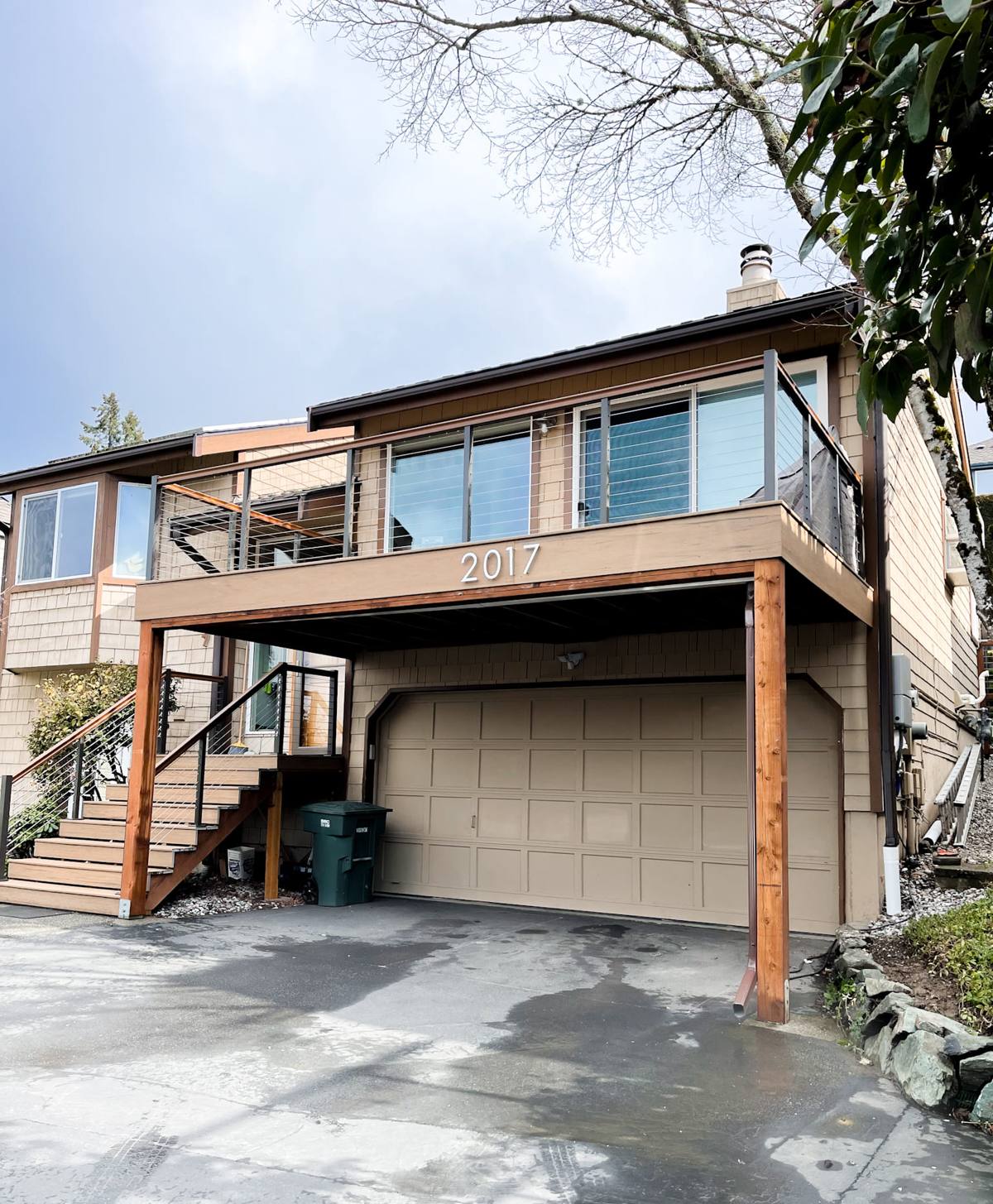
What Salt Air, Driving Rain, and Moss Actually Do to Siding
Salt Air
Airborne salt is corrosive to fasteners, flashing, and any exposed metal components in a wall assembly. It also accelerates the breakdown of lower-grade coatings, which is why paint on wood or engineered wood siding near the water tends to chalk, fade, and fail faster than the same product installed a few miles inland. Salt exposure doesn't just affect finish — over years it can compromise the hardware holding the siding to the house if that hardware wasn't specified for a marine-adjacent environment.
Wind-Driven Rain
Blaine's exposure to open water means rain frequently arrives sideways, not straight down. Wind-driven rain finds every gap, lap, and seam a standard rain event never reaches. Siding systems rated for average rainfall can still leak on a home with this kind of exposure if the laps, flashing, and water-resistive barrier underneath weren't installed with that wind direction in mind.
Moss and Algae
Shaded, damp siding grows moss and algae. It's mostly a cosmetic problem at first, but persistent moss holds moisture against the siding surface far longer than open air ever would, which speeds up any rot, swelling, or coating failure that a moisture-sensitive material is prone to. On wood, engineered wood, and even some fiber cement products with weaker factory finishes, a few seasons of untreated moss growth can turn into a real maintenance project.
None of these three factors is unique to Blaine — but the combination, applied to a coastal town in Whatcom County, is more aggressive than what most siding products were designed to shrug off for decades without babysitting.
Why We Install James Hardie and Nothing Else
We made a standing decision as a company to install James Hardie fiber cement siding exclusively — no vinyl, no LP SmartSide, no Cemplank or Allura, no primed spruce or cedar. That's not a marketing position, it's a practical one built around jobs like the ones we do in Blaine.
- Non-combustible core. Fiber cement doesn't feed a fire the way wood-based products can, which matters for insurance conversations as much as safety.
- ColorPlus factory finish. A baked-on finish applied under controlled conditions holds up to UV and salt exposure far better than field-applied paint, and it's backed by its own finish warranty separate from the product warranty.
- Climate-engineered HZ product lines. Hardie's HZ5 formulation is engineered for the wetter, harsher climate zones on the map — the Pacific Northwest coast qualifies.
- Moisture behavior. Fiber cement doesn't absorb and swell the way engineered wood products can when a lap seam takes on water repeatedly, which is a real consideration given how often that happens on a wind-exposed Blaine elevation.
- Transferable warranty. A strong, transferable warranty is worth more on a coastal property, where buyers already scrutinize exterior condition closely during inspections.
We're not going to tell you every other product on the market is worthless — plenty of them perform fine in moderate, sheltered conditions. But we don't think moderate, sheltered conditions describe most Blaine properties, and we'd rather stand behind one product system we trust in this environment than install several we'd need to caveat.
What a Correct Installation Looks Like Here
James Hardie siding performs the way it's rated to perform only when it goes on correctly. In a wind-and-salt environment like Blaine, a few details matter more than they would on a sheltered inland lot:
Water-Resistive Barrier and Flashing First
Before a single piece of siding goes up, the wall needs a continuous water-resistive barrier with properly lapped and sealed seams, plus flashing at every window, door, and penetration. On wind-driven rain exposures, this layer is what actually keeps water out of the wall assembly — the siding itself is the first line of defense, not the only one.
Fastener Selection and Placement
Corrosion-resistant fasteners, placed and spaced according to Hardie's published installation instructions, are non-negotiable in a salt-air environment. Under-driven or over-driven nails, wrong fastener material, or incorrect spacing are common failure points we see on homes near the water that were sided by crews used to inland work.
Proper Clearances and Gaps
Hardie specifies minimum clearances from grade, roof lines, decks, and other siding terminations, along with expansion gaps at butt joints. Skipping these is one of the most common corner-cutting mistakes in the industry, and it's exactly the kind of shortcut that shows up as a moisture problem two or three winters later — which, on a wind-driven-rain site, comes faster than it would elsewhere.
Caulking and Sealant Choices
Not all sealants hold up to constant UV, salt, and moisture cycling. Using the right sealant at butt joints and penetrations, applied correctly, is a small line item that has an outsized effect on how the siding performs over the following decade.
Comparing How Common Siding Materials Handle Blaine's Conditions
| Material | Salt Air Resistance | Wind-Driven Rain Behavior | Moss/Algae Resistance |
|---|---|---|---|
| James Hardie fiber cement (HZ5) | Strong — non-corrosive core, factory finish holds up | Strong when flashing and laps are installed to spec | Good — factory finish resists growth better than field-painted surfaces |
| Vinyl siding | Fair — panels themselves are inert but can become brittle over time | Weaker seams; can allow water intrusion behind panels | Fair — smooth surface but growth is common in shaded coastal spots |
| LP SmartSide / engineered wood | Weaker — more sensitive to repeated moisture exposure | Prone to swelling at laps if water gets in repeatedly | Weaker — moisture-sensitive substrate compounds moss-related damage |
| Primed cedar or spruce | Weakest — natural wood needs ongoing coating maintenance | Requires diligent maintenance to stay sealed | Weakest — organic material feeds growth and rot together |
This isn't a claim that the other materials fail outright — it's a description of relative maintenance burden and risk in exactly the conditions a Blaine home actually sees. That gap is why we standardized on Hardie rather than offering a menu of options.
Our Process for a Blaine Job
- On-site assessment. We look at wind exposure, shading and moss history, current siding condition, and any moisture damage already present before we talk product or price.
- Scope and product selection. We walk through the right Hardie plank, panel, or shingle profile and ColorPlus finish for the home, factoring in HOA or neighborhood expectations where relevant.
- Written estimate. A clear, itemized estimate — no surprise change orders for work that should have been scoped up front.
- Tear-off and inspection. Once old siding comes off, we inspect sheathing and framing for hidden moisture damage before anything new goes on — this is often the point where a wind-exposed Blaine home reveals problems that weren't visible from outside.
- Barrier, flashing, and fastening. Installed to Hardie's specifications for the HZ5 climate zone, with attention to the wind and salt factors specific to the site.
- Final inspection and walk-through. We review the finished work with the homeowner and go over care and maintenance specific to a coastal property.
Why Local Experience in Blaine Specifically Matters
A crew that mostly works sheltered, inland Whatcom County neighborhoods and occasionally takes a Blaine job doesn't build the same instincts as a crew that regularly works this stretch of coastline. Knowing which elevations on a given lot catch the worst of the wind, how much extra attention a shaded, moss-prone north wall needs, and how salt exposure changes fastener and sealant choices isn't something you get from a manufacturer's install manual alone — it comes from doing the work here repeatedly. We treat Blaine as its own environment within our broader Whatcom County service area, not a variation on a standard inland job.
Maintenance After Installation
Correctly installed Hardie siding is low-maintenance, not zero-maintenance. A short annual routine goes a long way in a coastal environment like Blaine's:
- Rinse siding periodically to clear accumulated salt residue, especially on wind-exposed elevations.
- Trim back vegetation that keeps siding shaded and damp, particularly on north- and east-facing walls.
- Check caulking at butt joints and penetrations every year or two, and re-seal if it's cracking or pulling away.
- Address any moss growth early with a gentle wash rather than letting it establish and hold moisture long-term.
- Watch gutters and downspouts — overflow during heavy wind-driven rain events is a common source of siding damage that has nothing to do with the siding itself.
What to Ask Before Hiring Anyone for Coastal Siding Work
Whether you hire us or someone else, a few questions separate a crew that understands coastal installation from one that's just installing siding wherever the next job happens to be:
- Do you install to the specific HZ climate-zone requirements for this area, or a generic spec?
- What fastener material and flashing approach do you use for wind-driven rain exposure?
- Can you walk me through how you'll handle laps, gaps, and sealant on the sides of the house that take the worst weather?
- Do you inspect sheathing and framing during tear-off, and what happens if you find damage?
- What does the warranty actually cover, and is it transferable if I sell the house?
If your Blaine home's siding is showing salt residue, persistent moss, cracked caulking, or you're just planning ahead for a replacement, we're happy to take a look and walk you through what your home specifically needs. Reach out for a free, no-pressure estimate using the form below.