 Ferndale
 What Sudden Valley Siding Is Actually Up Against
Homes in and around Sudden Valley don't fail the same way homes in drier parts of the country do. The problems here are slow and cumulative: moisture that never fully dries out between rain events, salt-laden air moving in off the water, and a moss and algae season that can run most of the year on shaded, north-facing walls. None of that is dramatic on its own. It's the accumulation, year after year, that turns a small gap in the siding into a soft spot in the sheathing behind it.
Whatcom County's marine climate means long stretches of low-intensity, driving rain rather than the short, heavy downpours you'd see inland. Wind-driven rain finds its way into laps, seams, and fastener holes that would stay dry in a calmer climate. Add salt air corrosion on metal flashing and fasteners, plus moss holding moisture against the wall longer than it should, and you get a siding system that's tested constantly rather than occasionally. Correct material choice and correct installation both matter more here than they would somewhere drier.
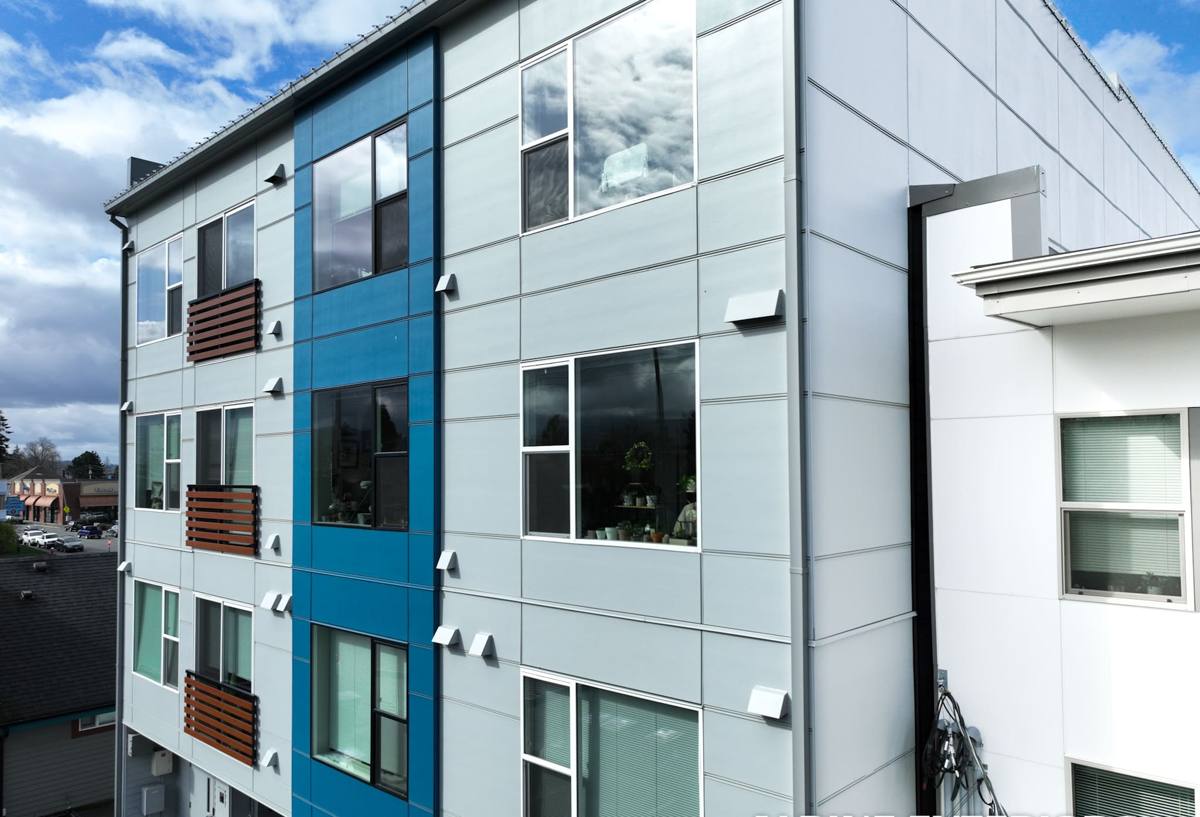
What a Correct Siding Replacement Involves
Siding replacement isn't just pulling off old material and nailing up new panels. Done right, it's a full reset of how water moves around the exterior of the house. A rushed re-side can look fine for a year or two and still fail early because the water management underneath was never actually fixed.
The Parts Homeowners Don't See
- Full tear-off to bare sheathing so rot, soft spots, and old damage are found — not covered up
- A new weather-resistive barrier installed with correct overlaps, shingle-style, so water sheds down and out
- Properly integrated flashing at every window, door, deck ledger, and roof-to-wall transition
- Rain screen or drainage gap where the wall assembly calls for it, so siding can dry from behind
- Correct fastener type, spacing, and depth — over- or under-driven nails are one of the most common causes of early siding failure
- Proper caulking and sealant only where it belongs, not as a substitute for real flashing
Any one of these done wrong can undo the benefit of even the best siding material. This is where the installer matters as much as the product.
Why We Only Install James Hardie Fiber Cement
We don't install vinyl siding, LP SmartSide, Cemplank, Allura, or primed spruce and cedar. That's a deliberate standard, not a lack of options, and it's worth explaining honestly rather than just stating it.
Vinyl is affordable and low-maintenance in mild, dry climates, but it expands and contracts with temperature swings, can warp or crack in cold snaps, and doesn't hold up well against sustained wind-driven rain at seams and corners — exactly the conditions this area produces regularly. LP SmartSide is a wood-strand product with real strengths, but it's an engineered wood product at its core, meaning any breach in its factory coating opens the door to moisture absorption and swelling, which is a bigger risk in a climate that rarely gets a long dry stretch to let materials fully recover. Primed spruce and cedar are beautiful and traditional, but they're natural wood — they need repainting on a real schedule, they're the most susceptible of any siding option to moss and mildew staining in shaded, damp conditions, and skipping maintenance for even a couple of years shows up fast here.
James Hardie fiber cement is non-combustible, dimensionally stable in wet-dry cycling, and doesn't feed mold or moss growth the way wood-based products can. Its ColorPlus factory finish is baked on under controlled conditions rather than field-painted, which matters in a place where you don't get many consecutive dry, moderate-temperature days to paint correctly. That combination — stability, moisture resistance, and a finish that doesn't depend on job-site weather — is why it's the only product we put on homes.
How the Options Compare
| Material | Behavior in Sustained Damp Climate | Maintenance Burden |
|---|---|---|
| Vinyl siding | Can warp, crack at seams under wind-driven rain and temperature swings | Low, but limited repair options once damaged |
| LP SmartSide | Engineered wood core; vulnerable if factory coating is breached | Moderate; edge sealing and caulk upkeep matter |
| Primed spruce/cedar | Natural wood; absorbs moisture, prone to moss and mildew in shade | High; repainting and moss treatment on a schedule |
| James Hardie fiber cement | Non-combustible, stable through wet-dry cycles, resists moss growth | Low; occasional wash, no repainting cycle with ColorPlus finish |
Choosing the Right Hardie Line for This Climate
James Hardie engineers its products by climate zone, and the Pacific Northwest falls into the wetter HZ5 category. That's not a marketing distinction — it affects the formulation and moisture performance of the board itself. We spec HZ5 product for Sudden Valley homes rather than a generic national product, because the engineering is built for exactly the wet-dry cycling this area sees.
Beyond the base product, ColorPlus finishes give you a factory-applied, baked-on color coat with a stronger bond than field-applied paint, plus color-matched caulk and touch-up so seams and trim don't stand out as a different shade over time. For a home taking on salt air and near-constant moisture exposure, that finish durability is doing real work, not just saving you a paint job.
Our Process, Start to Finish
- On-site assessment: We look at the existing siding, sheathing condition, trim, flashing, and any problem areas — north-facing walls and moss buildup get particular attention.
- Honest scope and estimate: You get a clear breakdown of what's being replaced, what product line is recommended, and why — no pressure, no upsell beyond what the house actually needs.
- Full tear-off: Old siding comes off completely so we can see and fix what's underneath, not just what's visible from the outside.
- Water management first: New weather-resistive barrier, flashing, and drainage details go in before a single piece of new siding is hung.
- Hardie installation to spec: Correct fastening, spacing, and clearances, following manufacturer installation requirements so the warranty stays valid.
- Final walkthrough: We go over the finished work with you, including caulking, trim details, and paint touch-up where applicable.
What Drives the Cost of a Siding Replacement Here
| Factor | Why It Matters in This Area |
|---|---|
| Extent of existing damage | Homes that went years without maintenance often need sheathing repair, not just new siding |
| Wall complexity | Dormers, multiple stories, and cut-up rooflines mean more flashing and trim work |
| Product line and finish | HZ5 boards and ColorPlus color selection affect material cost |
| Access and site conditions | Sloped lots, trees, and limited staging space common in wooded communities affect labor time |
| Trim and detail work | Fascia, soffits, and window trim replacement alongside siding adds scope but avoids mismatched future repairs |
We won't quote a number without seeing the house, but these are the variables that actually move the price — not guesswork.
Signs Your Siding Needs Replacing, Not Just Patching
- Soft or spongy spots when you press on the siding, especially near the bottom courses
- Persistent moss or algae growth that comes right back after cleaning
- Paint that's peeling or bubbling in patterns rather than evenly across the wall
- Visible warping, cupping, or gaps opening up at seams and corners
- Interior signs like musty smells, staining, or bubbling drywall near exterior walls
- Siding that's original to a home over 20-25 years old, regardless of how it looks from the street
If you're only seeing one or two of these, a repair might genuinely be enough. If you're seeing several at once, especially soft sheathing, that's usually a sign the water management behind the siding has already failed and a full replacement is the more honest recommendation.
Why Hiring a Crew That Already Works This Area Matters
Siding installation isn't identical everywhere, and a crew that mainly works drier inland regions can make assumptions that don't hold up on the water side of Whatcom County. Local experience means knowing which walls need extra flashing attention because of prevailing wind and rain direction, how much drainage gap actually gets used versus specified, and where moss control needs to be built into the maintenance conversation rather than treated as an afterthought.
It also means understanding practical realities specific to established communities like Sudden Valley — some neighborhoods have design guidelines or shared aesthetic standards for exterior changes, and a local crew is more likely to already understand what to check for before work starts rather than finding out mid-project. That's less about paperwork and more about not creating a headache for you after the job is done.
Get a Straight Answer About Your Siding
If your siding is showing its age, or you just want an honest opinion on whether repair or replacement makes more sense for your home, we're happy to take a look. The estimate is free, there's no pressure, and you'll get a straight answer about what your house actually needs — not a sales pitch. Reach out through the form below to get started.