 Ferndale
 Sudden Valley's Setting Is Hard on Siding
Sudden Valley sits in a wooded, hilly pocket of Whatcom County near Lake Whatcom, and that setting is exactly what makes siding here behave differently than siding on an open lot in town. Mature tree canopy shades large sections of most homes for much of the day. Combine that shade with lake-influenced humidity and the long, wet stretch of Pacific Northwest fall through spring, and you get siding that rarely gets a full, fast dry-out between rain events. That's the core problem we're solving on almost every Sudden Valley project: not just keeping water out, but managing a surface that stays damp longer than siding does on a sunny, exposed lot elsewhere in Ferndale or Whatcom County.
None of that is unique to any one street or property — it's a function of tree cover, elevation, and proximity to water that shows up across the neighborhood. Add in the driving rain that blows through this part of Washington and the long moss season that follows it, and you have a climate that punishes the wrong siding choice faster than most homeowners expect.
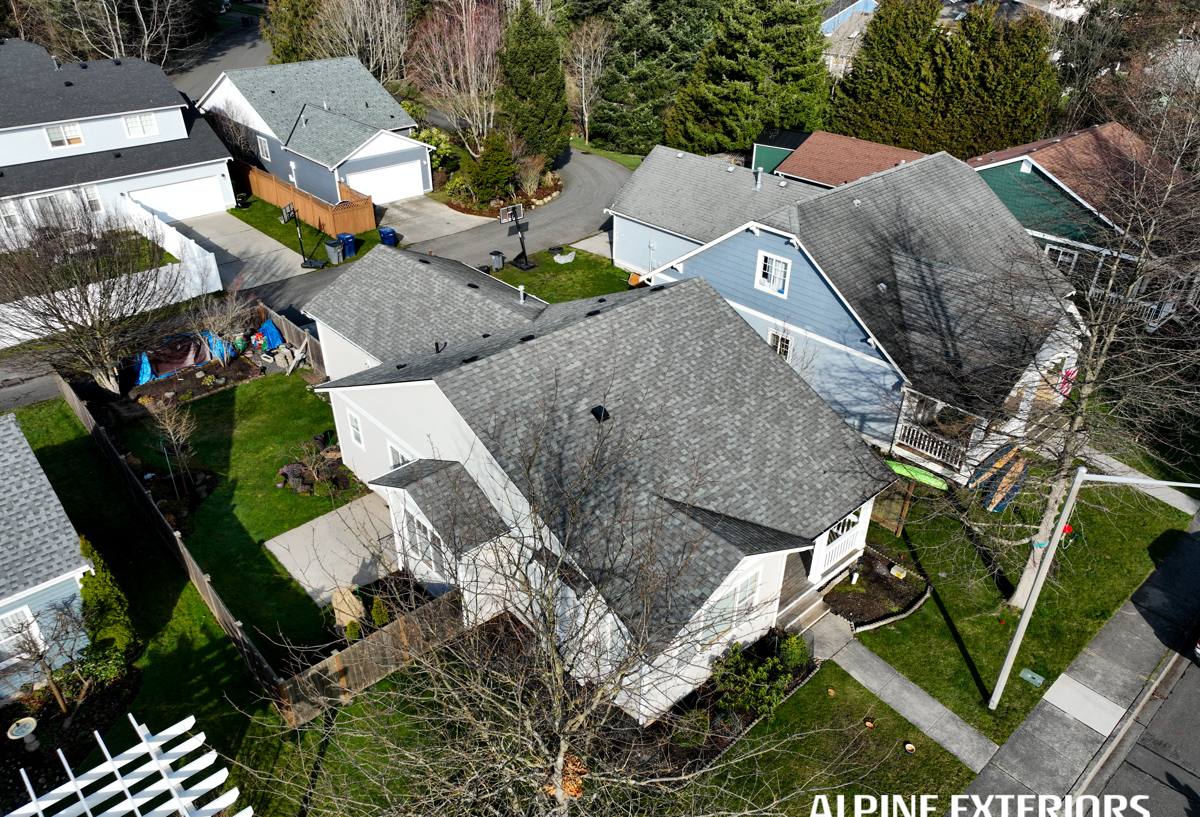
What Driving Rain and a Long Moss Season Actually Do to Siding
Moss and algae don't just sit on top of siding — they root into any texture or seam that holds moisture, and shaded, damp siding gives them months of runway to do it. On the wrong material, that leads to a predictable chain of problems:
- Moss and algae take hold in butt joints, lap seams, and anywhere caulk has started to shrink or crack
- Trapped moisture behind or under panels leads to swelling, delamination, or rot depending on the substrate
- Paint and factory finishes break down faster where they stay wet longer, leading to chalking and color loss
- Fastener heads and cut edges that weren't properly sealed become entry points for water over time
- Driving rain pushed by wind finds gaps that would never leak in a calmer, drier climate
This is also where Whatcom County's broader coastal-influenced climate plays a role — the salt-tinged air that moves through this part of Washington accelerates corrosion on unprotected fasteners and trim hardware, which is one more reason we're particular about the materials and fastener systems that go on a home here, lake-adjacent or not.
Why This Hits Some Materials Harder Than Others
Wood and wood-composite siding products absorb moisture at cut edges and panel faces; once that moisture is trapped by shade, it doesn't leave quickly, and rot follows. Vinyl doesn't rot, but it doesn't stop moss either — algae grows directly on its surface, and vinyl's expansion and contraction in temperature swings opens gaps at seams over years, which is exactly where wind-driven rain gets in. Fiber cement handles this environment differently because it isn't an organic material to begin with — there's no wood fiber for moss to feed on and no wood substrate to rot from the inside out.
Why We Install Only James Hardie Fiber Cement
We don't install LP SmartSide, vinyl, Cemplank, Allura, primed spruce, or cedar. That's not a marketing position — it's a standard we hold because of what we see happen to those products in exactly this kind of climate. Vinyl and engineered wood products can be good products in the right application; in a shaded, damp, moss-prone environment like Sudden Valley, they simply ask for more maintenance and carry more failure points than we're willing to put our name on.
James Hardie fiber cement is cement, sand, and cellulose fiber — it doesn't rot, and it isn't a food source for moss or fungus the way wood-based products are. Hardie's HZ5 product line is engineered specifically for climates with prolonged moisture exposure, which describes Whatcom County generally and Sudden Valley's shaded, humid microclimate in particular. The ColorPlus factory finish is baked on under controlled conditions rather than field-applied, which means better adhesion and a finish that holds its color and resists the chalking and fading that comes from prolonged damp exposure. It also carries a strong, transferable warranty backed by a manufacturer that's been refining this specific product category for decades — not a caulk-and-hope system that depends entirely on perfect field conditions to perform.
We're upfront that Hardie costs more up front than vinyl and is not a do-it-yourself product. In a lot like this, where siding sits wet longer than it does almost anywhere else in the county, that upfront cost is what buys you a material that isn't fighting its environment for the next 20 years.
What a Correct Installation Involves
Fiber cement siding is only as good as the installation behind it. A huge share of the siding failures we get called out to inspect — regardless of brand — trace back to installation shortcuts, not the product itself. On a Sudden Valley home, correct installation means:
- A continuous water-resistive barrier installed and lapped correctly behind the siding, with no gaps for wind-driven rain to exploit
- Proper flashing at every window, door, and roof-to-wall transition — the places where almost every real leak actually starts
- Correct fastener placement and type per Hardie's published fastening schedule, sized and spaced for the panel and climate exposure
- Manufacturer-specified gapping and caulking at butt joints and penetrations, not tight-butted seams that trap water
- A ventilation gap behind the siding so moisture that does get in can dry out instead of sitting against the sheathing
- Field-cut edge sealing so every cut end is protected, not just the factory edges
Skip any one of these on a shaded, damp lot and you're not buying yourself years before a problem shows up — you're buying yourself one wet season.
Comparing Materials for a Shaded, Moisture-Prone Lot
| Factor | James Hardie Fiber Cement | Vinyl | Wood / Engineered Wood |
|---|---|---|---|
| Moss and algae resistance | Doesn't feed moss growth; factory finish resists staining | Moss grows directly on the surface over time | Absorbs moisture, feeds fungal and moss growth |
| Behavior in prolonged damp | Cement-based, no rot risk | Won't rot but seams can open and leak | Prone to swelling, rot, and delamination |
| Finish durability | Factory-baked ColorPlus finish | Color molded in but can fade/chalk | Field-applied paint/primer needs recoating |
| Fire performance | Non-combustible | Combustible | Combustible |
| Typical maintenance | Occasional wash, minimal upkeep | Low, but moss cleaning needed in shade | Regular inspection, recoating, caulk upkeep |
| Upfront cost | Higher | Lowest | Moderate to high |
Our Process for a Sudden Valley Project
- On-site assessment — we look at tree cover, sun exposure on each elevation, drainage around the foundation, and the current siding's failure points before recommending anything
- Product and color selection — matching the right Hardie panel profile and ColorPlus color to the home, factoring in how much shade each side gets
- Tear-off and substrate check — removing old siding and inspecting sheathing for hidden moisture damage before anything new goes up
- Water-resistive barrier and flashing — the layer that actually keeps the home dry, installed before a single piece of siding goes on
- Installation to Hardie's fastening and gapping spec — no shortcuts on cut-edge sealing or joint spacing
- Final walkthrough and cleanup — including a look at trim, caulking, and any areas where trees overhang the roofline that owners should keep in mind going forward
A Quick Checklist Before You Hire
- Ask what water-resistive barrier and flashing details they use — not just what siding brand
- Confirm they're following the manufacturer's published fastening and gapping specifications, not a generic approach
- Ask how they've handled tree-shaded, moisture-heavy lots before
- Get the warranty terms in writing — both the manufacturer's and the installer's labor warranty
- Make sure the quote includes flashing and water barrier work, not just siding material and labor
Why Local Experience in Sudden Valley Matters
A crew that's already worked this neighborhood knows what to expect before they show up: which elevations tend to hold shade longest, how tree-lined lots affect drying time, and what it takes to stage material and equipment on hilly, wooded driveways without tearing up landscaping. That's not something you get from a crew that mainly works flat, open subdivisions elsewhere in Ferndale. It shows up in small decisions — how flashing details are handled at a shaded window, how much dry time is built into the schedule around a wet week — that add up to a siding job that actually holds up in this specific environment instead of one that was installed the same way it would be anywhere else in the county.
If you're planning a siding project in Sudden Valley, we're happy to take a look at your home, walk you through what we're seeing with sun exposure and moisture on your specific lot, and put together a straightforward, no-pressure estimate — use the form below to get started.