 Ferndale
 Siding Installation Built for Nooksack's Climate
Nooksack sits far enough inland from the Strait of Georgia that people sometimes assume salt air isn't a factor here the way it is on the coast. It still is, just in a different form — moisture-laden marine air moves up the Nooksack River valley and settles against homes for months at a time, especially through the fall and winter when driving rain comes through sideways off passing fronts. Add in a moss season that can run from October through April in shaded, tree-lined yards, and you have a siding environment that punishes anything not built to shed water and resist organic growth. We install siding in Nooksack and the surrounding Whatcom County communities regularly, and the failures we get called out to inspect almost always trace back to the same root cause: a product or installation detail that wasn't matched to this climate.
This page covers what a correct siding installation looks like specifically for a Nooksack home — not a generic overview, but the details that matter given the rain exposure, humidity, and moss pressure typical of this part of the county.
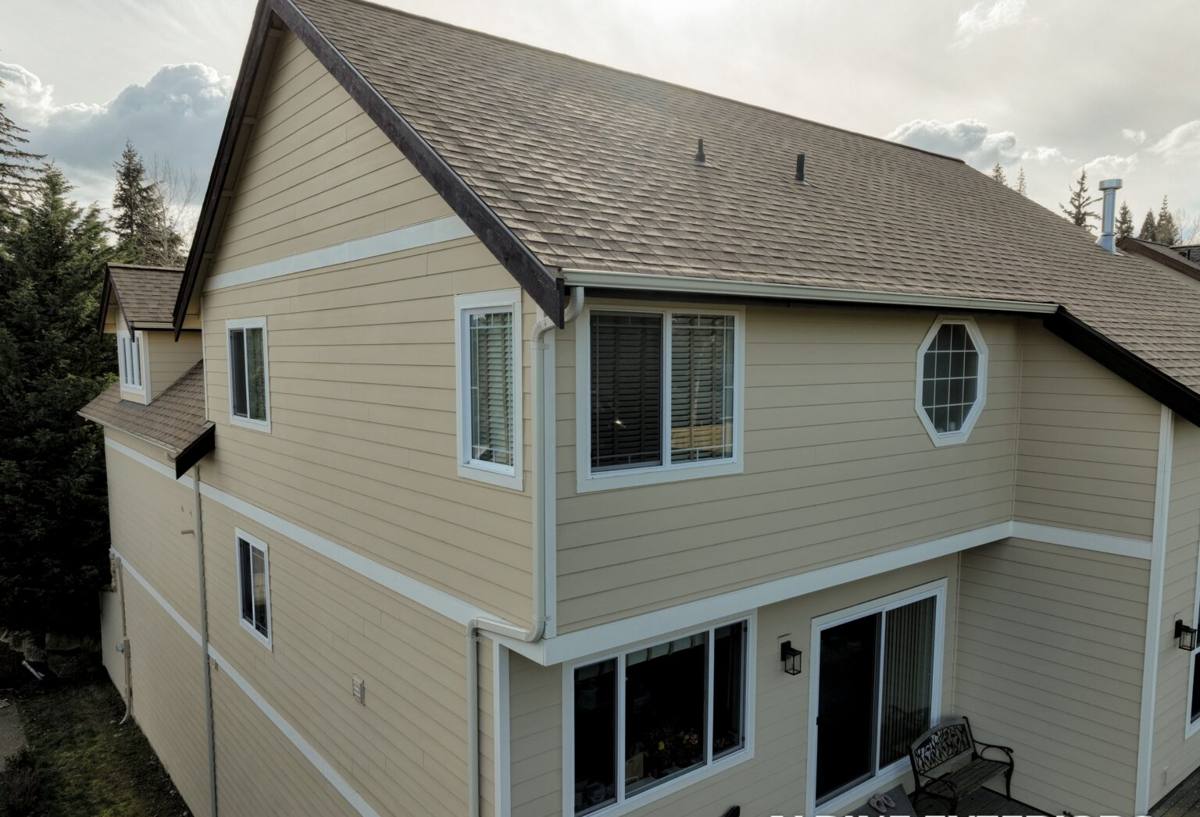
What Local Homes Are Up Against
Driving Rain and Wind-Driven Moisture
Whatcom County storms frequently come with enough wind to push rain sideways into wall assemblies rather than letting it fall straight down and run off. That means siding here has to perform as an actual water-management system — laps, flashing, and house wrap all working together — not just as a decorative skin. Any gap, short lap, or missed flashing detail becomes an entry point during a hard blow, and once water gets behind the cladding, it doesn't dry out quickly in our climate.
Sustained Humidity and Moss
Nooksack's tree cover and river-valley humidity create ideal conditions for moss, algae, and mildew on north-facing and shaded walls. Products that absorb moisture or that rely on paint film to stay sealed are the ones we see degrading fastest — swelling, edge softening, and finish failure show up first wherever moss holds moisture against the surface for weeks at a time.
Temperature Swings and Material Movement
Summers bring dry heat that shrinks wood-based products, while wet winters swell them back up. That expansion-and-contraction cycle, repeated every year, is what eventually opens up seams, cracks paint, and loosens fasteners on siding that isn't dimensionally stable.
Why We Install James Hardie and Nothing Else
We standardized on James Hardie fiber cement siding for every home we side, including here in Nooksack, because it's engineered to handle exactly the conditions described above. It's non-combustible, doesn't absorb water the way wood-based or wood-fiber products do, and comes with a factory-applied ColorPlus finish that's baked on under controlled conditions rather than field-painted — which matters a lot in a climate where field paint doesn't get much of a dry window to cure. Hardie's HZ5 product line is specifically engineered for climates with sustained moisture exposure, which describes Whatcom County well. The finish carries a strong transferable warranty, and the product itself has a long track record in Pacific Northwest conditions when installed to spec.
We don't install LP SmartSide, vinyl, Cemplank, Allura, primed spruce, or cedar. Each of those has legitimate uses elsewhere, but we've made a professional decision not to put our name behind them here, mainly because of how they behave over time in exactly this kind of wet, moss-prone environment — moisture absorption at cut edges, field-paint maintenance cycles, or long-term dimensional stability. Hardie is the one product line we've found holds up consistently under Whatcom County conditions without asking the homeowner to fight the climate every few years.
What Correct Installation Actually Involves
The siding material is only half the equation. Most of the failures we inspect on other contractors' work aren't material failures — they're installation shortcuts. A correct Hardie installation in a high-moisture area like Nooksack includes:
- A properly lapped and sealed weather-resistant barrier behind the siding, with all penetrations flashed before the first board goes up
- Correct minimum clearances from grade, decks, patios, and roof lines so water and moss-holding debris can't wick or collect against the bottom course
- Proper fastener placement and spacing per James Hardie's published installation specs — not shortcuts that void the warranty
- Correctly sized gaps at butt joints and trim, caulked with a quality sealant rated for exterior movement, not just gapped tight and painted over
- Flashing integrated at every window, door, and roof intersection — the single most common failure point we find on inspections
- Proper field-cut edge sealing wherever boards are trimmed on site
Skip any one of these and you can install the best siding material available and still end up with moisture intrusion within a few years. This is why installation quality matters as much as product choice.
Our Process for Nooksack Projects
1. On-Site Assessment
We walk the home, check the current siding and sheathing condition, look at grading and drainage around the foundation, and identify any moisture damage already present — which is common on older homes in shaded, tree-covered lots typical of the area.
2. Scope and Product Plan
We spec the correct Hardie plank profile, exposure, and HZ product line for the home's exposure — a fully exposed south wall and a shaded north wall under fir trees don't always need identical detailing.
3. Tear-Off and Sheathing Check
Old siding comes off and we inspect the sheathing underneath. If there's rot or water damage from a prior failure, we address it before anything new goes up — covering damaged sheathing with new siding just locks the problem in.
4. Weather Barrier and Flashing
This is the step most often rushed elsewhere and the one we spend the most care on, given how much of Nooksack's siding damage traces back to water getting behind the cladding rather than through it.
5. Installation to Manufacturer Spec
Boards, fasteners, and joints installed per James Hardie's requirements, which also keeps the manufacturer warranty intact — something that's void on a large share of the "poor installation" failures we're asked to inspect.
6. Final Walkthrough
We review the finished work with the homeowner, including basic maintenance expectations for a moss-prone, wet-winter property.
Comparing Siding Options for a Nooksack Home
| Factor | James Hardie Fiber Cement | Wood-Based Products (LP, cedar, spruce) | Vinyl |
|---|---|---|---|
| Moisture absorption | Very low; engineered cement composition | Higher; edges and cuts vulnerable | Doesn't absorb, but can warp/buckle |
| Moss/algae resistance | Good with ColorPlus finish; cleans easily | Traps moisture under growth, accelerating decay | Resistant but shows staining over time |
| Finish durability in this climate | Factory-cured finish, long warranty | Field paint, shorter repaint cycles | Color baked in but can fade/chalk |
| Fire resistance | Non-combustible | Combustible | Combustible, can melt/deform |
| Typical lifespan when installed to spec | Multiple decades | Shorter, climate-dependent | Multiple decades, but brittle with age |
Cost Factors for a Nooksack Siding Project
Every home is different, and we don't quote sight-unseen, but the factors that typically move a Nooksack project's price include:
| Factor | Why It Matters Locally |
|---|---|
| Sheathing/rot repair needed | Older homes with prior moisture intrusion often need sheathing replaced before new siding goes on |
| Home exposure and elevation changes | Multi-story or wooded, hard-to-access walls take longer to properly flash and finish |
| Trim and detail complexity | Homes with more window/door openings need more flashing and cut-edge sealing work |
| Plank profile and HZ line selection | Higher-exposure elevations may call for a heavier-duty HZ5 spec |
| Site access | Tree-lined lots and narrow driveways common in Nooksack can affect staging and disposal logistics |
Why Hiring a Crew That Already Works This Area Matters
A crew that regularly works Nooksack and greater Whatcom County knows which walls typically take the worst weather exposure, how much moss pressure to expect on a shaded lot, and where prior installations in this area tend to fail. That local pattern recognition shows up in small decisions — extra flashing at a vulnerable transition, a different fastening approach on a particularly exposed gable — that a crew unfamiliar with this specific climate might not think to make. It also means we're not learning the region's weather behavior on your home; we've already seen how it plays out on others nearby.
Signs Your Current Siding May Already Be Failing
- Soft spots or visible swelling, especially near the bottom courses or under windows
- Persistent moss or dark staining that returns quickly after cleaning
- Peeling or bubbling paint, particularly on shaded or north-facing walls
- Visible gaps at butt joints or trim where caulking has failed
- Warping, cupping, or delamination on wood-based siding
- Musty smell or visible staining on interior walls that share an exterior wall
If you're seeing any of these on a Nooksack-area home, it's worth having the siding and sheathing looked at before deciding whether a full replacement or a targeted repair is the right move.
If you're considering new siding or replacing failing siding on a home in Nooksack, we're happy to come take a look, walk the exterior with you, and give you a straightforward, no-pressure estimate for what a correct James Hardie installation would involve on your specific property. Use the form below to get started.