 Ferndale
 Siding That Has to Work in Nooksack's Climate, Not Just Look Good in a Brochure
Nooksack sits inland from the Salish Sea but still gets the full package of Whatcom County weather: salt-laden air pushing in off the water, long stretches of driving rain from fall through spring, and a moss season that can run half the year on shaded north and east walls. Any siding product you put on a home here is going to be tested by moisture cycling — wet, dry, wet again — for months at a stretch. Most of what fails on local homes isn't dramatic. It's slow: swelling at the bottom courses, soft trim, paint that won't hold, or dark green streaks that come back every year no matter how many times you pressure wash them off.
We install James Hardie fiber cement siding exclusively, and this page is specifically about what that looks like for a Nooksack-area home — what the climate demands, what a correct installation actually involves, and how we run the job from estimate to final walk-through.
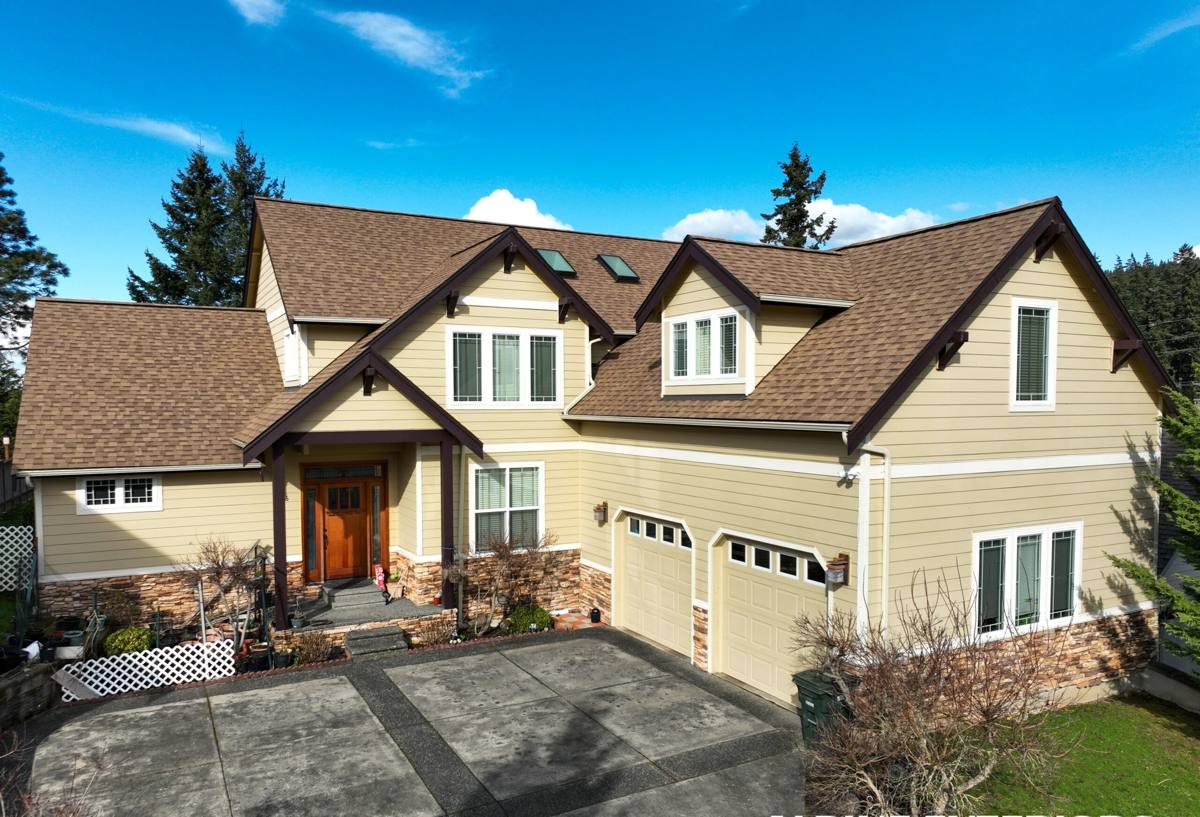
What Nooksack Homes Are Actually Up Against
Salt Air and Corrosion
Homes in this part of Whatcom County are close enough to the water that salt-bearing moisture in the air is a real factor, even inland. Salt air accelerates corrosion on exposed fasteners, weakens paint film adhesion over time, and speeds up the breakdown of anything wood-based that isn't fully sealed on every cut edge. It's slow, cumulative damage — the kind that doesn't show up in year one but shows up in year eight.
Driving Rain
Wind-driven rain doesn't just wet a wall surface — it pushes water sideways and upward into laps, seams, and penetrations that a calm rain would never reach. That means the water-resistive barrier behind the siding, the flashing details around windows and doors, and the lap engineering of the siding itself all matter as much as the siding material itself. A product that's fine in a dry climate can perform very differently here.
Moss and Sustained Dampness
Shaded walls, especially north-facing ones under trees, stay damp longer than they dry out for large stretches of the year. That sustained dampness is exactly what moss and mildew need to take hold. On absorptive siding materials, moisture gets pulled into the substrate itself, not just the surface — which is a different and more serious problem than a green stain you can wash off.
Why We Standardized on James Hardie for This Kind of Exposure
James Hardie fiber cement is engineered from cement, sand, and cellulose fibers — it doesn't have the wood-based substrate that lets moisture soak in and cause swelling or rot. That matters directly for a climate like this one: the material itself isn't the weak point in a wet cycle the way wood-based or wood-composite sidings can be. Hardie's HZ5 product line is specifically engineered for the wetter, harsher climate zones the Pacific Northwest falls into, with moisture and freeze-thaw performance tuned for exactly the conditions Whatcom County sees.
It's also non-combustible, which is a real advantage during dry summer stretches when wildfire smoke and regional fire risk are a concern even on the wet side of the state — that's a separate benefit from the moisture story, but it's part of why we don't hedge with other materials.
ColorPlus Factory Finish
Most of the siding we install uses Hardie's ColorPlus finish — baked on at the factory under controlled conditions, not brushed or sprayed on site. That finish holds up better against UV fading and against the kind of moisture cycling this area produces, and it comes with its own finish warranty separate from the product warranty. Field-painted siding, by contrast, is only as good as the weather conditions and prep work on the day it was painted — and repainting is a recurring cost homeowners end up carrying every several years.
What a Correct James Hardie Installation Involves
Fiber cement siding is only as good as the installation behind it. This is where a lot of the real-world problems with any siding product actually originate — not the material, the details.
- Water-resistive barrier: A continuous, correctly lapped barrier behind the siding, with seams taped and penetrations sealed, so any moisture that gets past the siding has a drainage path instead of a place to sit.
- Rainscreen or proper furring where called for: Creating a small air gap behind the siding lets water drain and the wall assembly dry, which matters a lot more here than in a drier climate.
- Correct fastener pattern and type: Hardie specifies fastener type, spacing, and placement for a reason — this is a fiber cement product, not lumber, and it doesn't forgive shortcuts the way wood siding sometimes does.
- Flashing at every penetration: Windows, doors, hose bibs, light fixtures, and any other wall penetration need proper flashing and sealant details, not just caulk over a gap.
- Cut-edge sealing: Any field-cut edge of Hardie board needs to be primed or sealed per manufacturer spec before installation — an exposed cut edge is a moisture entry point.
- Proper clearances: Correct gaps at grade, roof lines, decks, and other siding-to-material transitions so water can shed instead of wicking up into the bottom of the board.
Any one of these done wrong can undercut the performance of the product itself. This is why we treat installation quality as the actual product, not just the board.
Our Process for a Nooksack-Area Job
1. On-Site Assessment
We walk the whole exterior, not just the obviously damaged sections. We're looking at existing moisture damage, trim and flashing condition, shaded and exposed wall exposures separately, and anything already showing moss or staining patterns that tell us where water is lingering.
2. Product and Line Selection
We talk through Hardie's plank profiles, panel options, and color choices, and we're straightforward about which choices make sense for a given wall's sun and moisture exposure versus which are purely aesthetic preferences.
3. Tear-Off and Substrate Check
Old siding comes off and we inspect sheathing before anything new goes up. If there's hidden rot or water damage behind the old material, that gets addressed before siding — covering over a wet wall assembly just hides the problem.
4. Barrier, Flashing, and Rainscreen Installation
This is the stage that decides how the wall performs for the next 30-plus years, and it's the stage that's invisible once the siding goes on. We don't rush it.
5. Hardie Installation to Manufacturer Spec
Fastening, lap spacing, cut-edge sealing, and clearances all done to James Hardie's published installation requirements — which is also what keeps the manufacturer's warranty intact.
6. Final Walk-Through
We go over the finished work with the homeowner, including care and maintenance basics specific to the local climate.
Cost Factors for a Nooksack-Area Hardie Project
| Factor | Why It Moves the Price |
|---|---|
| Home size and wall complexity | More corners, gables, and dormers mean more cutting, flashing, and labor time |
| Tear-off scope | Removing existing siding down to sheathing versus a simpler re-side changes labor hours |
| Substrate repair | Hidden rot or water damage found during tear-off adds carpentry work before siding can start |
| Product line and profile | Lap, shingle, and panel profiles, plus HZ5 versus standard lines, carry different material costs |
| ColorPlus versus field paint | Factory finish costs more upfront but removes a recurring repaint expense |
| Site access and shade exposure | Steep lots, tight setbacks, or heavily shaded elevations can add time and detailing |
We give straightforward, itemized estimates and won't quote a number without seeing the house — every one of these factors changes depending on the specific property.
Maintenance Once It's Installed
One of the practical advantages of Hardie in this climate is how little upkeep it needs compared to wood-based or wood-composite sidings — but "little" isn't "none."
- Rinse off pollen, salt residue, and general grime with a garden hose once or twice a year; a soft brush handles anything stubborn.
- Check caulking at trim, window, and door joints annually — sealant is the first line of defense and it does wear over time.
- Keep an eye on shaded, moss-prone elevations and treat early growth before it spreads rather than letting it establish.
- Trim back vegetation and tree limbs that keep a wall section shaded and damp longer than the rest of the house.
- Address any impact damage (a stray branch, equipment, etc.) promptly — Hardie repairs are straightforward when caught early.
Why Hire a Crew That Already Works in This Area
Installation requirements for fiber cement don't change from one town to the next, but the judgment calls do. Knowing which walls in a given neighborhood take the worst wind-driven rain, which lots hold shade and moisture longest, and how salt exposure trends closer to the water versus further inland — that's local knowledge that only comes from working this specific stretch of Whatcom County repeatedly. A crew that's done Hardie installs across Ferndale and the surrounding Nooksack area isn't guessing at how a wall assembly will perform here; they've already seen how it holds up through a full wet season.
It also means direct access to a crew that installs one product, correctly, rather than juggling installation specs across five different siding lines. That focus is deliberate — it's the reason we don't install LP SmartSide, vinyl, or other fiber cement alternatives alongside Hardie. One product, done to spec, every time.
If you're planning a siding project in Nooksack or anywhere around Ferndale, we're glad to walk your home, look at what your walls are actually dealing with, and put together a straightforward, no-pressure estimate. Use the form below to get started.