 Ferndale
 New-Construction Windows Are a Different Job Than Replacement
Installing windows in a house that's still being framed is not the same trade as swapping out an old window in a finished wall. On a new build, the window goes in before the siding, before most of the trim, and often before the weather-resistive barrier (WRB) is fully lapped and taped. That means the window installer isn't just setting a unit in an opening — they're building one of the most important water-management layers in the entire house. Get that layer wrong on a Semiahmoo build and the mistake gets buried behind siding and drywall for years, showing up later as staining, soft trim, or a musty smell nobody can source.
For new construction, we work directly off the framer's rough openings and the plans, coordinate with the builder's schedule, and integrate the window flashing with the WRB and siding assembly as one continuous system — not three separate trades doing their own thing and hoping the layers overlap correctly.
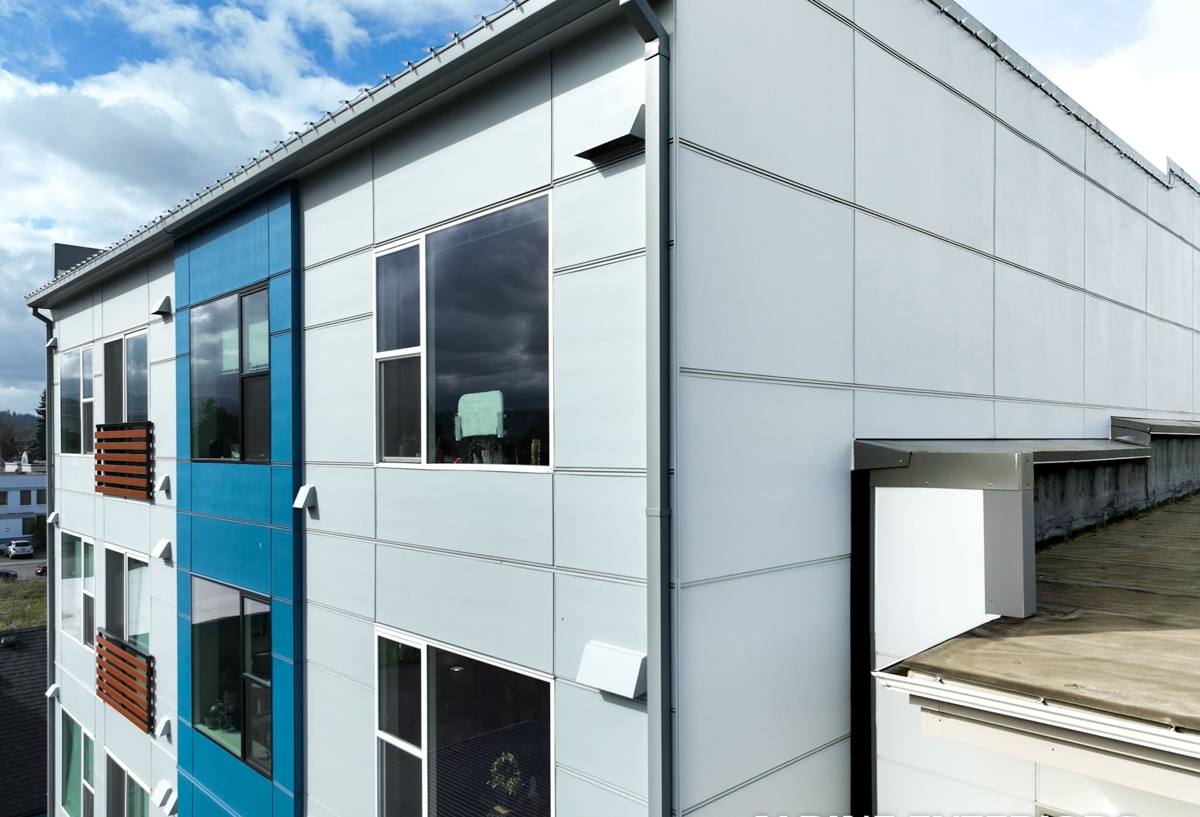
What Semiahmoo's Climate Asks of a Window Install
Semiahmoo sits on the water in Whatcom County, and that location changes what "correct installation" needs to account for. Three things matter more here than in a typical inland build:
Salt Air
Airborne salt off the bay accelerates corrosion on anything metal — fasteners, hinges, cranks, and unprotected flashing. Hardware and fasteners that would be fine 20 miles inland can start pitting or staining within a few seasons on a waterfront lot. This is a material and hardware selection question as much as an installation one.
Driving Rain
Wind off the water pushes rain sideways, not straight down. That means water is being forced against and under trim, sills, and siding laps in a way that gravity-only flashing details don't handle. Sill pans, end-dams, and properly lapped flashing tape aren't optional extras on an exposed Semiahmoo elevation — they're the difference between a window that sheds water and one that slowly feeds it into the wall.
A Long Moss Season
Whatcom County's wet stretch runs long, and moss and algae take hold on north-facing and shaded trim and siding faster here than in drier parts of the state. Persistent moisture at a window's trim and sill accelerates rot in any material not detailed and finished correctly from day one.
None of this means new construction near Semiahmoo requires exotic products. It means ordinary best-practice window flashing has to actually be followed — no shortcuts, no gaps in the sequence — because the climate here punishes the shortcuts faster than it would elsewhere.
What a Correct New-Construction Install Actually Involves
Sill Pans and Flashing Sequencing
Every opening should get a sloped or dammed sill pan that directs any water that gets past the window back out, not into the wall cavity. Flashing tape at the jambs and head needs to lap correctly with the WRB above and below it — this is a "shingle" sequence, where each layer overlaps the one below so water always drains outward, never into a seam.
Shimming and Fastening
Windows need to be shimmed plumb, level, and square at the manufacturer's specified fastening points — not just at the corners. An out-of-square window stresses the frame, can bind hardware, and often leaks at a corner that never got proper contact with the shim.
Sealant Compatibility
Not every sealant bonds to every flashing tape or window frame material. Using the wrong sealant chemistry against a given frame or tape can fail quietly — it looks sealed for a season or two, then releases. We match sealant to the substrate, not the other way around.
Interior and Exterior Air Sealing
Washington's energy code expects continuous air sealing around window rough openings, not just weatherstripping at the sash. Backer rod and low-expansion foam at the interior perimeter, done correctly, also keeps warm interior moisture from condensing inside the wall cavity in cold snaps.
Choosing Frame Material for a Waterfront Site
Frame material affects how a window holds up to salt air and constant damp, and how much upkeep it asks of the homeowner. There's no single "right" answer — it depends on budget, exposure, and how much maintenance you want to take on.
| Frame Material | Salt-Air Behavior | Maintenance | Typical Fit |
|---|---|---|---|
| Vinyl | Won't corrode; UV and heat cycling matter more than salt exposure | Low — occasional cleaning | Budget-conscious builds, most elevations |
| Fiberglass | Very stable dimensionally, resists pitting and corrosion well | Low | Exposed, wind-driven elevations facing the water |
| Aluminum-clad wood | Clad exterior resists weather; hardware and clad seams need corrosion-rated fasteners near salt air | Moderate — interior wood finish upkeep | Homeowners wanting a wood interior look with a protected exterior |
| Bare or mill-finish aluminum | Prone to pitting and corrosion in salt air without a marine-grade finish | Higher near the water | Generally avoided on direct waterfront exposures |
Whatever frame material you choose, we spec corrosion-resistant fasteners and hardware on Semiahmoo builds as a standard practice, not an upcharge — it's cheap insurance against the one thing this location does to ordinary hardware.
Our Process on a New-Construction Job
- Plan and order review — we confirm window sizes, swing/operation, and glazing package against the approved plans before anything ships, catching mismatches before they cost a schedule delay.
- Rough opening check — every opening gets verified plumb, level, and square, and sized correctly, before install day. Framing tolerances get flagged to the builder early, not discovered mid-install.
- WRB and flashing integration — sill pans, jamb and head flashing, and WRB laps go in as one sequenced system so water always has a path out.
- Setting and fastening — units are shimmed, squared, and fastened to manufacturer spec at every required point, not just the corners.
- Air sealing and sealant — interior and exterior sealing done with materials matched to the frame and tape in use.
- Quality walk and punch list — every opening gets checked for operation, seal, and squareness before we sign off, with any punch items resolved before the next trade covers the wall.
Coordinating With Your Builder or GC
New-construction window work only goes smoothly when the sequencing with other trades is right. We work directly with your general contractor or builder on scheduling — windows typically go in after the WRB is on and before siding starts, and that window in the schedule can be tight. We show up on the date agreed, come with materials verified against the order, and communicate directly with the GC on any framing or flashing issue that needs a decision, rather than letting it sit unresolved and hold up the siding crew behind us.
Cost Factors on a New-Construction Window Package
Every build is different, but the line items that move the number are consistent. Broad ranges below are for planning conversations only — an accurate number comes from your actual window schedule and plans.
| Factor | Why It Matters |
|---|---|
| Frame material | Vinyl is typically the most economical; fiberglass and clad-wood cost more but bring different durability and maintenance trade-offs |
| Glazing package | Double- vs. triple-pane, low-E coatings, and argon fill affect both cost and how the home performs against wind and cold |
| Number and size of openings | Larger units and more openings mean more labor and material, straightforwardly |
| Exposure and elevation | Water-facing elevations often warrant upgraded flashing details and corrosion-rated hardware |
| Access and building height | Second-story or hard-to-reach openings add setup and safety time |
| Energy code compliance | Washington's energy code sets minimum U-factor performance; hitting it sometimes means upgrading the glazing package |
As a rough planning range, homeowners in this area are often looking at roughly $450 to $1,200 per window installed depending on size, material, and glazing — but the only reliable number is one built off your actual plans and window schedule.
A Checklist Before You Hire
- Ask whether the installer flashes sills with a pan or dam, not just tape across the sill
- Confirm they'll integrate their flashing sequence with your WRB, not just "caulk it and move on"
- Ask what fastener and hardware grade they spec for waterfront or near-waterfront lots
- Get written confirmation of the U-factor and glazing package matching your energy code path
- Ask how they coordinate scheduling with your GC and other trades
- Confirm punch-list items get resolved before the wall is covered by siding, not after
Why a Crew That Already Works Semiahmoo Matters
A lot of window flashing failures aren't caused by a bad window — they're caused by a good window installed with a detail that works fine inland but doesn't hold up against driving rain off the water. A crew that's already done new-construction window work on Semiahmoo and elsewhere along the Whatcom County coastline knows which elevations need the extra flashing course, which fastener grade actually holds up to the salt air, and where moss and standing moisture tend to collect on trim if the drainage detail isn't right the first time. That's knowledge that comes from working this specific stretch of coastline, not from a generic install checklist.
If you're building near Semiahmoo and want a window installer who already understands what this coastline does to a house, we'd like to walk your plans with you. Reach out for a free, no-pressure estimate — the form below gets you started.