 Ferndale
 Why Composite Decking Makes Sense for Marietta Homes
Marietta sits close enough to Bellingham Bay and the Nooksack River delta that homes here deal with a specific mix of conditions: salt-tinged air, long stretches of driving rain, and a moss season that can run from fall well into spring. A deck built in this stretch of Whatcom County isn't fighting the same battles as one in a dry inland climate. It's fighting constant moisture, organic growth, and slow corrosion, month after month, year after year.
Composite decking exists because wood struggles with exactly these conditions. It doesn't absorb water the way lumber does, it doesn't need annual staining or sealing, and it holds up to the freeze-thaw-damp cycle common to this part of Washington far better than dimensional lumber. That doesn't mean every composite deck performs well here — installation quality and material choice still matter enormously — but the material itself is a sound starting point for a Marietta property.
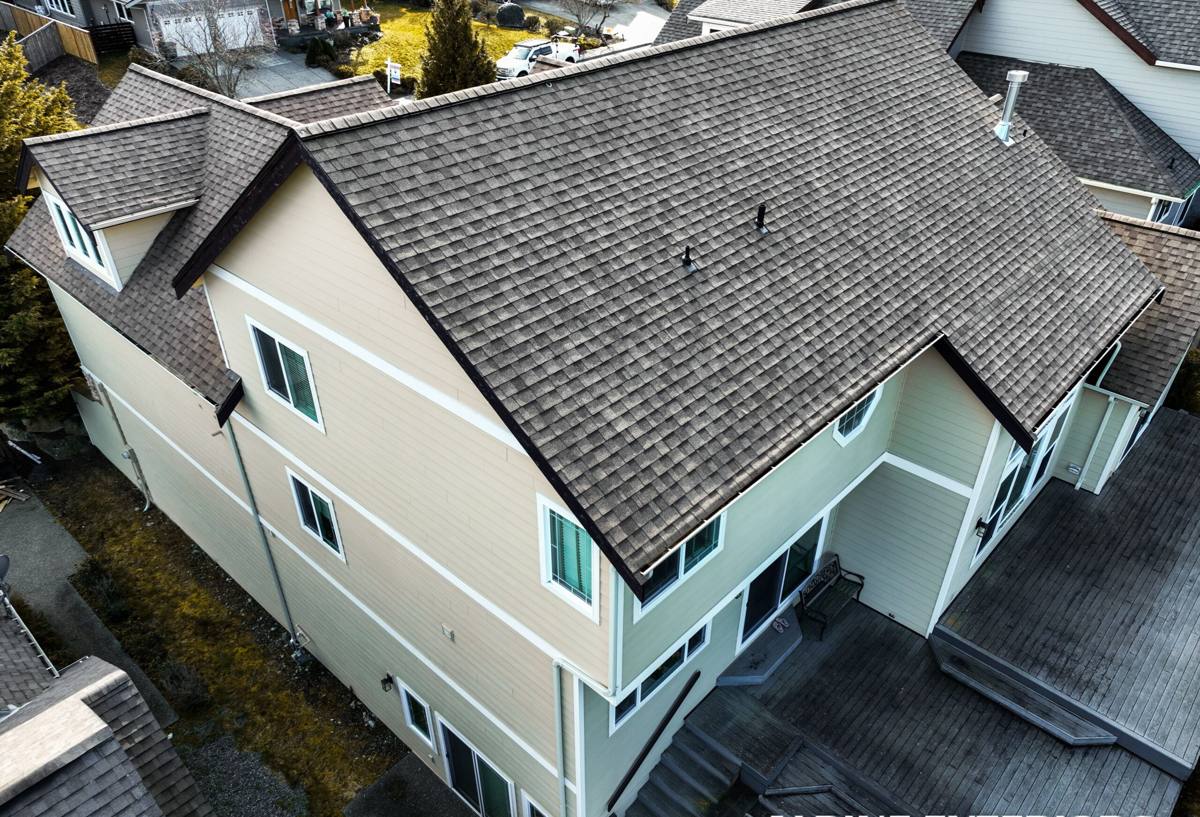
What Marietta's Weather Actually Does to a Deck
Before talking about products, it's worth being specific about what local conditions do to an outdoor structure over time. This isn't generic weather talk — it's the actual mechanism of deck failure we see in this area.
Salt Air and Metal Hardware
Proximity to the bay means a low but steady level of airborne salt, especially on days with wind off the water. Salt accelerates corrosion in exposed fasteners, brackets, and railing hardware. A deck built with standard, non-marine-grade fasteners can show rust streaks and weakened joints years before the decking itself would ever fail. This is a hardware problem as much as a decking-material problem, and it's often the part homeowners don't think to ask about.
Moss, Algae, and Shade
Marietta's tree cover and cloudy, wet stretches create ideal conditions for moss and algae, particularly on the shaded or north-facing side of a house. Moss holds moisture against a surface, and on wood decking that moisture works its way into the grain, softening fibers and setting up rot. On poor-quality or uncapped composite, algae can also take hold in surface texture if the boards aren't cleaned occasionally. The board itself needs to resist this, and so does the gap and drainage design underneath it.
Driving Rain and Standing Water
Rain here doesn't fall straight down — wind-driven rain gets under railings, into ledger connections, and along the edges of boards where they meet the house. If a deck isn't detailed with proper flashing and slope, water finds its way into framing and fascia regardless of what the decking surface is made of.
Composite Decking vs. Wood vs. PVC
Homeowners in Marietta usually end up comparing three real options. Here's an honest, side-by-side look at how they hold up under local conditions.
| Factor | Pressure-Treated Wood | Composite | PVC / Cellular |
|---|---|---|---|
| Upfront cost | Lowest | Mid-range | Highest |
| Moisture & rot resistance | Poor without ongoing care | Strong | Very strong |
| Moss/algae resistance (shaded, damp areas) | Poor | Good to strong, capped boards best | Strong |
| Annual maintenance | Staining/sealing needed | Occasional washing | Occasional washing |
| Typical lifespan here | 10-15 years with upkeep | 25-30+ years | 25-30+ years |
| Feel/appearance | Natural wood grain | Wood-look, wide color range | Cleaner, more uniform look |
Composite lands in a practical middle ground for most Marietta homes — meaningfully better weather performance than wood without the top-end cost of full PVC systems. We're happy to walk through when PVC is genuinely worth the extra investment for a specific property.
What a Correct Composite Deck Installation Actually Involves
Composite boards are only as good as what's underneath them. Most deck problems we get called out to fix in this area aren't the decking material failing — they're the substructure or the details around it failing first.
Substructure and Framing First
Joists, beams, and posts need to be sized and spaced correctly for the specific composite product, since composite boards flex differently than wood and often require tighter joist spacing than a traditional wood deck. Any framing that's already showing moisture damage gets addressed before a single composite board goes down — covering rotten framing with new decking just hides a problem that will resurface.
Fasteners, Flashing, and Hidden Details
Given the salt exposure in this area, we use corrosion-resistant, marine-rated fasteners and hardware rather than standard-grade hardware. Ledger boards where the deck meets the house get proper flashing and a moisture barrier, since that connection point is one of the most common places water intrusion starts on any deck, composite or not.
Spacing and Airflow
Composite boards need consistent gapping for expansion, drainage, and airflow underneath. Too tight, and boards can buckle or trap moisture; too loose, and the deck looks unfinished and debris collects in the gaps. Airflow underneath the deck also matters for keeping the framing dry through a wet Whatcom County winter.
Choosing the Right Composite Board for This Climate
Capped vs. Uncapped Composite
Capped composite boards have a polymer shell wrapped around the composite core, which resists moisture absorption, staining, and surface mold/algae far better than uncapped boards. In a climate with this much sustained dampness and moss pressure, we generally steer homeowners toward capped products — the modest price difference tends to pay for itself in reduced maintenance and a longer usable lifespan.
Color, Heat, and Glare
Darker composite colors absorb more heat on sunny days and can be noticeably warmer underfoot, though Marietta's cloud cover limits how often that's a real concern compared to sunnier climates. Lighter and mid-tone colors also tend to show pollen, moss spores, and organic debris less than very dark boards, which matters given the tree cover common around local properties.
Our Process, Start to Finish
- On-site visit to look at the existing structure (if any), drainage, sun/shade exposure, and how the deck will actually be used.
- Honest assessment of framing condition — repair or replace anything compromised before decking goes on.
- Material selection based on budget, color, and how much shade/moss exposure the specific area gets.
- Written estimate with clear scope, so there are no surprises about what's included.
- Installation with attention to fasteners, flashing, spacing, and drainage detailing specific to this climate.
- Final walkthrough covering care and what to expect over the first year.
Maintenance Marietta Homeowners Should Actually Expect
Composite decking is low-maintenance, not no-maintenance. A little seasonal attention goes a long way toward getting the full lifespan out of the material in this climate.
- Sweep debris and fallen leaves out of board gaps regularly, especially in fall when trees are shedding.
- Rinse or wash the deck surface a couple of times a year to keep pollen and early moss growth from taking hold.
- Check railing hardware and fasteners periodically for early rust or corrosion, particularly on decks with more direct water exposure.
- Keep gutters and downspouts near the deck clear so runoff isn't dumping extra water onto or under the structure.
- Trim back overhanging branches where practical to reduce shade and moss pressure on the deck surface.
- Avoid pressure-washing at close range or high PSI directly into board seams, which can damage the cap layer over time.
Why It Matters to Hire a Crew That Already Works in Marietta
A lot of deck problems in this area trace back to installation crews applying general, one-size-fits-all methods that don't account for local conditions — standard fasteners instead of corrosion-resistant hardware, gapping set for a drier climate, or flashing details that assume less driving rain than this area actually gets. Working regularly on homes throughout Ferndale and the surrounding Whatcom County communities means we've seen how decks in this specific climate age over five, ten, and fifteen years — what holds up and what doesn't. That's the kind of knowledge that shows up in the details, not in the sales pitch.
Cost Factors to Plan Around
Every deck is different, so we don't quote real numbers without seeing the site, but the main factors that move a project's cost are consistent:
- Total square footage and deck shape — more corners and cutouts add labor.
- Condition of existing framing — repair or full rebuild versus resurfacing on sound structure.
- Board tier — capped composite costs more upfront than uncapped, but typically less over its lifespan.
- Railing style — composite, metal cable, or glass railing systems all price differently.
- Stairs, multiple levels, or built-in features like benches or lighting.
- Permit requirements, which depend on deck height, attachment to the home, and local jurisdiction rules.
If you're weighing a new composite deck or replacing a tired wood one in Marietta, we're glad to take a look and give you a straightforward, no-pressure estimate — just fill out the form below.