 Ferndale
 Why a New Roof in Lynden Has to Be Built Differently Than a Catalog Job
Lynden sits in the same wet, marine-influenced weather system as the rest of Whatcom County, and that shows up on roofs in specific ways. Winters bring long stretches of low-intensity rain that can blow sideways during a windstorm, shaded and tree-lined lots hold moisture on north-facing slopes long after the sun comes out, and moss season isn't a one-time event here — it's most of the year. A roof installed the way it would be in a drier climate will underperform in Lynden within a few seasons, usually starting with granule loss, moss colonies at the shaded eaves, and slow leaks at valleys and flashing that homeowners don't notice until there's a stain on a ceiling.
A correct installation for this area isn't about using fancier materials — it's about getting the underlayment, ventilation, flashing, and moss-resistant details right the first time, because a roof up here has to shed water fast, breathe properly, and resist a nearly year-round moss cycle.
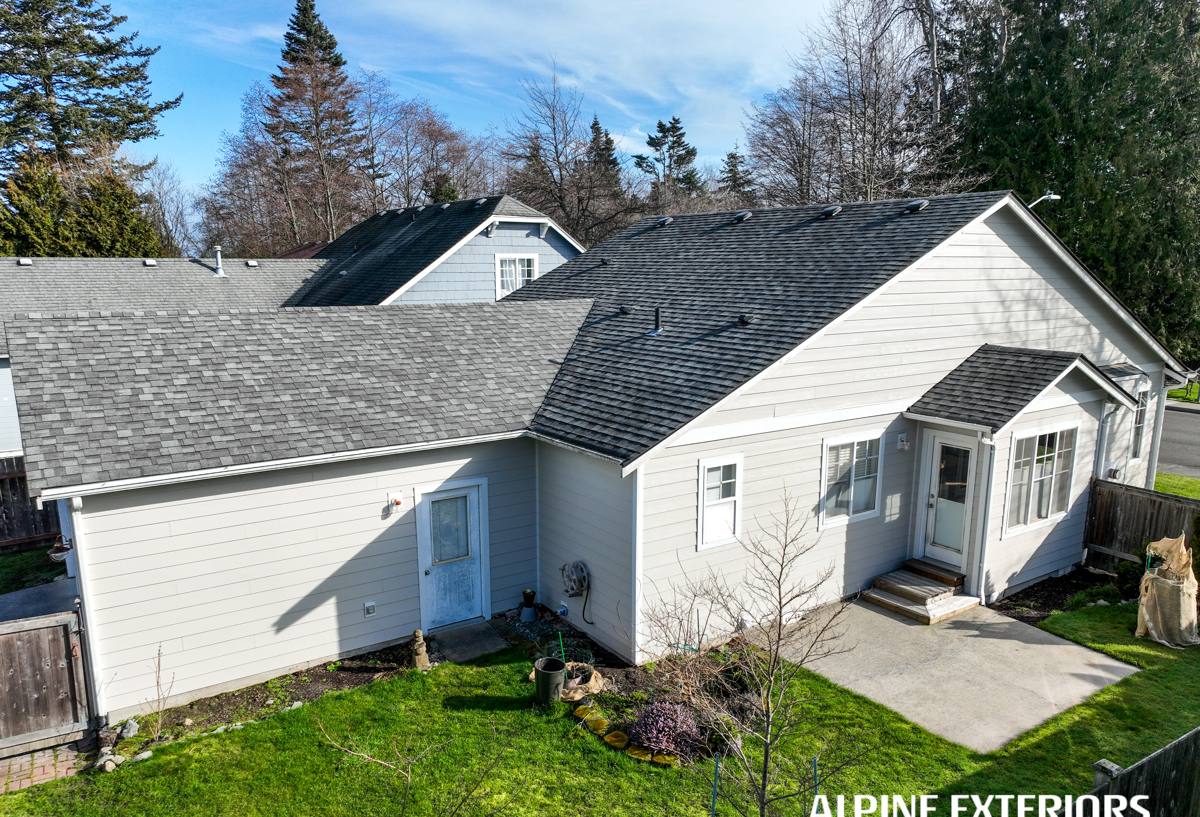
Signs a Lynden Roof Needs Replacement, Not Another Repair
Homeowners often call us for a repair and find out the roof is past the point where patching makes sense. A few honest markers we look for:
- Shingles that are cupping, curling, or missing granules across large areas, not just one spot
- Moss growth that keeps coming back within months of being cleaned, especially on north- and west-facing slopes
- Soft or spongy decking felt underfoot in the attic, a sign moisture has already gotten past the roofing layer
- Daylight visible through the roof deck at the attic, or water stains that track along rafters after wind-driven rain
- A roof that's 20+ years old (asphalt) or has already had two or more repair visits for the same leak area
If a roof is showing two or more of these, replacement is usually the more honest recommendation than another round of spot repairs.
What an Honest New Roof Installation Actually Includes
Full Tear-Off, Not a Layover
We remove the existing roofing down to the deck rather than installing over old layers. That lets us inspect the decking for rot or soft spots, replace what needs replacing, and start every new roof on a sound, dry base — which matters more in a climate where moisture has usually been working its way into that deck for years already.
Ice and Water Shield Where It Counts
Valleys, eaves, and roof-to-wall transitions get a self-adhering waterproof membrane underneath the roofing, not just standard felt. These are the spots where wind-driven rain gets pushed backward under shingles, and they're the first places a poorly built roof fails in Whatcom County weather.
Flashing Done Right
Chimneys, skylights, dormers, and sidewall intersections all need properly formed and step-flashed metal, not caulk covering a gap. Caulk is a maintenance item; correct flashing is a structural detail. We treat it as the latter.
Balanced Attic Ventilation
Intake at the soffits and exhaust at the ridge, sized to actually move air through the attic. Without this, moisture from the living space condenses on the underside of the deck all winter, which rots plywood from the inside and has nothing to do with how good the shingles on top are.
Starter Strips, Drip Edge, and Fastening Pattern
Small details — but a starter course installed backward or nails set too high are exactly the kind of shortcuts that don't show up at final walk-through and do show up as a leak two winters later.
Choosing a Roofing System for Lynden's Climate
There's no single "best" roofing material — the right choice depends on budget, roof pitch, tree cover, and how much long-term maintenance a homeowner wants to take on. Here's how the common options actually compare for this climate:
| Material | Moss/Moisture Behavior | Maintenance | Typical Lifespan |
|---|---|---|---|
| Architectural asphalt shingle | Good with zinc/copper strips at ridges; needs periodic moss treatment on shaded slopes | Low to moderate | 25–30 years |
| Standing seam metal | Sheds water and dries fastest; moss struggles to hold on the smooth panel surface | Low | 40–50+ years |
| Cedar shake | Attractive but holds moisture in a wet climate; moss and rot risk is highest of the group without diligent upkeep | High | 20–30 years with upkeep |
| Synthetic/composite shake | Mimics cedar's look without absorbing moisture the same way | Low to moderate | 30–50 years |
We don't install traditional cedar shake as a standard offering. It's a legitimate, attractive product elsewhere, but in a climate with this much sustained moisture and moss pressure, it asks a homeowner to commit to a maintenance schedule most people don't keep up with — and when that upkeep slips, moisture problems follow. We'd rather steer a homeowner toward a material that performs well here with realistic maintenance than sell a product that looks great on day one and becomes a recurring problem by year five.
Our Installation Process
- On-site inspection and measurement — we walk the roof and attic, check decking condition, ventilation, and flashing points, and take real measurements rather than estimating from the ground.
- Written estimate with material options — a clear scope of work and price, not a vague range, so there are no surprises mid-job.
- Scheduling around weather — in a climate where rain windows matter, we plan tear-off and dry-in to minimize the time a roof deck sits exposed.
- Tear-off and deck inspection — old roofing removed, deck inspected board by board, and any rot or soft sheathing replaced before anything new goes down.
- Underlayment, flashing, and ventilation install — the parts of the job that don't show but determine whether the roof lasts.
- Roofing material installation — installed to manufacturer spec and local best practice for wind and rain exposure, not just "to code minimum."
- Final walk-through and cleanup — magnetic sweep for nails, debris removal, and a walk-through so the homeowner sees exactly what was done.
Ventilation and Moisture: The Part of the Job Nobody Sees
Most roof failures we're called out to inspect in this area trace back to moisture trapped in the attic, not a failure of the shingles themselves. Warm, moist air from inside the house rises into the attic; if it can't escape through balanced ridge and soffit venting, it condenses on the cold underside of the roof deck. Over a Whatcom County winter, that cycle repeats for months. The result is delaminated plywood, mold, and a roof deck that's too soft to hold fasteners securely — sometimes while the shingles on top still look fine. Getting ventilation right during installation is cheaper than any of the fixes for what happens when it's wrong.
What Drives the Cost of a New Roof in Lynden
| Factor | Why It Matters |
|---|---|
| Roof size and number of stories | More square footage and steeper access mean more material and labor time |
| Roof pitch and complexity | Multiple valleys, dormers, and hips take more flashing work and labor than a simple gable |
| Layers to remove | Tearing off two layers of old roofing costs more than one, but leaves a sounder result than roofing over either |
| Decking repair needed | Rotted or soft sheathing found during tear-off has to be replaced before new roofing goes down |
| Ventilation upgrades | Adding proper intake/exhaust venting where none existed adds cost but prevents moisture problems down the line |
| Material choice | Standing seam metal costs more upfront than architectural shingle but requires far less long-term maintenance |
We give real, itemized numbers based on an actual inspection rather than a rough phone quote — roofs vary too much house to house for a flat "per square" number to mean anything useful to a homeowner planning a budget.
Why It Matters to Hire a Crew That Already Works This Area
A roofing crew that works Whatcom County regularly knows which slopes hold moss year-round, how far up a valley the ice-and-water membrane needs to run given local wind-driven rain, and how attic ventilation needs to be sized for homes built decades apart with different original construction standards. That local pattern recognition is the difference between a roof that's technically installed to code and one that's actually built for what Lynden weather does to it every year. It also means faster response if something needs a warranty check after a big windstorm, rather than waiting on a crew based hours away.
After Installation: Keeping a New Roof Performing
A well-installed roof still benefits from basic upkeep in this climate:
- Clear gutters and downspouts each fall so water isn't backing up under the eaves
- Have moss treated or gently removed before it builds into thick mats, especially on shaded north-facing slopes
- Trim back overhanging branches that keep sections of roof shaded and damp longer than the rest
- Do a visual check after major windstorms for lifted shingles or damaged flashing
- Keep attic ventilation paths (soffit vents especially) clear of insulation or debris
None of this is heavy maintenance — it's the difference between a roof that reaches its full expected lifespan and one that starts having problems ten years early.
If your Lynden home's roof is showing its age or you're planning ahead rather than waiting for a leak, we're happy to take a look and give you a straight, no-pressure assessment. Fill out the form below for a free estimate.