 Ferndale
 Why Everson Homes Put Extra Demands on Siding
Homes around Everson sit in the same weather pattern that shapes the rest of Whatcom County: long stretches of driving rain, marine-influenced humidity that never fully dries out the air, and a moss season that can run most of the year on shaded north and west walls. Siding here isn't just cosmetic. It's the one layer standing between framing and a climate that stays damp for months at a time. A product or installation that's marginal in a drier part of the state will show its weaknesses fast in this one — swelling at cut edges, paint failure, moss and algae staining, and eventually moisture working its way behind the cladding.
That's the lens we use on every Everson-area project: not "what looks good going up," but "what still looks and performs the same in fifteen years after another fifteen wet winters." That standard is why we install James Hardie fiber cement exclusively, and why we're specific about how it goes on a house in this climate rather than treating installation as a generic, one-size-fits-all process.
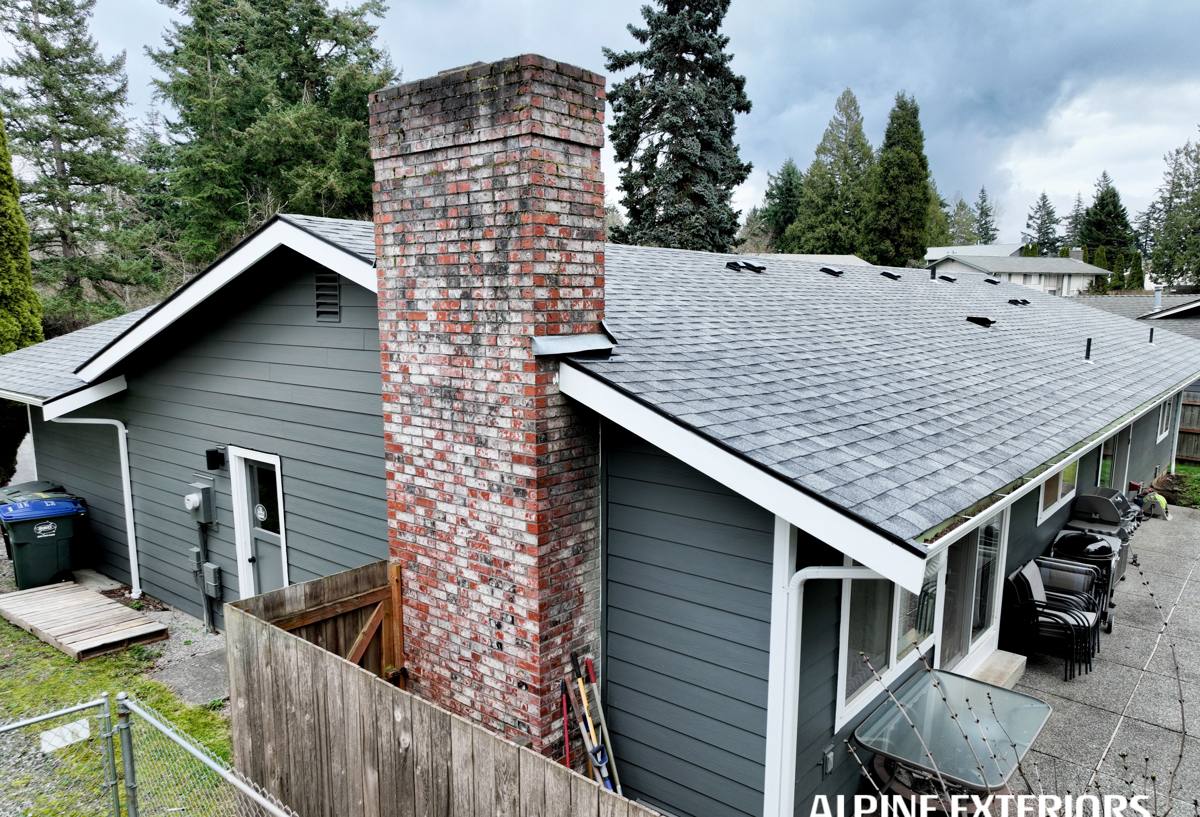
What James Hardie Is Actually Built to Handle Here
A formulation matched to moisture, not just cold
James Hardie engineers its siding by climate zone, and most of western Washington falls into the moisture-focused HZ10 formulation rather than the freeze-thaw HZ5 blend used in colder, drier interior climates. In practical terms, that means the board itself is engineered around resisting the kind of sustained dampness and mildew pressure Whatcom County produces, rather than around surviving hard freezes it rarely sees. It's a small distinction on paper that matters a lot over a couple of decades on a wall that's wet more often than it's dry.
A factory finish that doesn't rely on field paint
Hardie's ColorPlus finish is baked on at the factory under controlled conditions, not brushed or sprayed on-site after installation. That matters in a climate where field-applied paint has a narrow window of dry weather to cure properly. A factory finish also holds its color and resists fading and chipping more consistently than site-applied paint, and it's backed by its own finish warranty separate from the board's product warranty.
A non-combustible core
Fiber cement doesn't feed a fire the way wood-based sidings can, which matters for insurance conversations and for peace of mind regardless of climate. It's a secondary benefit here, but a real one.
What a Correct Installation Actually Involves
James Hardie makes a durable board. Whether it performs like one for thirty years depends almost entirely on installation details that are easy to skip and impossible to see from the ground once the job is done.
Clearance and drainage
Siding needs real clearance from grade, decks, and roof lines — Hardie's published minimums call for several inches of separation from soil and paved surfaces and a gap above roofing. In a climate that keeps ground-level moisture high most of the year, skipping this clearance is one of the fastest ways to start rot at the bottom course, hidden behind the very siding meant to prevent it.
A drainage plane behind the board
A weather-resistant barrier, properly lapped and taped, goes behind every board — and on a wall this exposed to wind-driven rain, a rainscreen gap that lets any incidental moisture drain and dry out behind the siding is worth the extra step rather than optional.
Fastening and joints
Corrosion-resistant fasteners, driven to the correct depth (not overdriven, not proud), following Hardie's actual fastening schedule rather than "close enough," are what keep boards flat and joints tight over time. Butt joints get flashed, not just caulked, and the bottom edge of the siding is left able to shed water rather than sealed in a way that traps it. These are the details that separate a Hardie installation that earns its warranty from one that technically used Hardie boards but installed them like any other siding.
How Our Process Works on an Everson-Area Project
- Walkthrough and assessment — we look at the existing siding, sheathing, and trim, and check for moisture damage before quoting anything, since what's underneath often decides the real scope of work.
- Scope and product selection — plank profile, exposure width, and ColorPlus color are set based on the home's style and how much weather exposure each elevation actually gets.
- Tear-off and sheathing check — old siding comes off, sheathing is inspected and repaired as needed, and any hidden moisture issues get addressed before anything new goes up.
- Weather barrier and drainage plane — installed and detailed around every window, door, and penetration before the first board is hung.
- Installation to Hardie's fastening and clearance specs — not shortcuts, not field judgment calls that skip the manual.
- Trim, flashing, and caulk review — joints, corners, and transitions get a final pass before cleanup.
- Cleanup and walkthrough — site cleared, and we walk the finished job with the homeowner.
James Hardie Compared to Other Siding Options in This Climate
| Material | Moisture behavior in WA climate | Finish durability | Long-term maintenance |
|---|---|---|---|
| James Hardie fiber cement | Engineered for high-moisture zones; resists swelling | Factory ColorPlus finish, doesn't rely on field paint | Occasional wash; repaint cycle much longer than wood |
| Vinyl | Doesn't absorb water but can warp, and seams give moisture a path | Color molded in but fades and chalks over time; can't be repainted easily | Low upkeep but limited lifespan and repair options |
| Cedar / primed spruce | Absorbs moisture; prone to swelling, cupping, and rot in sustained damp | Field-applied paint or stain; needs a dry cure window | Frequent repainting and moisture monitoring |
| LP SmartSide (engineered wood) | Wood-based core; more moisture-sensitive than fiber cement at cut edges and seams | Factory finish available but substrate is still wood-based | Edge sealing and joint maintenance matter more over time |
This is why we standardized on Hardie rather than offering all of the above: in a climate this wet this often, the material's long-term moisture behavior matters more than upfront cost or how it looks on install day.
What a Project Typically Costs and Why
| Cost factor | Why it moves the number |
|---|---|
| Home size and wall complexity | More elevations, gables, and cutouts mean more labor and material waste |
| Tear-off and sheathing condition | Rot or damaged sheathing found underneath adds repair scope before new siding goes on |
| Plank profile and exposure | Wider reveals and specialty profiles cost more in material than standard lap |
| Trim and detail work | Corner boards, window trim, and fascia detail add labor beyond flat wall footage |
| Access and site conditions | Steep lots, tight setbacks, or limited staging area affect crew time |
We give a firm number after seeing the house, not a phone estimate — too much of the real cost depends on what's under the existing siding.
Living With Hardie Through a Long Moss Season
Fiber cement doesn't feed moss and algae the way bare wood can, but nothing installed outdoors in Whatcom County stays completely clean through a wet fall-to-spring stretch. A little routine care keeps a Hardie exterior looking like it did the day it went up:
- Rinse siding with a garden hose and soft brush once or twice a year, focusing on shaded north- and west-facing walls where moss and algae collect first.
- Skip the pressure washer on wide fan settings close to the surface — it can force water behind boards and trim at joints.
- Keep gutters clear so overflow doesn't run down the face of the siding and concentrate moisture in one spot.
- Trim back shrubs and trees that keep a wall shaded and damp longer than the rest of the house.
- Have caulked joints and trim checked every few years — caulk is the one part of the system that wears out well before the siding does.
Why a Crew That Already Works This Area Matters
A contractor who's put Hardie siding on homes around Everson and the rest of Whatcom County already knows which walls need extra drainage detail, which fastener spacing holds up to our wind-driven rain, and how the local permitting and inspection process actually works — rather than learning it on your project. That familiarity shows up in fewer surprises mid-job and in a finished exterior that's detailed for this climate specifically, not for a generic install manual written for a dry, mild region.
It also matters for accountability. A crew that plans to keep working in this area has every reason to install correctly the first time and stand behind the work, since a callback isn't a stranger's problem — it's a neighbor's.
Signs Your Current Siding Is Already Behind
- Soft or spongy spots when you press on siding, especially near the bottom courses or under windows.
- Paint that's peeling or bubbling rather than just fading evenly.
- Persistent moss or dark staining that comes back within weeks of cleaning.
- Visible gaps, warping, or boards separating at seams and corners.
- Rising heating bills or drafts that suggest the siding and weather barrier behind it are no longer doing their job.
If any of that sounds familiar, it's worth having someone look at what's happening behind the siding, not just at the surface.
If you're weighing options for a home in the Everson area, we're happy to take a look and give you a straight, no-pressure estimate — use the form below to get started.