 Ferndale
 Sumas's Siding Has to Handle a Specific Kind of Weather
Sumas sits at the top of Whatcom County, tucked against the Canadian border where the Fraser Valley opens up. Most of the year, homes here deal with the same marine, rain-heavy climate as the rest of the county: long stretches of overcast, driving rain that comes in sideways during winter storms, and enough dampness that moss and algae get a real foothold on north-facing walls and anywhere tree cover keeps siding from drying out. Whatcom County's proximity to Puget Sound and the Strait of Georgia means that salt-tinged marine air moves through the region regularly, and it works its way inland with the weather systems that pass through.
What makes Sumas a little different from towns closer to the water is its position at the mouth of the Fraser Valley. In winter, cold air spilling down out of British Columbia can bring sharper temperature swings than you'll see closer to the coast. For siding, that means more freeze-thaw and wet-dry cycling over the course of a season — conditions that punish materials that swell, absorb moisture, or rely on a factory coating that isn't built for it. A siding product that performs fine in a milder microclimate can start showing its limits here faster than homeowners expect.
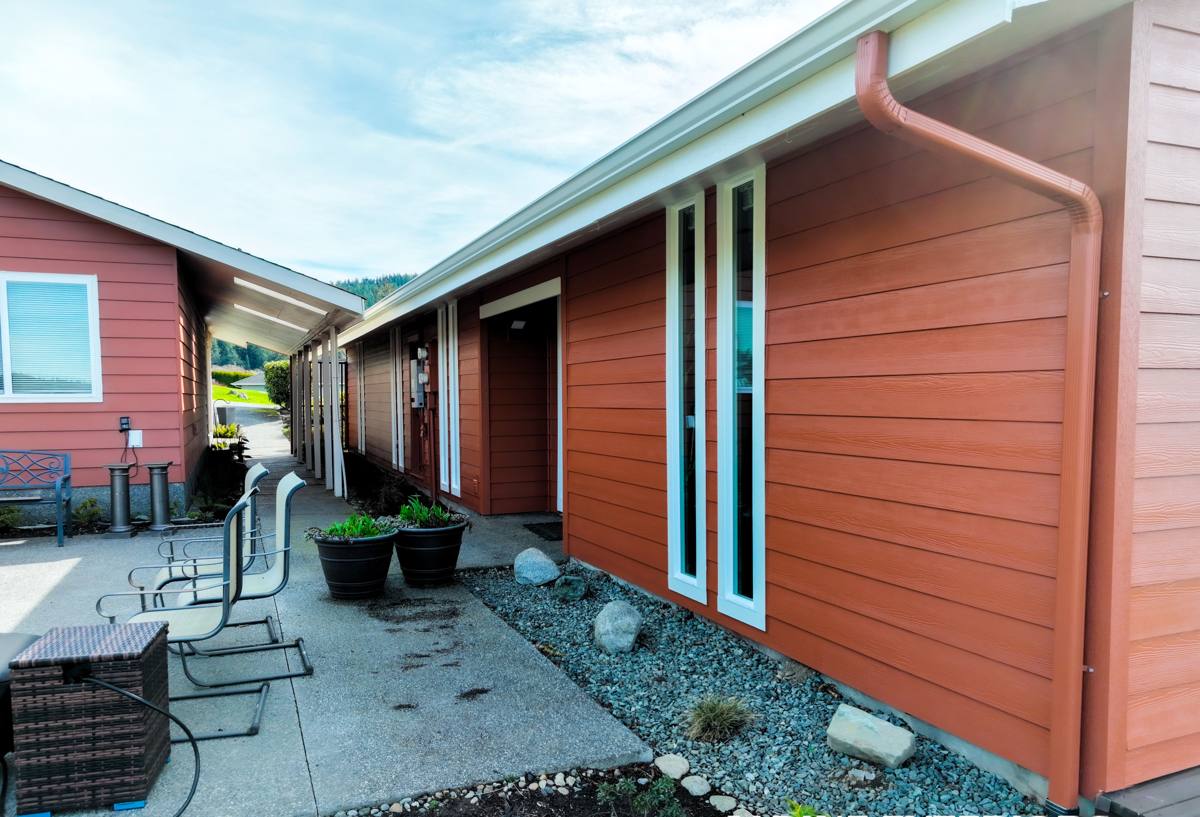
Why Fiber Cement Is the Right Material for This Climate
Fiber cement is cement, sand, and cellulose fiber pressed and cured into a dense board. It doesn't absorb water the way wood-based products do, it doesn't expand and contract with humidity the way vinyl does, and it's non-combustible. For a place like Sumas, where siding is wet more often than it's dry for months at a stretch, that moisture stability matters more than almost any other property. It's also why we only install James Hardie fiber cement rather than offering a menu of siding brands and materials — we'd rather install one product correctly, on every job, than spread our crews thin across products with very different installation requirements and moisture behavior.
Hardie's ColorPlus factory-applied finish is baked on and cured before the boards ever leave the plant, which gives it more consistent adhesion and UV resistance than field-applied paint. Hardie also engineers its HZ5 product line specifically for climates with a lot of moisture cycling, which the Pacific Northwest — and Sumas in particular, given its valley-mouth location — qualifies as.
What "Correct" Fiber Cement Installation Actually Means
Fiber cement is only as good as the installation behind it. The board itself is durable, but the systems around it — drainage, fasteners, flashing, gaps — are what determine whether a home stays dry for the next 30 years or starts showing rot and staining in five.
Rain Screen and Drainage
In a climate that sees as much sustained rain as Whatcom County, siding needs a way for incidental moisture to drain and the wall to dry out behind it. We install a drainage plane (typically a weather-resistant barrier plus a rainscreen gap or drainage wrap) so that water that gets behind the siding — and some always will, eventually — has somewhere to go besides sitting against the sheathing.
Fastening, Flashing, and Caulking
Hardie specifies exact nailing patterns, fastener types, and minimum clearances from the ground and rooflines, and those specs exist for a reason: over-driven nails crack boards, wrong fasteners corrode and stain, and missed clearances wick moisture straight into the bottom course. Every horizontal joint, window, and door opening gets proper flashing so water is directed out and down, not behind the wall. Caulk is used where Hardie's install guide calls for it and left out where it isn't — sealing every joint solid actually traps moisture rather than letting it escape.
Trim and Accessory Details
Corner boards, window trim, and transition flashing at rooflines and decks are where most siding failures actually start, not the field of the wall. We treat these details as the priority, not an afterthought, because they're the parts doing the real water-management work.
James Hardie vs. the Alternatives for a Sumas Home
| Material | Moisture Performance | Typical Maintenance | Fit for Sumas Climate |
|---|---|---|---|
| James Hardie fiber cement | Dimensionally stable; doesn't swell or rot | Occasional wash; repaint only if beyond ColorPlus warranty | Engineered for wet, cycling climates |
| Vinyl siding | Doesn't rot, but expands/contracts with temperature swings and can warp or crack in cold snaps | Low, but panels can't be spot-repaired invisibly | Weak in freeze-thaw swings and impact damage |
| LP SmartSide / engineered wood | Wood-based core is vulnerable at cut edges and seams if moisture gets in | Needs diligent caulk/paint upkeep to stay sealed | Cut-edge sealing failures show up faster in sustained rain |
| Cedar / primed spruce | Absorbs moisture, cups and checks over time | Regular refinishing to hold the wood | High-maintenance in a long wet season |
Cost Factors for a Sumas Fiber Cement Project
Every home is different, but the same handful of factors drive most of the cost variation we see on jobs in this area:
| Factor | Why It Matters |
|---|---|
| Home size and wall complexity | More corners, gables, and dormers mean more cutting, trim, and labor time |
| Existing siding removal | Tear-off of old wood, vinyl, or damaged material adds time versus a bare wall |
| Sheathing and framing condition | Rot found once old siding comes off has to be repaired before new siding goes on |
| Product line and profile | HardiePlank lap, HardiePanel, and HardieShingle carry different material and labor costs |
| Trim and accessory scope | Corner boards, window trim, and fascia work add up beyond the field siding itself |
We don't quote broad numbers on this page because guessing at a price without seeing the home does homeowners a disservice — the honest answer only comes from a walk-around estimate.
Our Installation Process
- On-site assessment: we walk the exterior, check sheathing and framing where accessible, and note trim, window, and roofline details that affect scope.
- Prep and tear-off: old siding comes off, damaged sheathing gets repaired, and the drainage plane goes on before any new material touches the wall.
- Installation to Hardie spec: boards, fasteners, flashing, and clearances all follow James Hardie's published installation guide, not a shortcut version of it.
- Trim and detail work: corners, window and door trim, and transitions at the roofline get finished carefully, since these are the spots most likely to fail if rushed.
- Final walkthrough: we go over the finished job with the homeowner before calling it done.
Maintenance: What Ongoing Care Actually Looks Like
One of the practical advantages of fiber cement in this climate is how little upkeep it asks for compared to wood or engineered wood siding. It doesn't need re-caulking every couple of years to stay sealed, and it won't swell or delaminate the way a wood-based product can once water finds a way in. That said, "low maintenance" doesn't mean "no maintenance" — a long moss season and driving rain still call for a bit of homeowner attention:
- Rinse the exterior once or twice a year to keep moss, algae, and pollen from building up, especially on shaded or north-facing walls
- Trim back vegetation and tree branches that keep siding from drying out between rains
- Check caulking at windows, doors, and trim joints periodically and re-caulk if it's cracked or pulling away
- Keep gutters and downspouts clear so water isn't sheeting down the wall or pooling at the base of the siding
- Look at the bottom courses near grade and any deck or patio transitions for early signs of staining or softness
Signs Your Current Siding Is Failing
If any of the following show up on a Sumas home, it's worth having a contractor take a closer look before it turns into a bigger repair:
- Soft or spongy spots when you press on the siding, especially near the bottom courses or under windows
- Visible cupping, warping, or bowing in wood-based or engineered wood boards
- Persistent moss or algae growth that comes right back after cleaning
- Paint that's peeling or bubbling rather than just fading
- Staining or streaking below seams, joints, or trim, which usually points to water getting behind the siding
- Visible cracking at panel edges or corners, particularly after a cold snap
Why a Crew That Already Works Sumas Matters
Installation quality and local knowledge go hand in hand. A crew that regularly works Whatcom County homes already knows how this climate behaves — where moss tends to build up fastest, how much clearance to leave at grade given the rainfall this area gets, and how a border-valley winter can stress a wall differently than a coastal one. That's not something a crew based somewhere drier picks up on the fly. It shows up in the details: how a job is sequenced around the weather window, how flashing is handled at trim, and how seriously the drainage plane gets treated before the first board goes up.
If you're weighing a siding replacement or repair on a Sumas home, we're glad to take a look and walk you through what your home actually needs — no pressure, no obligation. Reach out for a free estimate using the form below.