 Ferndale
 Everson's Climate Puts Real Demands on Siding
Everson sits along the Nooksack River in Whatcom County, and that river valley setting shapes what siding has to survive here. Moisture-laden marine air moves inland off the Salish Sea and settles into the valley, where it lingers longer than it does on more exposed, breezier ground. Add driving rain off the water, cool damp winters, and a moss season that can stretch from fall through spring, and you get an environment that is unusually hard on exterior building materials. Siding here isn't just cosmetic — it's the first line of defense against water intrusion, wood rot, and the slow green film that spreads across anything that stays wet too long.
Homes in and around Everson that were sided with wood, older composite panels, or vinyl often show the wear pattern early: swelling at the bottom courses, dark streaking under window sills, and moss creeping up from the ground line where splashback keeps the material damp. None of that is unusual for the area — it's what the climate does. The question is which siding material actually holds up to it, and how it needs to be installed to do so.
Why the River Valley Setting Matters
Inland river valleys like the one Everson sits in tend to trap fog and humidity rather than letting wind clear it out the way it does closer to open water. That means siding surfaces stay damp longer after a rain event, and moisture has more time to work its way into any gap, seam, or unsealed joint. It's a slower, quieter kind of wear than a storm-battered coastline, but it adds up over years just the same.
Why Fiber Cement Is the Right Material for This Environment
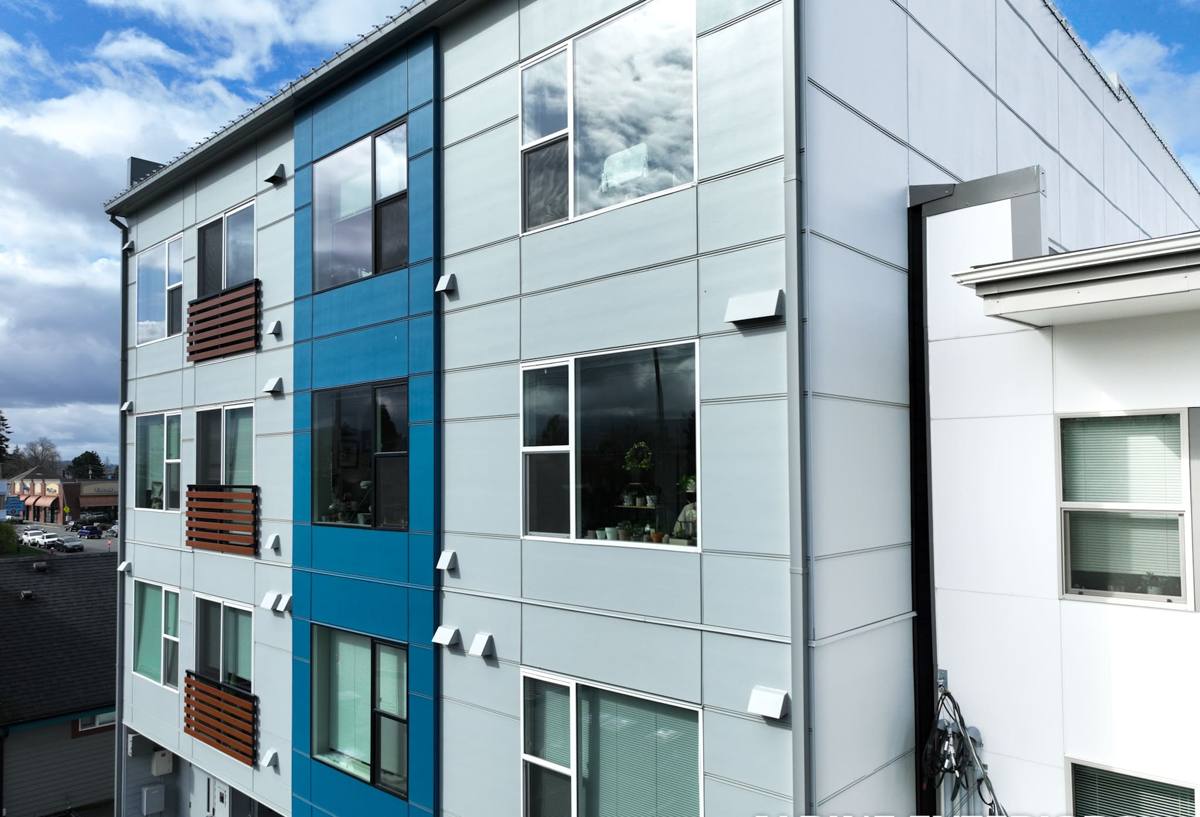
Fiber cement is cement, sand, and cellulose fiber pressed into a dense, stable board. It doesn't absorb water the way wood does, it doesn't warp or delaminate the way lower-grade composite panels can, and it doesn't expand and contract with humidity swings the way vinyl does. For a climate that keeps siding damp for long stretches at a time, that dimensional stability is the whole ballgame.
We install James Hardie fiber cement products exclusively, factory-finished with their ColorPlus coating system. That finish is baked on and cured at the factory rather than field-applied, which matters in a market like Everson's — a coating that's fully cured before it ever reaches a damp jobsite holds up better long-term than paint applied on-site in marginal drying conditions. Hardie's HZ5 product line is also engineered specifically for the kind of wet, freeze-thaw-adjacent Pacific Northwest weather Whatcom County sees, which is a meaningfully different specification than siding built for a dry southern climate.
What This Means Day to Day for an Everson Homeowner
- No repainting cycle every 5-7 years — the factory finish is warrantied separately from the substrate
- No soft spots or rot at butt joints, corners, or ground-level courses
- No swelling and buckling after a wet winter
- A surface that sheds moss more easily than porous wood or weathered composite
- Non-combustible material, which matters given Whatcom County's dry-season wildfire risk in surrounding areas
What a Correct Fiber Cement Installation Actually Involves
Fiber cement is only as good as the installation behind it. This is a product that is genuinely sensitive to installation errors — more so than vinyl, which forgives a lot of sloppiness. Getting it wrong doesn't show up on day one; it shows up two or three winters later as water staining, cracked caulk lines, or rot at the sheathing behind the board.
The Details That Separate a Correct Install From a Problem Install
- Clearance from grade and hard surfaces: Hardie's specifications call for minimum clearance above soil, decks, patios, and roof lines. Skipping this is one of the most common causes of rot we see on inspection.
- Proper flashing at every penetration: Windows, doors, hose bibs, light fixtures, and vents all need correctly lapped flashing so water sheds outward instead of tracking behind the board.
- Weather-resistive barrier underneath: A correctly lapped house wrap or building paper behind the siding is the backup layer that catches whatever the siding doesn't stop.
- Fastener pattern and depth: Over-driven or under-driven nails compromise the board's ability to manage its own moisture and can void the manufacturer's warranty.
- Joint treatment: Butt joints need to be treated and sealed to manufacturer spec, not just butted and caulked over.
- Rainscreen or drainage plane where called for: In consistently wet climates, a drainage gap behind the siding gives incidental moisture somewhere to go instead of sitting against the wall assembly.
Every one of these is a place where a crew unfamiliar with fiber cement, or one rushing to hit a lower bid, tends to cut corners. The material tolerates almost none of it in a climate like Everson's.
Our Process, Start to Finish
1. On-Site Assessment
We walk the exterior with you, looking at current siding condition, moisture damage at grade level and around penetrations, existing flashing, and any rot in the sheathing that needs to be addressed before new siding goes on. Covering up a rot problem with new siding is one of the most expensive mistakes a homeowner can make.
2. Written Scope and Product Selection
You get a clear, itemized scope — square footage, trim and accessory pieces, the specific Hardie product line and profile, and the ColorPlus color selected. No vague allowances.
3. Prep and Moisture Barrier
Removal of the old siding, repair of any damaged sheathing, and installation of a correctly lapped weather-resistive barrier before a single new board goes up.
4. Installation to Manufacturer Spec
Fastening, clearances, flashing, and joint treatment done to Hardie's published installation guidelines — not shortcuts that happen to look fine from the street.
5. Final Walkthrough
We go around the house with you, check every elevation, and confirm trim, caulking, and touch-up are complete before calling the job done.
Signs an Everson Home May Need New Siding Now
| What You See | What It Usually Means |
|---|---|
| Dark streaking or persistent moss below window sills | Water is tracking down the wall face and staying wet longer than it should |
| Soft or spongy siding near the ground line | Likely moisture intrusion or rot starting at the base course |
| Paint peeling or bubbling in patches | Trapped moisture behind the finish, common on older wood or composite siding |
| Visible gaps or warping at panel seams | Material has swelled and shrunk with moisture cycles over time |
| Rising energy bills with no other explanation | Compromised siding and wrap can mean air and moisture leakage at the wall assembly |
Fiber Cement Compared to Other Siding Options
We only install James Hardie fiber cement, but homeowners deserve an honest comparison, not just a sales pitch. Here's how the common alternatives stack up for a climate like Everson's:
| Material | Moisture Performance in This Climate | Longevity Consideration |
|---|---|---|
| Fiber cement (Hardie) | Dimensionally stable, resists swelling and rot, factory-cured finish | Manufacturer-backed warranty when installed to spec; typically the longest service life of the common options |
| Vinyl | Doesn't rot, but expands/contracts with temperature and can warp or crack in impact | Field seams and clips can loosen over decades; color is molded-in, not repaintable in the same way |
| Engineered wood (LP-type) | More moisture-sensitive at cut edges and seams than fiber cement | Requires diligent sealing and maintenance to avoid edge swelling in wet climates |
| Cedar / primed wood | Attractive but absorbs moisture readily; needs an ongoing paint/stain cycle | Highest long-term maintenance burden in a consistently wet climate |
This is exactly why we standardized on Hardie rather than offering a menu of products: in a climate that punishes moisture-sensitive materials, we'd rather install one thing correctly every time than offer options we know will underperform here.
What Fiber Cement Siding Costs to Install in Everson
Pricing depends on the specifics of the home, but the main cost drivers are consistent from job to job:
| Cost Factor | Why It Moves the Price |
|---|---|
| Home size and number of stories | More square footage and higher elevations mean more material and labor, plus scaffolding for two-story work |
| Current siding removal and disposal | Tear-off adds labor and disposal cost versus a rare install over compliant existing sheathing |
| Sheathing or rot repair discovered underneath | Hidden water damage found during removal has to be fixed before new siding goes on |
| Board profile and trim complexity | Lap siding, panel systems, and detailed trim packages each carry different labor time |
| Number of penetrations and transitions | Windows, vents, and roof-to-wall transitions each need individual flashing work |
We give a written, itemized number after seeing the home in person — not a phone-quote range that changes once the crew shows up.
Why It Matters That We Already Work in Everson
A crew that regularly works Whatcom County jobs knows what this climate does to a wall assembly before they ever pull a tape measure. That means recognizing rot patterns specific to river-valley moisture, knowing which detailing holds up through a wet Pacific Northwest winter versus a mild one elsewhere, and not having to relearn local permitting or inspection expectations on your job. It also means we're not disappearing after the invoice clears — warranty service and follow-up on Hardie installations is straightforward when the company that installed it is still working the same area.
Caring for Fiber Cement Siding After Installation
One of the practical advantages of fiber cement in this climate is how little upkeep it asks for compared to wood or repainted composite. That said, a few habits extend its life even further:
- Rinse the siding down once or twice a year, especially north-facing walls that stay shaded and damp longer
- Keep gutters clear so overflow doesn't run down the wall face and feed moss growth
- Trim back vegetation and mulch beds so soil and plant matter don't hold moisture against the bottom courses
- Have caulking at trim and penetrations checked periodically — caulk is a maintenance item even when the siding itself isn't
- Address any impact damage promptly rather than letting a cracked area sit exposed through a wet season
If you're weighing siding options for a home in Everson, we're happy to take a look and give you a straight, no-pressure estimate — what your home actually needs, what it will cost, and why we'd recommend Hardie fiber cement for a property in this part of Whatcom County. Reach out through the form below to get started.